Asia Centre and Oxfam Announce 2019 Journalism Award Finalists
Asia Centre and Oxfam in Asia are pleased to announce the finalists for the 2019 Journalism For An Equitable Asia Award. As thought leaders and creators, journalists have the skills and voice to expose social issues of inequality to build the public’s understanding and support for equality, #humanrights, and #sustainability. Many journalists across Asia fight the injustice of #inequality and poverty. Journalism for an Equitable Asia Award, co-hosted by Asia Centre and Oxfam in Asia aims to recognize them and encourage more journalists to write for a fairer #Asia. Here are the finalists: Aidila Razak is Special Reports Editor at Malaysiakini, where she explores topics which go beyond the daily headlines. She has worked as a journalist for a decade, covering Malaysian politics and socio-economics. She has a keen interest in using data and technology to find innovative ways to do better journalism. She is passionate about freedom of expression and social justice, and hopes her work can contribute to a more equitable and inclusive society. Read her article “Whither Integration? How our children are growing up in separate bubbles”, here. Anna Lawattanatrakul holds a Bachelor of Art in Language and Culture from Chulalongkorn University and a Master of Letter in Modern and Contemporary Literature and Culture from the University of St Andrews in Scotland. She is currently a reporter for Prachatai English and is focusing on reporting gender-based violence and discrimination. She is also a translator and contributed three stories to “This Flower” a translated volume of Katherine Mansfield’s short stories, published in early 2019 by Gammemagie Publishing. Read her article “13-year-old girl’s escape from forced marriage highlights the neglected issue of Thailand’s child brides”, here. Banani Mallick is currently working at the Daily Observer as a reporter. She writes on various aspects of the environment, giving special focus on air and river pollution, climate change issues (including its impact on the health of women and children), Sundarbans’ (ecology and biodiversity) plastic and chemical pollution in the Bay of Bengal, and possible measures to combat climate change. She also writes on various human rights issues that include early marriage, child labor, domestic workers, dowry and health issues. Read her article “Endless miseries haunt women victims of climate change”, here. Didem Tali is a multimedia journalist and a documentary filmmaker covering issues of human rights, gender, and culture in Southeast Asia and Europe. Her work has been featured by the New York Times, National Geographic, The Guardian, Financial Times, BBC, CNN, NPR, and many more. She currently writes for New Naratif. Read her article “Our Mother Sold Us for One Lakh Each”, here. Do Haong Oanh is a graduate of the Academy of Journalism and Communication. As a tourism reporter, she has had the opportunity to travel to various places, including areas home to ethnic minorities. Their lives, customs and culture alongside the scenery of their hometown attracted her to write about these women. Do Hoang Oanh is a writer for Vietnam Investment Review. She co-wrote this article with Nguyen Thi Hao. Read their article “Woman power riding high in ethnic minority communities”, here. Donabel Magsino is a graduate of Bachelor of Arts in Development Studies at the University of the Philippines-Manila. She first pursued writing scripts for sociopolitical college plays and eventually built her path to the newsroom of GMA Network in 2015. Dona is currently the Senate beat reporter of GMA News Online. She hopes to write more development-oriented stories as she explores the legislative sphere. She co-wrote this article with Jessica Alaina Bartolome. Read their article “A Very Long Summer”, here. Gaea Katreena Cabico has been a reporter at Philstar.com for roughly three years. She covers topics that include complex national issues especially those related to human rights. She wrote explanatory reports on the war on drugs, the Philippines’ exit from the International Criminal Court and nationwide health crises. She has been shifting to environmental reporting because it impacts fundamental rights like the right to livelihood, right to life and right to health. Read her article “Fed by the waters. Coastal waters in Bulacan that have provided food and livelihood for decades may soon be paved over for an airport project.”, here. Jessica Alaina Bartolome is a senior content producer for GMA News Online, the online news arm of one of the Philippines’ largest broadcast networks. A multimedia journalist since 2014, she creates visually-driven stories and special reports, using her knowledge in photography, video production, graphic design, and writing to tell important stories for online consumption. She co-wrote this article with Donabel Magsino. Read their article “A Very Long Summer”, here. Nutcha Tantivitayapitak was born in 1993 in Bangkok, Thailand. She graduated in Film and Photography, Faculty of Journalism and Mass communication at Thammasat University. She is a journalist at Prachatai where she focuses on wellbeing, art and culture. Read her article “The forest reclamation case: when the court sent the Sapwai villagers to prison and off their land”, here. Nguyen Thi Hao has worked in media, radio, television and print for ten years. During her career she has had particular interest in topics about women. These include gender equality, women in business, women’s political participation and ethnic minority women. Her interests have led her to talk with various inspiring and admirable women. She notes “These women have shown an important role in ethnic minority communities’ development.” Nguyen Thi Hao is a writer for Vietnam Investment Review. She co-wrote this article with Do Haong Oanh. Read their article “Woman power riding high in ethnic minority communities”, here. Partha Shankar Saha is a senior sub editor of Prothom Alo, the largest Bengali daily in Bangladesh. He started his career with a national research organization that deals with environmental and human rights issues. His areas of interest are water, land, human rights, indigenous people and development economics. He is co-authors of at least six books on environment, development and human rights issues. Read his article “Water discrimination in cities and villages, among rich and poor”, here. Sarah B.
Hate Speech Echoes Government Speak

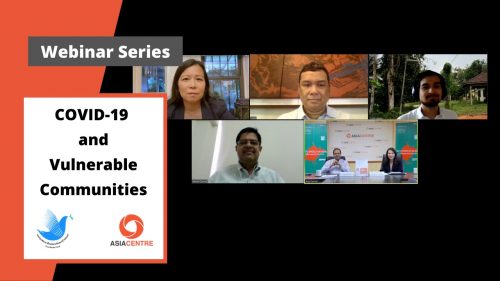
Hate speech in society towards vulnerable communities often reflects the discriminatory and prejudicial language by government officials and political leaders. In Southeast Asia, the spike in hate speech against migrant workers, refugees, undocumented workers, ethnic minorities and the homeless can be attributed to this trend. This was the analysis offered by speakers at Asia Centre’s webinar on COVID-19 and Vulnerable Communities on 24 June 2020. (watch it here) The webinar attended by over 114 attendees of 380 registrants, offered a thorough discussion on hate speech arising from government and political speak. The event follows an earlier webinar on COVID-19 and Hate Speech held on 27 May, 2020, both partnered with the Thai Media Fund (watch it here) and read the article here. Four speakers addressed the webinar, Ms. Khin Mai Aung from Doa-A-Yae: Coalition for Human Rights in Burma and an Asia Centre Associate (USA) via vodcast (due to the US time difference), Prof. Jude William R. Genilo from the University of Liberal Arts Bangladesh, Mr. Lutfi Hakim as an independent communications professional and Asia Centre’s Associate (Malaysia) and Dr. Chanansara Oranop na Ayutthaya from the National Institute of Development Administration. Focusing on the Rohingya minority and other religious and ethnic groups, Ms. Khin Mai Aung pointed out that there is unequal government enforcement of social distancing and quarantine measures of minority communities in Myanmar. Laws and policies aimed at protecting the vulnerable in Myanmar are used as tools of oppression and social control. For instance, the pandemic has provided the government a convenient excuse to enforce emergency laws especially in conflict areas where minorities are under siege. The COVID-19 spurred governmental suppression of minorities and other vulnerable groups is fueling hate speech among Buddhist extremists. Watch her vodcast here. Also addressing the situation among the Rohingya refugees, Prof. Jude William R. Genilo highlighted the inevitable impact of hate speech that originates from state authorities in Bangladesh. He also noted that government inaction is occurring and giving rise to governmental discourse that the Rohingya community have become a burden. This has led to negative perceptions of the refugees as news circulates about delayed repatriation, overpopulation, alleged drugs networks, environmental destruction and their reluctance to move to another location. This negativity arising from government discourse about the Rohingyas is causing hate speech to take root. Mr. Lutfi Hakim noted the importance of the language used by state officials, which sets a tone for how the media and wider population view vulnerable communities. He examined the plight of undocumented workers and migrants in general, especially their dehumaniztion through prejudicial language used by authorities. The fear of the ‘other’ – migrants as a security threat – has led the authorities to securitize the ‘threat’ from migrants. He recommended that it is important to identify the causes of insecurities and re-anchor the narrative so that it clarifies the policies and power structures that allow for these insecurities to fester. In Thailand, said Dr. Chanansara Oranop na Ayutthaya, the pandemic can trigger an outburst of discrimination and hate speech against vulnerable groups on social media. She highlighted one incident of Thai returnees, during the height of the pandemic, that refused to self-isolate citing excuses that they were not informed when they landed in Thailand. When government officials announced that they had their personal information to track them down and pursue legal action, personal details of these returnees were anonymously leaked over social media giving rise to hate speech against this group. In the Q&A section, participants engaged with the speakers over details of their presentations and expertise related to incidents of violence against the Rohingya and how the community can engage on the Internet in countering hate speech against them, inter-communal tensions in South Thailand and regional sensibilities regarding the alleged “China virus” that has spread globally. With the webinar concluded, attention now turns to the launch of Asia Centre’s report, “ Hate Speech in Southeast Asia: New Forms, Old Rules”, a collaborative study with the Thai Media Fund, scheduled for 22 July, 2020. You can register here. The report will be presented at Asia Centre’s International Conference on Hate Speech in Asia; Challenges and Solutions from 7-9 October 2020 and registration for the event is still open. The event has 11 international partners confirmed and will be held in collaboration with the Thai Media Fund, Faculty of Law, Thammasat University, Friedrich Nauman Stiftung and the Taiwan Foundation for Democracy. For more information contact: research@asiacentre.org.
Hate Speech: Measures Shouldn’t Infringe Rights

Legal and non-legal measures to regulate hate speech should not infringe on freedom of expression. This was the cautionary advice arising from speakers and participants at Asia Centre’s first webinar that discussed the impact of COVID-19 crisis on hate speech in Asia. Over 215 attendees from a total of 395 registrants took part in the proceedings (See link to video). The webinar was the first of two on hate speech convened with the support of the Thai Media Fund. A second webinar, “COVID-19 and Vulnerable Communities”, is scheduled for 24 June 2020 which will discuss COVID-19’s impact on vulnerable and marginalized communities. Asia Centre’s regional director Dr. James Gomez and 4 speakers, Prof. Andrew Harding of the National University of Singapore, Ms. Ayako Hatano of the University of Tokyo, Prof. Yasuko Hassall Kobayashi of Ritsumeikan University and Mr. Wasin Punthong of Thammasat University raised different viewpoints during the event moderated by Dr. Robin Ramcharan, Executive Director, Asia Centre. The webinar kicked off with a presentation of Asia Centre’s draft baseline study on Hate Speech in ASEAN, produced in collaboration with the Thai Media Fund. Dr. James Gomez outlined the key findings of the report. The main point was that hate speech analysis needs to move beyond the traditional racial and religious markers. Hence, it needs to encompass hate speech towards other groups such as the LGBT community, refugees and asylum seekers and migrant workers as well as those holding different political values and ideology. The report calls for expanding the definition of hate speech taking into account these other forms. In considering such expansion, a cautionary note was sounded by Prof Andrew Harding against over-regulating hate speech. Dr. Harding noted the potentially deleterious impact on freedom of expression from any change to include new groups. Such expansion should not be too hasty and should be guided by key principles: necessity, proportionality (to the mischief being addressed) and a high threshold for limiting free speech. From an international human rights law perspective, limitations on rights need also to be considered, noted Ms. Ayako Hatano. She pointed to the applicability of international standards: the International Convention on the Elimination of Racial Discrimination (ICERD), the International Covenant on Civil and Political Rights (ICCPR) and the Rabat Plan of Action in this regard. Moving away from law, Dr. Yasuko Hassall Kobayashi called attention to the need for building social resilience in the context of post-colonial states. Majority-minority dynamics inherited from the colonial era, she noted, perpetuated in-group and out-group mentalities that are characteristic to the “nation-state” idea. New tools for building social trust were required. In this connection, the role of rational and reasonable political discourse was treated by Mr. Wasin Punthong. He highlighted the deep divide in Thailand over political values between generations and social classes in a society marred by inequality. He said that the problem in Thailand is about implementation of the existing law which is quite selective. Thereafter participants were able to put questions to the speakers. These included the role of nationalism in fostering hate speech, the effectiveness of interventions or programmatic responses to hate speech, and that of exploiting cultural and political identities to mobilise electoral constituencies for political gain. Overall, the thrust of the discussion pointed to the need to address hate speech firmly through various legal and non-legal measures but to proceed cautiously in order not to infringe on rights, especially freedom of expression. Asia Centre will continue its exploration of hate speech at the next webinar “COVID-19 and Vulnerable Communities” on 24 June 2020. The findings drawn from the webinars will be used to finalise the baseline study in July 2020. The report will be presented at Asia Centre’s International Conference on Hate Speech in Asia; Challenges and Solutions from 7-9 October 2020. The event has 10 international partners confirmed and will be held in collaboration with the Thai Media Fund, Faculty of Law, Thammasat University, Friedrich Nauman Stiftung and the Taiwan Foundation for Democracy. For more information contact: research@asiacentre.org
Asia Centre resumes operations, strengthens online capacity

Introduction Asia Centre has resumed office operations and has taken steps to strengthen its online capacity. The Centre is re-starting activities following a requisite COVID-19 postponement of some events and 10 weeks of remote working. Selected postponed activities will now move online, while the Centre enhances its online meeting capabilities and presence over social media. Postponed Activities The Centre’s first response to the COVID-19 pandemic began when it announced on 16 March 2020 that in-person activities will be postponed. These included halting the Melbourne Outreach planned for 23-27 March 2020 that consisted of meetings and lectures as well as two half-day seminars one each at Chiang Mai University on 29 April 2002 and Prince of Songkla University on 22 May 2020 in HatYai. Other events postponed was the Journalism for An Equitable Asia Award Ceremony and Workshop with Oxfam in Asia in Bangkok scheduled for 2-3 April 2020. Following consultation with all partners on 6 April 2020, Asia Centre announced its annual international conference, Hate Speech in Asia: Challenges and Solutions will be moved from 8-10 July 2020 to 7-9 October 2020, with a possible postponement to 3-5 December 2020 if the situation warrants it. Work From Home On 18 March 2020, following the postponement of planned activities, Asia Centre initiated remote working for all staff and interns. During the remote working period, Asia Centre’s management team held daily video calls via Zoom, coordinated through Whatsapp and utilized Google Document to work on projects. In this way, the Centre’s operations related to administration and accounting, research and publications, social media updates and media engagement continued to run smoothly. Asia Centre was in regular communications with partners and participants and kept them informed about the status of projects and took their inputs onboard. During this time, bookings for the use of Asia Centre meeting space was discontinued. Office Re-opening Following the phased opening of the Thai economy on 3 May 2020, Asia Centre’s management team initiated plans for the resumption of limited services and operations. To facilitate this, an on-site inspection was undertaken of the Phayathai Plaza Building to observe its health and social distancing protocols. Thereafter, an office inspection and deep cleaning was initiated for Asia Centre’s premises. Thereafter, the Centre developed a set of guidelines and protocols to ensure the safety of all staff and interns that included, including mask-wearing, temperature checks, clean hands policy, and 2m social distancing. To minimize the risk of transmission, all face-to-face events at Asia Centre remain discontinued. Installing Video-Conferencing System As part Asia Centre’s limited operations, some postponed activities have now been re-designed as webinars. To prepare itself for such activities, the Centre installed a video-conferencing system and upgraded its Zoom Pro account to enable up to 500 participants to join its webinars. Hosting webinars will also become part of the new service that Asia Centre will provide partners moving forward. The Centre expects in-person events, up to the 3rd quarter this year, to be largely postponed. Hence switching to video conferencing enabled meetings would be a solution for meetings and activities. Strengthening Social Media Presence Anticipating that more outreach will take place online, the Centre has launched a social media strengthening initiative. Starting the first week of June, Asia Centre will run a campaign to boost its followers on all social media platforms such as Facebook, Instagram, LinkedIn, Twitter and YouTube. The Centre has long been using Facebook as its major channel to connect with the public. The move to connect with audiences from different social media platforms will also mean that Asia Centre will be reaching out to different audiences and using different approaches. Conclusion While COVID-19 did impact Asia Centre’s operations in the short term. However, through the early actions taken and strategic planning, the Centre has been able to respond quickly to the changing situation. Asia Centre is now well prepared to confidently operate in a post-COVID-19 situation.
Call for Chapter Proposals

Call for Chapter Proposals Fake News and Elections in South Asia BOOK PROJECT Proposal to Established Publisher South Asia has not been spared the scourge of fake news that has spread globally in the social media era. Strategic exploitation of fake news negatively affects fact-based democratic discourse and the conduct of elections, the most basic indicator of governmental legitimacy. At election-time disinformation and misinformation exact a toll on democracy, especially in contexts of low-literacy. The central theme of this book is on disinformation, fake news, hoaxes and foreign influence operations immediately prior to and during elections that have taken place in South Asia since 2016. The key question being addressed is whether the different types of fake news had an impact on voter behaviour, candidates’ policy positions, the electoral results and the politics of identity in each country. Chapters on the respective South Asian countries probe the following specifically: the digital, legal and political landscape; specific disinformation campaigns and/or influence operations against politicians or groups; strategies, tools, and information infrastructures used to do so; and the electoral/political impact of such disinformation or influence operations. Each author grounds their work in relevant theoretical frameworks and social science methodologies. Asia Centre invites high quality proposals for chapters of a forthcoming book on Fake News and Elections in South Asia. Interested authors may submit a title, an abstract of 300 words (max), 5 keywords and a bio of 100 words (max) per author for consideration. See sample. Submit your abstracts to Mr. Yawee Butrkrawee at research@asiacentre.org Submission deadline: 30 June 2020 Selected chapter proposals will be invited to submit a full chapter of 6000-8000 words. Each chapter submission will incur an editorial fee of USD$300. Click here for more details. Editors: James Gomez and Robin Ramcharan For examples of Asia Centre’s recent publications see links below: National Human Rights Institutions in Southeast Asia: Selected Case Studieshttps://www.palgrave.com/gp/book/9789811510731 The Universal Periodic Review of Southeast Asia: Civil Society Perspectiveshttps://www.palgrave.com/gp/book/978981106225h
Call for Chapter Proposals

Call for Chapter Proposals Fake News and Elections in East Asia BOOK PROJECT Proposal to Established Publisher Asia Centre invites high quality proposals for chapters of a forthcoming book on Fake News and Elections in East Asia. Interested authors may submit a title, an abstract of 300 words (max), 5 keywords and a bio of 100 words (max) per author for consideration. The central theme that chapters must focus on is disinformation, fake news and foreign influence operations immediately prior to and during elections that have taken place in the years 2016, 2017, 2018, 2019 and 2020 in East Asia. Chapters on Japan, Hong Kong, South Korea, Taiwan as well as chapters on China’s influence operations targeted at elections and political activities in these countries are encouraged. The chapters can analyse the East Asia situation as follows: an overview of the digital, legal and political landscape an outline of specific disinformation campaigns and/ or influence operations against politicians or groups dissect the strategies, tools, and information infrastructures used to do so assess the electoral/political impact of such disinformation or influence operations ensure the research is guided by a relevant theoretical framework and research methodology Submit your abstracts to Mr. Yawee Butrkrawee at research@asiacentre.org Submission deadline: 30 May 2020 Selected chapter proposals will be invited to submit a full chapter of 6000-8000 words. Each chapter submission will incur an editorial fee of USD$300. Click here for more details. Editors: James Gomez and Yasuko Hassall Kobayashi For examples of Asia Centre’s recent publications see links below: National Human Rights Institutions in Southeast Asia: Selected Case Studieshttps://www.palgrave.com/gp/book/9789811510731 The Universal Periodic Review of Southeast Asia: Civil Society Perspectiveshttps://www.palgrave.com/gp/book/978981106225
Call for Chapter Proposals

Call for Chapter Proposals Fake News and Elections in Indonesia: The Politics of Identity BOOK PROJECT Proposal to Publisher: Palgrave Macmillan Asia Centre invites high quality proposals for chapters of a forthcoming book on Fake News and Elections in Indonesia: The Politics of Identity. Interested authors may submit a title, an abstract of 300 words (max) and bio of 100 word (max) for consideration. The central theme that chapters must focus on is disinformation, hoaxes and fake news immediately prior to and during the presidential elections of 2019. Authors are recommended to make comparisons to the 2014 presidential elections and to also discuss the post-2019 elections scenario. The key question to address is whether the different type of fake news had an impact on voter behaviour, candidates’ policy positions, the electoral results and the overall politics of identify in Indonesia. Chapters that examine and evaluate efforts to combat fake news or discuss government legal and policy measures are also welcome. The research needs to be guided by a relevant theoretical framework and research methodology. The chapters can analyse the Indonesian situation as follows: The internet, legal and political landscape Specific disinformation campaigns against candidates, politicians or groups Islam, the politics of identity and gender dimensions Independent fact-checking initiatives and government policies Submit your abstracts to Mr. Yawee Butrkrawee at research@asiacentre.org Submission deadline: 31 August 2020 Selected chapter proposals will be invited to submit a full chapter of 6000-8000 words. Each chapter submission will incur an editorial fee of USD$300. Click here for more details. Editors: Dr. James Gomez and Wisnu T. Hanggoro For examples of Asia Centre recent publications see links below: National Human Rights Institutions in Southeast Asia: Selected Case Studieshttps://www.palgrave.com/gp/book/9789811510731 The Universal Periodic Review of Southeast Asia: Civil Society Perspectiveshttps://www.palgrave.com/gp/book/978981106225
The Emerging Human Rights Protection Architecture of Southeast Asia

This work is currently being drafted. Check back later for updates.
Business and Human Rights in Asia: Duty of The State to Protect

Buy Now Abstract In this book the authors examine the State’s duty to protect human rights in Asia amidst rising concern over the human rights impact of business organisations in Asia. States in the region have recently begun to consider the need for rules and policies in this area. This work examines the upswing in interest in business and human rights (BHR). It focuses on the duty of the State in the region to uphold their existing obligations, which has hitherto been understudied. It examines a range of inter-connected issues: the advent of international standards, the UN Guiding Principles on Business and Human Rights, the challenges inherent in the formulation of National Action Plans on business and human rights, the need for improved legislation and policies, access to remedies and conflicts with indigenous peoples over business activities. The book also treats innovative themes such as BHR in the era of smart cities, ethical consumer behaviour and a human rights management system, which are emerging areas of enquiry in relation to business and human rights. It concludes with a range of critical issues to be addressed, including the need for an assessment of COVID-19 pandemic’s impact on BHR in Asia and beyond. This book is part of Asia Centre’s exploration of the nascent regional human rights architecture that is facing significant challenges in protecting human rights. The body of work offered by this book showcases the progress achieved and challenges across Asia. Table of contents Introduction: Business and Human Rights in a Complex Westphalian Order. Gomez, James; Ramcharan, Robin Chapter 2: Does the slipper fit? National Action Plans on Business and Human Rights in South East Asia. White, Michael Chapter 3:National Action Plans on BHR: Norms, Procedures, Pitfalls. Gomez, James; Ramcharan, Robin Chapter 4: Multinational Corporations and Human Rights in Indonesia: The Need for Improvement in Legislation. Ghufron, Nurul; Evanty, Nukila Chapter 5: All Carrots and No Stick: Human Rights Regulation of Companies in Japan. Takahashi, Saul Chapter 6: States’ Rights to Development of Natural Resources versus Indigenous People’s Rights: Resource Corporations and Free, Prior and Informed Consent. Storey, Matthew Chapter 7: Effect of Minimum Wage on Employment Security: The Case of Precarious Workers in Myanmar. Nguyen, Hanh; Lin, Min Zar Ni; Ngwenya, Samukelisiwe Chapter 8: Recent Development on the Access to Remedy in Business and Human Rights in Indonesia. Prihandono, Iman; Religi, Fajri Hayu Chapter 9: The Current State of Affairs for Access to Remedy for People and Communities Affected by Alleged Arbitrary Takings of Land in the Agribusiness Industry in ASEAN. Soa, Socheata Chapter 10: As Smart Worlds Collide: Citizen Agency and Human Rights in the Smart City. Woodier, Jonathan; Zingerle, Andreas Chapter 11: Towards an Empirical Understanding of Ethical Consumption in Southeast Asia. Polomski, Daniel; Klukas, Emily; Mullen, Matthew Chapter 12: Designing a Human Rights Management Systems Standard Framed By the Value Of Human Life: A Practical Approach to Business Enterprise Human Rights in Asia. Sadlier, Robert Chapter 13: Conclusion-State’s Duties To Protect: New Issues in the Post-COVID 19 Era. Gomez, James; Ramcharan, Robin
National Human Rights Institutions in Southeast Asia: Selected Case Studies

Buy Now Abstract This book reviews Southeast Asia’s National Human Rights Institutions (NHRIs) as part of an emerging assessment of a nascent regional human rights architecture that is facing significant challenges in protecting human rights. The book asks, can NHRIs overcome its weaknesses and provide protection, including remedies, to victims of human rights abuses? Assessing NHRIs’ capacity to do so is vital as the future of human rights protection lies at the national level, and other parts of the architecture—the ASEAN Intergovernmental Commission on Human Rights (AICHR), and the international mechanism of the Universal Periodic Review (UPR)—though helpful, also have their limitations. The critical question the book addresses is whether NHRIs individually or collaboratively provide protection of fundamental human rights. The body of work offered in this book showcases the progress of the NHRIs in Southeast Asia where they also act as a barometer for the fluid political climate of their respective countries. Specifically, the book examines the NHRIs’ capacity to provide protection, notably through the pursuit of quasi-judicial functions, and concludes that this function has either been eroded due to political developments post-establishment or has not been included in the first place. The book’s findings point to the need for NHRIs to increase their effectiveness in the protection of human rights and invites readers and stakeholders to find ways of addressing this gap. Table of contents Introduction: National Human Rights Institutions in Southeast Asia: Challenges to the Protection of Human Rights. Gomez, James (et al.) Chapter 1: National Human Rights Institutions: From Idea to Implementation. White, Michael J. V. Chapter 2: National Human Rights Institutions in Southeast Asian States: The Necessary Foundation for an Efficient ASEAN Intergovernmental Commission on Human Rights. Martin, Céline Chapter 3: National Human Rights Institutions and the United Nations Human Rights Treaty Body System: A Rebuttal to the Skeptics. Zipoli, Domenico Chapter 4: Assessing the Effectiveness of the Myanmar National Human Rights Commission in the Wider Regional Geo-Political Context. Lang, Niki Esse Chapter 5: From Transition to Government Accountability: Opportunities for the Myanmar National Human Rights Commission. Traglia, Francesca Paola Chapter 6: Komnas HAM: Discrepancies Between Its Mandate and the Indonesian Constitutional Framework. Evanty, Nukila Chapter 7: Strengthening Komnas HAM and Building Synergies with Other National State Institutions on Human Rights. Samsul, Inosentius Chapter 8: The Protection Capacities of NHRIs in the Philippines, Thailand and Timor-Leste. Gomez, James (et al.) Chapter 9: Advocating for a National Human Rights Institution in Singapore, Gomez, James (et al.) Chapter 10: Mental Health and Human Rights: The Role of Komnas HAM. Clair, Kimberly Chapter 11: Bridging Gaps and Hopes: Malaysia’s National Human Rights Commission and Rights Related to SOGIESC. Koh, Henry Chapter 12: Komnas HAM and the Land Rights of Indigenous Peoples: National Inquiry as a New Mechanism for the Settlement of Disputes. Yulianti, Isnenningtyas Chapter 13: The Protection Capacities of NHRIs. Gomez, James (et al.)