Asia Centre Presents Disinformation Research in Taiwan
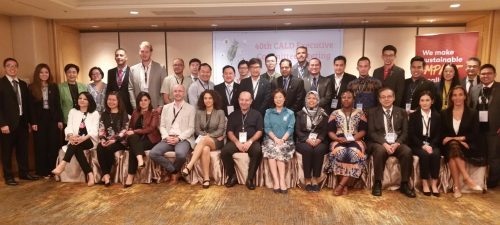
Asia Centre presented its research on disinformation in Southeast Asia at the Executive Committee Meeting of the Council of Asian Liberals and Democrats (CALD) in Taipei, from 18 to 23 October 2019. During the EXCOM meeting, the Centre’s Dr. Robin Ramcharan, also discussed future collaboration with CALD and its affiliated members. Created in 1993, CALD is a platform for dialogue and cooperation between liberal and democratic political parties in Asia. The Centre was invited to share its analysis on Fake News legislations in Southeast Asia, which has a considerable negative impact on democracy and elections in the region. The key point delivered is that fake news laws are contrary to international standards on freedom of expression. Fake news laws, complemented by existing laws, have led to the criminalisation of criticism of authoritarian regimes as disinformation and has led to increased Governmental control of what is true and what is fake. Dr. Ramcharan expounded these points on a panel that included the International Centre for Not-for-Profit Law (ICNL) based in Washington, D.C. Dr. Ramcharan was also invited to attend the EXCOM of CALD, chaired by Member of Parliament Bi-Khim Hsiao from Taiwan. CALD members gave strong support for a Memorandum of Cooperation between the Centre and CALD, which would see the two institutions collaborate on initiatives that advance their shared vision of a democratic, rule-of-law order across Asia. In line with this shared vision, Dr. Ramcharan emphasized the Centre’s advocacy for human rights in the region. It was proposed that CALD partner with the Centre during its International Conference on Hate Speech in Asia, from 8-10 July 2019. The Centre gained an update on the challenges to democracy across the region as CALD Members spoke of their travails: arrests of opposition politicians in Cambodia, the heavy-handed tactics towards protesters by Hong Kong authorities, fake news about Thai politicians and the assault on the rule-of-law in the Philippines, to name a few. African, Arab and Latin American delegates spoke of similar challenges in their respective regions. The evidence-based research of the Centre and the latter’s potential to serve as a knowledge partner was appreciated by the delegates. Members of Parliament who were apprised of the work of the Centre at the meeting hailed from liberal federations in Asia, Africa, the Arab World and Latin America. Expressions of interest for collaboration came from various MPs including from Africa, Hong Kong, Taiwan, Thailand and youth leaders from Malaysia. Asia Centre intends to take up the expressions of interest and to see if it can implement the ideas put forward by delegates.
Asia Centre’s Engagement with Diplomatic Missions

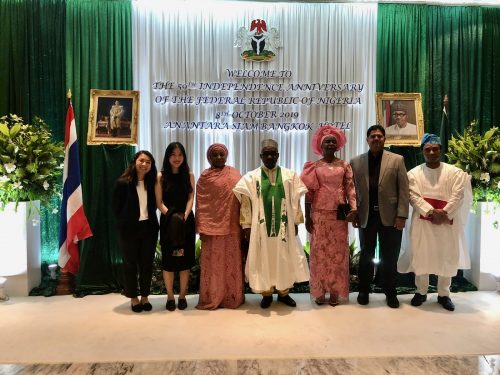
Asia Centre has built good relations with Bangkok-based diplomatic missions by attending embassy functions, meeting with embassy officials and hosting discussions with ambassadors. These embassy engagements are part of the Centre’s efforts to seek connections to overseas partners and broaden its global network. The bulk of engagements with diplomatic missions usually occur when Asia Centre’s representatives attend independence or national day celebrations organised by the embassies. In 2019, Asia Centre received an increased number of invites to embassy functions. On 10 Oct 2019, Dr. James Gomez and Johnny Hoang Nguyen attended the 108th National Day of the Republic of China (Taiwan) at the invitation of H.E. Dr. Tung Chen-Yuan. Participation at this function follows an earlier visit by Dr. Gomez and Asia Centre’s Taiwanese intern Wei-Wen Wang to the Taipei Economic and Cultural Office on 26 June 2019; where they discussed connecting to Taiwanese institutions. As part of the Centre’s engagement with East Asian diplomatic missions, during the Centre’s 1st Japan-ASEAN Roundtable on Business and Human Rights on 18 August 2017, the Centre also hosted Mr. Shutaro Omura — the Minister of Political Affairs from the Japanese embassy in Bangkok. The Centre also engages with Southeast Asian diplomatic missions through Indonesia and Vietnam. On 20 August 2019, Dr. James Gomez and Dr. Robin Ramcharan attended the 74th Anniversary of Indonesia’s Independence Day as part of Asia Centre’s continued efforts to develop activities and networks in Indonesia. Earlier on 29 April 2019, the Indonesian Embassy’s Education and Cultural Attaché, Prof. Dr. Mustari M.Pd also visited the Centre together with the students and staff from Satya Wacana Christian University. Asia Centre’s Dr. Robin Ramcharan, Dr. James Gomez and Michelle D’Cruz also attended a Vietnamese National Day celebration on 15 September 2017. They met with Vietnamese ambassador H.E. Nguyen Hai Bang and also corresponded with Indonesian embassy officials and the East Timor ambassador H.E. Joaquim Amaral, thereby extending Asia Centre’s network to Southeast Asian diplomatic missions. Adding to the Centre’s engagements in Southeast Asia, 2019 has seen Asia Centre actively build networks with South Asian missions. On 31 July 2019, Dr. James Gomez and Dr. Robin Ramcharan met with Pakistani Ambassador to Thailand, H.E. Asim Iftikhar Ahmad. During the meeting, they discussed connecting with universities in Pakistan and his participation in Asia Centre’s conference on Hate Speech from 8-10 July 2020. The Centre has also twice hosted Bangladeshi Ambassador H.E. Saida Muna Tasneem, when she spoke on the Rohingya refugee crisis at the “International Conference on Youth Engagement and Human Rights” in October 2017, and on women’s power in Asia during the “Third Annual Benedict Anderson Memorial Roundtable” in January 2018. Asia Centre has also increasingly made headways in its engagement with African missions. On 8 October 2019, Dr. James Gomez, Dr. Robin Ramcharan, Teo Gin Na and Charlotte Chua attended Nigeria’s 59th Independence Anniversary celebrations. This follows the previous meeting with the Nigerian Ambassador H.E. Mr. Ahmed Nuhu Bamalli at the embassy on 25 July 2019 to discuss Asia Centre’s engagement with Nigerian universities and a possible visit to Lagos. In line with Asia Centre’s engagement with Africa, Asia Centre representatives attended the Moroccan embassy function for “Throne Day” on the 30th of July 2019. Likewise, on 27 May 2019, Dr. James Gomez and Tessa Alleblas also represented the Centre at Africa Day where African states came together to host the event. Asia Centre’s formal engagement with an African state was first made in 2017 when the Centre hosted South African Ambassador to Thailand H.E. Geoff Doidge in the October 2017 roundtable event “Bandung Revisited: Africa-Asia Relations in the 21st Century”. Since then, Asia Centre’s network with African states continues to grow. As part of Asia Centre’s strategy of global engagement, the Centre also works with embassies in the Americas — Peru, Canada and the United States of America (USA). Asia Centre often extends the invite to the interns as well. As such, the Asia Centre team and their interns attended a Peruvian Embassy function in celebration of the “198th Anniversary of the Independence of the Republic of Peru” on 7 August 2019. During which, they engaged with their South American counterparts and discussed the possibilities of future partnerships with Peruvian organisations. On the 1st of July 2019, Canada Day, Asia Centre’s Dr. Robin Ramcharan attended the Canada-United Kingdom reception to support and promote press freedom in Thailand. During which, valuable discussions were had with Ayesha Rekhi, Canadian Chargé d’affaires a.i and other attendees, including those from the United Kingdom delegation. This follows an earlier meeting between Dr. Ramcharan and the Canadian ambassador to Thailand, H.E. Donica Pottie in November 2018. The month prior, the Canadian ambassador also participated in the Centre’s “Rice Before Rights” event. On 27 June 2019, Dr. James Gomez also attended a US embassy function in celebration of their Independence ahead of the actual commemoration on the 4th of July. US embassy officials – Thomas R. A Montgomery and Worawan Thanamongkol – then also participated in the Centre’s Fake News and Elections Conference held 2 weeks later on 10-12 July 2019, continuing the bilateral engagement. As with many of the other embassy engagements, Dr. Gomez’s engagement with the US embassy in Bangkok helped to lay the groundwork for furthering partnerships – in particular Dr. Gomez’s networking trip to Washington D.C. and New York in October 2019. Asia Centre also engages with countries from Europe — to date connecting with the Luxembourg, the European Union (EU) and Russian missions. In celebration of the National Day of the Grand Duchy of Luxembourg, on 21 June 2019, the Asia Centre team was invited and engaged with the many guests and ambassadors on Asia Centre’s activities in the region. The year prior, on 22 November 2018, Dr. Robin Ramcharan and Tessa Alleblas attended an EU delegation grant application briefing session aimed at supporting capacity building of civil society organisations (CSOs). Asia Centre’s Dr. James Gomez and Elise Schuster also attended earlier that year in May 2018, Europe Day. The Centre has
Asia Centre’s Rohingya Refugee ASEAN Advocacy

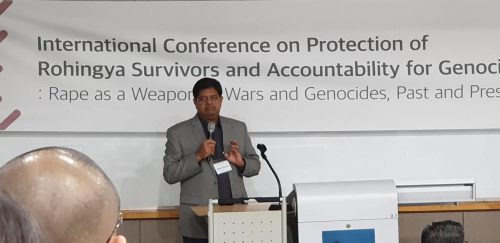
Since 2017, Asia Centre has been actively advocating for solutions to the Rohingya refugee crisis. Drs. James Gomez and Robin Ramcharan, as Asia Centre’s resource speakers have spoken at numerous international conferences particularly in 2018. While Dr. Gomez has been the lead Asia Centre spokesperson in responding to the media on developments that emerge related to the Rohingya refugee crisis. To take stock of the situation, one year after the 2017 mass exodus of Rohingya fleeing violence and persecution by the Myanmar Government and military, the Asia Centre convened a one day conference titled “The Rohingya Crisis: A Multidimensional Tragedy”, on 24 August 2018. Experts participating in the conference came from around the world, including Australia, Bangladesh, Ireland, Japan, Norway, Switzerland, the United Kingdom and the United States. The participants noted, one year on, the prospects of a deepening humanitarian crisis and of achieving justice are prolonged indefinitely into the future. The analysis was that pursuit of justice for the victims and accountability for crimes perpetrated will be hard to achieve as Myanmar enjoys the protective cover of ASEAN’s non-interference principle, regional commercial interests in Myanmar and a regional geopolitical climate that does not favour the protection of human rights. From this analysis one year on, Asia Centre has been focused on ASEAN’s intervention or lack there of in relation to the Rohingya refugee crisis. On 6 November 2018, Asia Centre’s Dr. Robin Ramcharan and Centre Associate, Dr. Kenneth Houston spoke at the Peace and Conflict Resolution Conference 2018, Bangkok, which was hosted by Tomorrow People Organization. They presented on ASEAN lack of effective engagement and solutions for the Rohingya refugees. On October 31st 2018, Dr. Gomez spoke at a well-attended talk organised by the Political Science and International Relations Programme of Victoria University of Wellington, New Zealand. In his speech, titled the “Rohingya Crisis: Is Human Rights Advocacy Working?”, Dr. Gomez touched on how ASEAN continues to provide Myanmar protective cover through the bloc’s non-interference policy while China, India and Japan prioritise wooing Myanmar for their strategic interests. He further added, “Constructive engagement” and behind the scenes conversations with Myanmar has to date proven ineffective in either preventing human rights violations and providing security and justice for Rohingyas and other minorities in the country. On 23 October, Dr. Gomez was an activist-in-residence at CARE, Massey University, New Zealand where he conducted a workshop on developing an advocacy strategy at the ASEAN level on the Rohingya refugee issue. The purpose of the workshop was to equip aspiring advocates with the ability to develop and produce a multi-country Southeast Asian project to enhance advocacy surrounding the plight of the Rohingya refugees in the region. Following the event, Dr. Gomez also interacted with Dr Murdoch Stephens of the Doing Our Bit campaign to double the quota of Rohingya refugees to New Zealand. On 19 September 2018, Dr. Gomez delivered a keynote address at the Law Faculty, Universitas Jember in Indonesia entitled “Political Culture in Human Rights: Gender, Migrant Workers and Human Trafficking in Southeast Asia” where he once again addressed the Rohingya refugee issue and its impact on Southeast Asia. Few months earlier on 1 August 2018, Asia Centre’s Dr. Robin Ramcharan spoke at an ActionAid conference in Dhaka entitled Bangladesh’s Rohingya Refugee Crisis: Towards Sustainable Solutions. Dr. Ramcharan highlighted ASEAN’s lack of responsibility in resolving the Rohingya refugee crisis which he labelled as a multidimensional humanitarian tragedy. Asia Centre has also made media appearances advocating for a change in the Rohingya status quo in Southeast Asia. Based on research undertaken at the Centre, its representative comment on developments related to the Rohingya refugee crisis as they evolve. Asia Centre’s, Dr. Gomez was live on Al Jazeera TV on 18 July 2019 to respond to US sanctions against the Myanmar generals and the arrival of the ICC delegation to Dhaka at that time. Dr. Gomez said more effective sanctions are needed and further cooperation with the ICC will determine if there can be real accountability for the crimes against the Rohingyas. On 5 November 2018, Dr. Gomez was interviewed by Lynda Chanwai-Earle, a researcher from Asia Media Centre at the Asia New Zealand Foundation which later published the article “Key Issues: Rohingya Crisis” featuring the role of ASEAN in the refugee crisis. In another media engagement, Dr. James Gomez also spoke to ABC News (Australian Broadcasting Corporation) from Tokyo on Friday, 28 September 2018 on the Rohingya refugee issue after the Canadian parliament voted to strip Myanmar’s Aung San Suu Kyi of honorary citizenship. While the Canada vote was a step in the right direction and strong symbolic gesture, Dr. Gomez urged Australia and New Zealand to put pressure on ASEAN members to do more for the Rohingya refugees. Asia Centre’s commentary titled “ASEAN’s non-interference policy hinders Rohingya justice” was featured in The Independent Singapore on 2 September 2018. The commentary argued that ASEAN’s policy of non-interference has literally resulted in non-action allowing the Rohingya crisis to grow. It reinforced the point that ASEAN indirectly provides Myanmar regime continued cover and effectively denying the Rohingya and other affected communities the justice they truly deserve. Following a slew of activities in 2018 following the 2017 exodus, on the occasion to commemorate the 2nd on, Asia Centre’s Dr. James Gomez spoke at the International Conference on Protection of Rohingya Survivors and Accountability for Genocide, on 23 August 2019, at Sogang University, South Korea. There he presented a base-line study on hate speech in Southeast Asia and the possible repercussions for Myanmar during the upcoming general elections in 2020. Dr. Gomez made the point that hate speech increases during the run up to elections. Given Myanmar’s internet penetration is expected to rise from 39% in 2019 to about 50% towards the 2020 general elections, he cautioned that anti-Muslim/Rohingya rhetoric is also expected to rise online. Dr. Gomez and Professor Yanghee Lee (UN Special Rapporteur on the situation of human rights in Myanmar) also discussed Asia Centre’s plans for its upcoming conference on Hate Speech
2nd ASEAN-Japan Roundtable: Competing for Influence in SEA

Japan needs to recalibrate and reevaluate its engagement with Southeast Asia (SEA) in view of China’s ascendency and the United States’ (US) uncertain engagement with the region. As Japan navigates competition from China and other rising powers, the influence of its economy will diminish. The question therefore, is how should Japan frame its foreign policy towards Southeast Asia in this new context. Policy experience, soft power project, people-to-people dimension or values based diplomacy on principles of democracy and human rights are non-economic dimensions that are likely to feature more as its foreign tools. The debate over a non-economic approach emerged as the key discussion point at the 4th October 2019 “Japan-ASEAN Roundtable: Competing for Influence in SEA”, organised by Asia Centre and supported by the Japan Foundation. It brought five expert panelists and 40 participants together to discuss current regional dynamics and Japan’s engagement with ASEAN moving forward. The event opened with remarks by Dr. Robin Ramcharan, Executive Director at Asia Centre, who traced the evolution of Japan-ASEAN relations: starting with the Fukuda Doctrine till current day, where Japan-ASEAN relations operate within burgeoning tensions between the US and China. The expert panelists made the following inputs: Japan’s economic impact, outlined by Mr. Daisuke Hiratsuka from Japan External Trade Organization looked at Japan’s role in the current dynamics of SEA. In recent years, China has been increasing its presence through e-commerce firms, the Belt and Road Initiative (BRI), fruit cultivation, Chinese tourism in SEA. At the same time, Mr. Hiratsuka noted that current dynamics need not necessarily decrease Japan’s presence but that Japan should look to value-add in other ways — in particular, through knowledge sharing for policy implementation. The purportedly anomalous development of military cooperation in Japan-ASEAN relations and whether it signalled a radical realignment, shifting from the Fukuda Document of ‘heart to heart’ approach, was addressed by Dr. David M. Malitz of BALAC, Chulalongkorn University. In providing an overview leading to the present context of the Japanese-ASEAN security relations, Dr. Malitz noted complementarities between ASEAN and Japan in the area of non-traditional security. Even in traditional security matters, he noted long-standing cooperation between the two. With the tense climate of US and China playing a zero-sum game and the emergence of non-traditional security issues like cyberwarfare, taking a multi-channel comprehensive approach, including that of military diplomacy, is a necessary way forward. Japan’s soft power appeal was examined critically by Dr. Saikaew Thipakorn of the Japan-ASEAN Studies Center, Chulalongkorn University. She outlined the realm of cultural diplomacy in terms of the establishment of the Japan Foundation, the Japan Society for the Promotion of Science and the Association for Overseas Technical Scholarship. However, while successful at nurturing young minds and developing human resources, Dr. Thipakorn pointed out the limits of Japan’s soft power influence over Southeast Asia stating that it does not have any real impact in foreign policy terms. As part of its strategy to counter the formation of rival blocs globally, Japan’s undertaking of the Free and Open Indo-Pacific strategy (FOIP) was reviewed by Dr. Sueo Sudo of Thammasat University. The quadrilateral nature of FOIP (involving the US, India and Australia) and the panoramic targeting of Asia-Pacific and Africa in theory is aimed at maintaining the global order and to combat the challenges of a rising China. In practice however, there are ambiguities surrounding FOIP like the feasibility of ASEAN’s centrality in the strategy and the absence of Africa in ASEAN’s approaches. Moving ahead, Dr. Sudo posited that Japan should look to clarify and determine what FOIP means. Besides using FOIP to counter the rise of China, Mr. Saul J. Takahashi from Osaka Jogakuin University also urged that it is imperative for Japan to better define its own political identity in order to formulate clear policies in the current geo-political context. Leveraging on a Chinese proverb by titling his presentation ‘The Fox in the Shadow of the Tiger: The Need for An Independent Identity’, Japan was metaphorically represented as the fox and US as the tiger – he expounded on the need for Japan to step out of the shadows of the US. While there have been low-level efforts to engage SEA on bilateral terms and combative rhetoric against China is slowly being retracted, Japan should work to realign its foreign policy on its own terms and to democratic and human rights values. Adding to the need for reevaluating Japan’s SEA engagement strategy, panellist Dr. Taro Mochizuki from Graduate School of Letters, Osaka University followed with another dimension — how should Japan differentiate its influence from extra-regional actors’? Dr. Mochizuki noted that over 90% of foreign students of nearly 300,000 come from Asia, of which 65% are from China. Although there are social infrastructures in place like awarding scholarships to foreign students there is a rising trend of privately funded students studying in Japan. Dr. Mochizuki proposed that this trend supports the effectiveness of fostering more people-to-people ties into Japan’s regional strategy. In the backdrop of increasing political uncertainty, Japan needs to reimagine its role within the Southeast Asia region and beyond. Caught between the reality of not being able to outspend China and not casting aside long-standing diplomatic ties with the US, Japan needs to lean into bolstering non-economic dimensions of engagement. Given that foreign policies’ goal is to support national interests, Japan needs to first look within to determine its own identity outside the shadows of the US. Moving forward, it should rework its soft power strategy, utilize people-to-people relations, tap into a multi-channel security approach and leverage on its democratic and human rights values to further relations with SEA. Only then will Japan be able to reinvent its engagement with Southeast Asia in the changing geopolitical context. This roundtable is the second on Japan-ASEAN relations. The first roundtable held in August 2017 focused on how the adoption of a human rights dimension to Japan-ASEAN economic and business relationship will provide greater traction for Japan in the region. Both events were organised by Asia Centre, with
Asia Centre’s MOUs extend reach

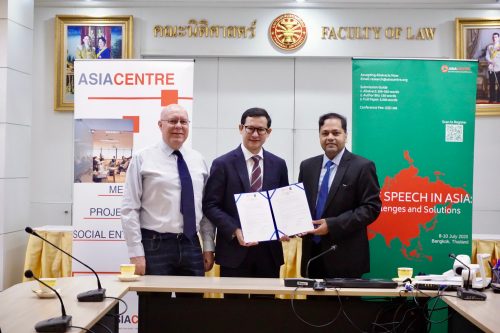
On 27 September 2019, Asia Centre signed an MOU with the Faculty of Law, Thammasat University. Dean, Faculty of Law, Munin Pongsapan and Asia Centre’s Executive Director Dr. Robin Ramcharan inked the agreement to cement their co-convening of Asia Centre’s 5th International conference on Hate Speech in Asia: Challenges and Solutions 8-10 July 2020. The MOU signing, witnessed by Asia Centre’s advisor Dr. Andrew Harding, builds on the Centre’s working relationship with the Faculty of Law since the last 2 years. For instance, on 30 October 2017, the Centre hosted the Faculty of Law’s students and Professor Thitirat Thipsamritkul at the International Conference on Youth Engagement and Human Rights. In June 2019, Chen Xiangyi a business law student at the Faculty of Law undertook her internship at Asia Centre. Starting 2019, Asia Centre began to sign Memorandums of Understanding (MOUs) with partners with whom it has established a working relationship. Areas of collaboration delineated in the MOUs include co-convening activities such as conferences, seminars and workshops; collaborating on research; organising study trips and facilitating internships. Having focused on consolidating its organizational structure and running a suite of activities in Bangkok, Thailand over the past 4 years, the MOUs help pivot Asia Centre externally towards the region and beyond. Collectively, the MOUs also allow Asia Centre and its partners to extend the geographical reach of their activities. On 23 September 2019, Dr. Rafal Pankowski from Poland-based Never Again Association signed an MOU with Asia Centre’s Dr. James Gomez. In line with Never Again Association’s goals to tackle racial and ethnic prejudice, the Association will also be forming a panel at the 2020 Hate Speech Conference to expound further on these topics. This cooperation marks Asia Centre’s first MOU with a European partner. In the same month on 9 September 2019, Asia Centre signed an MOU with the University of New South Wales to specifically collaborate with its Australian Institute for Human Rights. It is expected that the MOU will lead to a panel partnership during Asia Centre’s 5th International conference on Hate Speech in Asia: Challenges and Solutions 8-10 July 2020, hosting of New Colombo Plan Scholars at Asia Centre and explore collaboration around the Dignity in Design project which looks at human rights issues in the urban environment. Earlier in the year on 12 May 2019, Asia Centre signed an MOU with another human rights institution. This time it was with Chang Fo Chuan, Centre for the Study of Human Rights, Soochow University in Taipei, Taiwan. This MOU cemented the close working relationship Asia Centre has had with Soochow University starting from 2018 when Dr. James Gomez presented at a roundtable discussion the findings from the Centre’s book “The UPR of Southeast Asia: Civil Society Perspectives” on 8 November 2018. The next year, Asia Centre’s Dr James Gomez and Yawee Butrkrawee, Programme Coordinator attended the Workshop of Advocacy for Asian Human Rights Court at Soochow University from 9-12 May 2019 during which time, the MOU was signed. Asia Centre’s Advisory Board Member Nukila Evanty furthered this collaboration with Soochow University by speaking at their Gender and Business and Human Rights Workshop on 13 July 2019 also organised by the Chang Fo Chuan, Centre for the Study of Human Rights, Soochow University . 2 months before on 5 March 2019, Asia Centre’s Dr. James Gomez and Professor Neil Semuel Rupidara, Rector, Satya Wacana Christian University (UKSW) signed an MOU in Semarang, Indonesia. The partnership was signed following the two entities’ first joint general studies panel. Entitled “Religion, Media and Politics in Southeast Asia”, the event was organised in collaboration with the Faculty of Social Science and Communications, Faculty of Theology and the Centre for the Study of Religion, Pluralism and Democracy. Following the MOU signing, Asia Centre has since hosted 2 study visits of 30 students each. The visit on 8 May 2019 focused on discussions over the use of fake news during the Indonesian presidential elections. The visit on 16 September 2019 focused on the unrest in West Papua over the Papuan Independence movement. In line with India’s Act East policy, Asia Centre has also fostered close relations and signed MOUs with 3 institutions in Kolkata — Calcutta University, NSHM Knowledge Campus and Observer Research Foundation (ORF). The MOUs follow Asia Centre’s Dr. James Gomez’s previous visits to the region in 2018, where he laid the foundation for collaborations with these institutions. On 8 February 2019, Asia Centre’s Dr. James Gomez and Professor Sonali Chakravarti Banerjee, Vice Chancellor, Calcutta University signed an MOU. This event was also witnessed by Kolkata’s Chief Minister, Mamata Banarjee as part of the Government of West Bengal’s push for its universities to collaborate with knowledge partners abroad. Dr. Gomez was previously a Visiting Fellow at the Department of South and Southeast Asian Studies, University of Calcutta – College Street Campus from 26 to 30 November 2018. The second MOU was signed with Cecil Anthony, Chief Mentor, NSHM Knowledge Campus during NSHM Knowledge Campus’s International Conference on Media and Society on 8 March 2019. During which, Asia Centre’s Research and Grants Officer, Tessa Allebas spoke on trends in manufactured opinions over social media. In November 2018, Dr. Gomez had visited the media department of the NSHM Knowledge Campus and was also interviewed over 91.2 Y-FM NSHM Community Radio. Besides fostering close relations between both parties, the MOU also helps NSHM Knowledge Campus extend its reach to the Southeast Asia region. On 25 March 2019, Dr. Robin Ramcharan and ORF’s Director Dr. Nilanan Ghosh, signed an MOU during ORF’s opening ceremony of its two-day conference on the “Significance of the Bay of Bengal: India, Japan and Southeast Asia”. Specifically, the MOU pledges future collaboration on policy-oriented research that seeks to create social impact. As a follow up, Dr. Robin Ramcharan has been invited to and will be speaking at the Media Workshop, ‘Reimagining BIMSTEC’ hosted by ORF on 27-28 November 2019 in Kolkata, India. Within the South Asian region, Asia Centre was invited by the Centre
Asia Centre’s 2019 Taiwan Engagement

In 2019 Asia Centre undertook a series of meetings and interactions in Bangkok, Thailand, Kuala Lumpur, Malaysia and Taipei, Taiwan to strengthen its relationship with Taiwanese institutions. The 2019 meetings built on Asia Centre’s initial December 2018 collaborative visit to Taipei, Taiwan. Engagement with Taiwanese institutions is expected to continue in 2020. On 18 December 2019, Asia Centre’s Dr. James Gomez and Yawee Butrkrawee met with Taipei Economic and Cultural Office (TECO) Malaysia’s Head of Mission, Anne Hung and Director, General Affairs Division, Chichia Chen. Dr. Gomez introduced Asia Centre and its plans to establish operations in Johor Bahru, Malaysia. Earlier on 5-7 December 2019, Drs. James Gomez and Robin Ramcharan presented a paper on “The ASEAN Intergovernmental Commission on Human Rights (AICHR): Normative and Institutional Pathways towards an Enhanced Protection Role”. Thereafter from 8-11 December 2019, with Partnership Coordinator Charlotte Tseng, the Asia Centre team had a series of meetings in Taipei and lectures at National Chengchi University. From 12-14 December 2019 Dr. Gomez travelled to Kaohsiung and signed an MOU with Wenzao Ursuline University of Languages and delivered a public lecture at the National Sun Yat-Sen University. See link for details. On 18-23 October 2019, Asia Centre’s Executive Director Dr. Robin Ramcharan at the invitation of the Council of Asian Liberals and Democrats (CALD) and the Democratic Progressive Party (DPP) of Taiwan participated in the 40th CALD Executive Committee Meeting in Taipei on the theme of political innovation in the era of disinformation. Dr. Robin Ramcharan presented Asia Centre‘s research on fake news legislation in Southeast Asia during the panel discussion entitled Legislating to Address Digital Disinformation at the Defending Democracy Against Disinformation: Stakeholders Analysis and Intervention meeting. Earlier on 9-13 September, Dr. Gomez was in Taipei to attend the “Defending Democracy Through Media Literacy II” International Workshop from 10-11 September. The event was organised by The Taiwan Foundation for Democracy (TFD) andco-hosted with the Ministry of Foreign Affairs (MOFA), the American Institute in Taiwan (AIT), the National Democratic Institute (NDI), the International Republican Institute (IRI), the Japan-Taiwan Exchange Association, and the Swedish Trade and Investment Council. On 12 December 2019, Dr. Gomez participated in the U.S.-Taiwan Consultations on Democratic Governance in the Indo-Pacific Region. In Bangkok, on 3 July 2019 Asia Centre welcomed staff and students from Wenzao Ursuline University of Languages who learned about the Centre’s work in the Southeast Asian region. Assistant Professor Cathy Yi-Hung Liao discussed the signing an MOU between the two institutions and welcomed Dr. Gomez to an official MOU signing during the Asia Centre visit to Kaohsiung in December 2019. On 26 June 2019, Asia Centre’s Dr. Gomez and research intern Wei-Wen Wang visited The New Taipei Economic and Cultural Office in Laksi Bangkok. The discussed topics included the consolidation and continuing building relationships with Taiwanese academia, civil society, think-tanks, universities and other supporting institutions. Just a week earlier on 17 June 2019 Dr. Gomez meet with Taiwan’s Digital Minister Audrey Tang during the “International Conference on Fake News” held in Bangkok to promote digital literacy and fact-checking before sharing news stories. On 28 May 2019, Bo Tedards, Director of International Cooperation Department, Taiwan Foundation for Democracy came to Asia Centre where he responded to Asia Centre research on China’s influence in the South East Asian region. TFD is a regional partner of Asia Centre and both institutions have cooperated since the establishment of the Centre. On 22 May 2019 Asia Centre welcomed for three months Wei-Wen Wang, the first intern from Taiwan. Wei-Wan graduated from the National Taiwan University with a B.B.A. in International Business and moved to pursue a Master’s degree in Development Practice at the University of California. At Asia Centre, Wang researched on fake news, online disinformation and hate speech in Asia. She embodied Asia Centre’s mission to connect with Taiwanese institutions. At Soochow University, Taipei -13 July, Nukila Evanty, Advisory Board Member of Asia Centre, spoke at the Gender and Business and Human Rights Workshop. This was the second in a two-part event held by the Human Rights Centre at Soochow University. The first event, Workshop of Advocacy for Asian Human Rights Court 2019, was from 9-12 May and was attended by Asia Centre’s Dr. James Gomez and Yawee Butrkrawe. The meeting discussed the different types of human rights violations that could be brought to an Asian Human Rights Court. During this workshop, on 12 May, Asia Centre signed an official MOU with the Centre for the Study of Human Rights, Soochow University to deepen the strategic cooperation between the two organisations. Read write up here. On 11 March 2019, Dr. Gomez was in Taipei to represent Asia Centre at a two day event, “A Civil Society Dialogue on Securing Religious Freedom in the Indo-Pacific Region”. Taiwan’s President Tsai Ing-wen presented the welcome remarks during the opening of the conference. The event was the first International Religious Freedom Roundtable outside of U.S. Capitol in Washington D.C. The above visits and interactions planned and undertaken in 2019 build on activities undertaken by Asia Centre in November 2018. On 9 November 2018, Dr. Gomez discussed at Soochow University the use by Taiwanese CSOs of the different UN human rights mechanisms to plan submissions on issues that affect Taiwanese nationals and companies. In his presentation, “The UPR of Southeast Asia: Civil Society Perspectives”, Dr. Gomez highlighted the pollution caused by the Formosa company in Vietnam and how these concerns were raised during Vietnam’s UPR in January 2019. At National Chengchi University (NCCU), on 6 November 2018, Dr. Gomez led a discussion on Fake News & Elections in Southeast Asia where China’s use of misinformation for the purpose of causing divisions in Taiwanese society were debated. Taiwanese scholars and officials present expressed concern that fake news from China was a “national security threat” having possible negative influence on local elections on 24 November 2018. Asia Centre’s engagement with Taiwan is part of the Centre’s East Asian outreach covering Japan here and South Korea here which focuses on building relationships with academia, civil society, think-tanks, universities and
Asia Centre’s Expert Opinions in the Media

Asia Centre is often approached by different media outlets such as television news channels, radio stations and online news portals to either comment on current political issues or submit op-eds on human rights issues for publication. As Regional Director, Dr James Gomez is Asia Centre’s main spokesperson and takes the lead in speaking to the media, from time-to-time the Centre’s other representatives also speak to the media on their areas of expertise. Asia Centre media engagement has dealt with issues related to security concerns on the South China Sea, the Rohingya refugee crisis and political developments in Thailand and Singapore. In 2019, fake news led the way strongly building on numerous consecutive engagements on the topic. On the South China Sea issue, on 7 August 2019, Dr. James Gomez was interviewed by journalist Du Nhat Dang from the Hanoi based Vietnamese newspaper Tuoi Tre where Dr. Gomez pointed out that ASEAN unity is increasingly subverted by China’s influence over Cambodia and Laos. Just a month earlier, on 29th July 2019, Dr James Gomez had also discussed security issues related to the South China Sea with reporter Nguyen Ngoc Phuong from Vietnam Television on the sidelines of the 52nd ASEAN Ministerial Meeting. Asia Centre also regularly comments on developments related to the Rohingya refugee crisis. On 18 July 2019, Dr. James Gomez was live on Qatar based Al Jazeera – قناة الجزيرة to comment on the US sanctions against the Myanmar generals and their family and restricting them from entering the US, as well as the arrival of the International Criminal Court delegation in Dhaka to open an investigation into alleged crimes against the Rohingya people in Bangladesh and in the Rakhine state of Myanmar. Some 9 months earlier, on 28 September 2018 Dr. Gomez spoke from Tokyo, Japan to ABC News (Australian Broadcasting Corporation) on the Rohingya refugee issue after the Canadian parliament voted to strip Myanmar’s Aung San Suu Kyi of her honorary citizenship. Most interviews in 2019 centred around fake news. Mrs Tessa Alleblas, the Centre’s Research and Grants Officer, spoke about the rationale behind Asia Centre’s 4th International Conference on Fake News and elections with ICE Business Times in Bangladesh. On 13 June 2019, Dr. Gomez’s op-ed titled, “Fake News”: A New Weapon against Dissidents in Southeast Asia and published by the International Centre for Nonviolent Conflict on its portal, discussed how Southeast Asian governments are labelling critical opinions not in line with the government’s stance as “fake news”. Just a week earlier, on 8 June 2019, Dr. James Gomez was interviewed by Myanmar’s DVB TVnews for a media literacy programme on what constitutes disinformation and fake news. A month before on 9 May 2019, Dr. Gomez provided the Hong Kong based South China Morning Post an insight into the reasons given by states to introduce fake news laws. On World Press Freedom Day on 3 May 2019 Dr. Gomez was interviewed by the Myanmar based Irrawaddy on legislations being introduced across Southeast Asia to combat fake news in the name of preserving social harmony. On 22 April 2019 Dr. Gomez spoke to the Malaysia’s 89.9 BFM about the fake news legislation in the region, its impact on elections and the intersection of disinformation and false election results with Lyn Mak in Malaysia. On 16 April, Dr. Gomez was quoted in online portal Global Ground Media on how some member states in the Association of Southeast Asian Nations (ASEAN) have used the rise of online disinformation as an excuse to attack opposition parties. On 3 April, Dr. Gomez spoke to Malaysia’s 89.9 BFM on Singapore introduction of an ‘anti-fake news’ bill in Parliament and how it affects political landscape in the country. On 4 March 2019, Dr. Gomez hosted by Indonesia’s Kompas Daily to speak at a media literacy roundtable where his comments were reported on their online portal in Bahasa Indonesia, “Masyarakat Masih Senang Kabar Bohong yang Sensasional”. On 8 February 2019. Dr. Gomez spoke to the US based LA Times on how Southeast Asian government representatives are focused on using the term “fake news” to discredit critics. In 2018, on 5th December, The Shillong Times, in Meghalaya, Northeast India reported on report a panel discussion held at the Shillong Club where Dr. Gomez outlined how social media helped spread fake news and was impacting traditional media. In early 2019, political developments in the run to the Thai elections were of interest to the media and Asia Centre representatives were contacted for responses. On 4 February 2019, Dr. Gomez discussed with Malaysia’s 89.9 BFM the political situation in Thailand and public sentiment ahead of the elections, including the strength of the youth vote. Thailand will hold its first democratic elections on 24 March since the military took over the government in the May 2014 coup. On 11 February 2019 Dr. Gomez was interviewed on by Malaysia’s 89.9 BFM on the electoral developments in Thailand following the nomination by Thai Raksa Chart Party of Princess Ubolratana as a Prime Ministerial candidate. On 28 March 2019, the Centre’s Programme Coordinator, Yawee Butrkrawee was interviewed by Vietnam Television for his views about the post-election developments in Thailand. Singapore is also of interest to the media and Dr. Robin Ramcharan, Executive Director at Asia Centre, commented on evolving political developments in the city-state. On 13 September 2017, Dr. Ramcharan was interviewed by Agencia EFE a Spanish News Agency on his comments following the change in the constitutional role of the President of Singapore as Halimah Yacob took on the role as a member of an ethnic minority. On 16 June 2017, Dr. Ramcharan was interviewed by Australia’s ABC News regarding the family spat between Singaporean Prime Minister Lee Hsieng Loong and his brother Lee Hsien Yang. A day earlier, on 15 June 2017, Dr. Ramcharan spoke to Malaysia’s 89.9 BFM regarding the younger siblings of Lee Hsien Loong who released a six page statement accusing the Prime Minister of betraying the legacy of their father, Lee Kuan Yew. Dr Ramcharan questioned
Asia Centre co-hosts ASEAN Leadership Forum

Asia Centre co-hosted The ASEAN Community Leadership & Partnership Forum on 23th till 24th of June 2019 at Park Hyatt Bangkok. The event was held in conjunction with the 34th ASEAN Summit in Bangkok and was convened by Kingsley Strategic Institute together with other co-hosts Nation Building Institute, Thailand, the Federation of Thai Industries, the ASEAN Studies Centre and the Asia Centre. As co-host Asia Centre was responsible for inviting 50 participants from civil society, NGOs and academia which broadened the nature of interventions and networking opportunities during the event. Among those who attended included international organisation representatives from Amnesty International, Friedrich Naumann Foundation, Kenan Foundation, Oxfam Thailand, Plan International, The Japan Foundation, UNEP and representatives from academic institutions included Institute of Human Rights and Peace Studies, Mahidol University, Srinakharinwirot University, Thammasat University, Webster University and Journal of Urban Culture Research, Chulalongkorn University. At the ASEAN Community Leadership & Partnership Forum, Asia Centre made two key interventions. First, Asia Centre’s Dr. James Gomez read the citation for the ASEAN Entrepreneur of the Year Award for Goh Peng Ooi, Group Executive Chairman, Silverlake who is listed as Malaysia’s top 40 richest person. Second, Dr. Gomez chaired the panel “Youth Forum: ASEAN’s Next Generation – Shaping the Future: Reimagining ASEAN, Fueling Innovation”. The panelists collectively made the point made that an all rounded education in English that includes mentorship and industry experience is what will seamlessly move young people into the workforce. Asia Centre’s Dr. Robin Ramcharan also actively intervened from the floor asking thought provoking questions during the Q&A session which shaped the debate around the key issues that panels raised at the Forum. Apart from the interventions, in the run up to the meeting, Asia Centre served as a coordinator and liaised with hotel staff to ensure a smooth and problem free conference. In addition, the Asia Centre team also assisted in managing the event providing pre-event support, manning the registration desk, taking notes and writing summaries of the panel, photo documentation and other organisational needs. At the Forum, leaders from Government, Business, Academia, Think Tanks and Civil Society came to discuss the future challenges facing ASEAN in the new global era. The Forum’s theme, “Building Partnerships for a Sustainable and Inclusive ASEAN” attracted the next generation of ASEAN leaders, as well as women and young entrepreneurs. If you need Asia Centre’s help to identify speakers, coordinate participants or convene an event, do email us at contact@asiacentre.org
4th International Conference (2019): Fake News and Elections in Asia

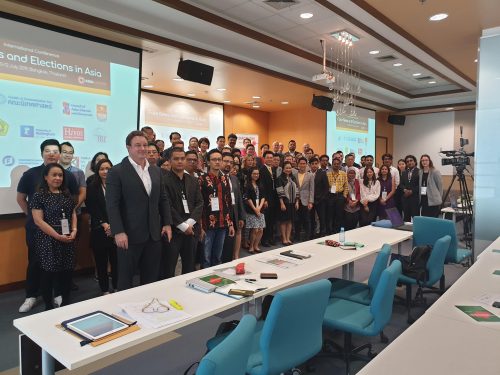
Asia Centre convened its 4th International Conference on Fake News and Elections in Asia which started from the evening of 10 July and went on for another 2 full days on 11 and 12 July 2019. It was the Centre’s largest to date with 12 partners, 13 panels, 46 presentations and a total of over 80 participants who discussed various issues related to fake news (See Conference Proceedings). The conference’s program can be found here. Watch the conference’s video here. Asia Centre’s 12 partners were the Faculty of Communication Arts, Chulalongkorn University, The Thai Media Fund, School of Media, Languages and Cultures, University of Nottingham, Malaysia, NSHM Knowledge Campus-Kolkata, Media Studies and Journalism Department, University of Liberal Arts Bangladesh, The Council of Asian Liberals and Democrats (CALD), International Center for Not-for-Profit Law, Law Faculty, University of Jember, International Republican Institute, HIVOS, The Friedrich Naumann Foundation and The Taiwan Foundation for Democracy (TFD). The Conference kicked off on the evening of 10 July 2019 at the Sukosol Hotel, Bangkok with Asia Centre’s Research and Grants Officer, Ms Tessa Alleblas welcoming the delegates and partners. Next the Centre’s Executive Director, Dr. Robin Ramcharan and Miklos Romandy, Regional Program Manager from Friedrich Naumann Foundation for Freedom Southeast & East Asia made their opening remarks. Both Asia Centre and Friedrich Naumann Foundation acknowledged the benefits of working together on issues related to fake news. Day one The opening panel was convened by conference partner Council of Asian Liberals and Democrats whose speakers focused on how political parties and political leaders observe and respond to the spread of disinformation in the digital age. The importance of fake news legislation, media literacy and cyber accountability were also recognised by the panelists. Day Two The next two days, 11 and 12 July 2019 were held at Faculty of Communication Arts, Chulalongkorn University. Day 2 of the conference started with welcome remarks by Prof. Parichart Sthapitanonda (See Speech) , Dean of the Faculty of Communication Arts, Chulalongkorn University followed by Mr. Wasan Paileeklee (See Speech), CEO of กองทุนพัฒนาสื่อปลอดภัยและสร้างสรรค์ (Thai Media Fund) and Dr. James Gomez (See Speech), Regional Director of Asia Centre. The three welcome remarks focused on a partnership approach to tackling fake news issues in the region and the benefits of working together. Day three The third day’s panels surrounded disinformation from the perspective of parliamentarians of politicians; disinformation in other regions outside of Asia; fake news and elections in India; and country specific analyses of fake news and elections in Southeast Asia. In the second and third day a total of thirteen panels discussed historical backgrounds of ethnic, political and religious violence, as well as the current phenomena of digital disinformation in Australia, Bangladesh,Cambodia, Estonia, India, Myanmar, Pakistan, Sri Lanka, Singapore, Thailand, United Kingdom and the United States of America. The main discussion point at the conference was whether legislative measures are effective against fake news and if governments would use it instead against its political critics. Preference was for non-legal measures such as media literacy and fact checking. Although fact-checking measures were deemed to not as effective as media literacy. The key concern whether any of the measures will affect freedom of expression. After 13 panels and 46 presentations, Asia Centre ran a final session on Post-Conference Publications. For conference proceedings, Ms. Tessa Alleblas explained the review process and the schedule. For the Book Project Dr. Robin Ramcharan and Palgrave Macmillan’s Vishal Daryanomel outlined the protocols and timeline. Wrapping up – Maintaining freedom of expression To wrap up the conference Asia Centre held a partnership dinner at the Sukosol Hotel, Bangkok where Regional Director, Dr. James Gomez briefed partners of next year’s annual conference “Hate Speech in Asia: Challenges and Solutions” to be held from 8-10 July, 2020. The conference is part of the centre’s ongoing 4 year project entitled “Freedom of Expression in Asia.” The Conference on Fake News and Elections was the first in the series, the conference on Hate Speech in Asia, 7-9 October 2020, will be the second conference, while the third will focus on COVID-19 and Democracy in Asia: Civic Space and Freedom of Expression, 14-16 July 2021. The project will culminate with a final conference entitled Freedom of Expression in Asia, 13-15 July 2022. In terms of publicity, Asia Centre’s 4th International Conference on Fake News and Elections in Asia did get some mention in various media outlets both in Thailand and the region. Before the conference it received a mention in ICE Business Times, during the conference a couple of conference speakers were featured on Khaosod English, and after the conference on Thai Media Fund. The conference inspired Asia Centre’s publication Fake News and Elections in Southeast Asia. It assesses the impact of fake news on electoral outcomes in Southeast Asia from the years 2018-2020. The aim is to provide an understanding of the evolving issues related to fake news and elections and to review its implications for democracy in Asia.
Asia Centre Strengthens South Korean Engagement

To strengthen relationships with South Korean academia, civil society and other supporting institutions and as part of Asia Centre’s efforts to engage with the Korean government’s Southern policy, in 2019 from 2-9 June, Dr. James Gomez visited Seoul, South Korea to attend two conferences and several partnership meetings. From June 3th to 5th Dr. Gomez was a discussant at the conference entitled Democracy, National Identity and Foreign Policy dialogue on 3th of June, where he was part of a panel that reviewed developments in Indonesia, Malaysia and Myanmar. From 4th to 5th June Dr. Gomez participated in a second conference entitled the Value Diplomacy Dialogue where he discussed Value Hedging in the Southeast Asian context. Organised by Columbia University and the National Endowment for Democracy, both the events were led at the ASAN Institute of Policy Studies in Seoul. From 6 to 8 June, Dr. Gomez met with Secretary-General Kweon Ohkun of The Korean Press Arbitration Commission (PAC) to discuss how the Commission addressed issues of fake news. After the meeting, PAC agreed to send 6 participants to Asia Centre’s Int. Conference on Fake News and Elections in Asia from 10-12 July in 2019. Dr. Gomez also visited the Korean Democracy Memorial Hall to understand the democratic history of South Korea. Thereafter he met with officials of the Democracy Foundation to discuss possible collaborations. The visit in June 2019 builds on a series of earlier engagements in the past three years that involved Asia Centre’s participation in activities in South Korea as well as visits from Koreans to the Asia Centre in Thailand. Formal engagement began when Dr. Jonathan Woodier joined the Centre’s Advisory Board in December 2016. A professor then at Sol International School of Media and Communications Arts at Woosong University, South Korea. Soon after on 17 January 2017, students from Korea University, accompanied by their professor Dr. Park Bun Soon, visited the Centre. During their visit, Asia Centre’s Dr. Robin Ramcharan discussed ASEAN integration challenges and developments related to the regional human rights mechanisms. Engagement with South Korean institutions picked up in 2018, when Dr. Jonathan Woodier and Dr. Andreas Zingerle presented a paper on the topic of Smart Cities and Human Rights in East Asia at Asia Centre’s International Conference on Business & Human Rights on 12-13 July that year in Bangkok, Thailand. In the same year, Dr. James Gomez, Chair, Board of Directors at Asia Centre won a Research Fellowship from Korea Democracy Foundation (KDF) to undertake research on “fake news”. He presented his findings on “Fake News and Electoral Democracy in Asia: at the Asia Democracy Conference in August 2018 in Sri Lanka. Later in 2018, Dr. Robin Ramcharan, Executive Director, represented Asia Centre at a panel discussion on “Peacebuilding and Sustaining Peace” at the 8th World Human Rights Cities Forum – 세계인권도시포럼, 18-21 October 2018, in Gwangju, Republic of Korea. Since 2016, as part of Asia Centre’s regional outreach, the Centre has been engaged with South Korean universities, think-tanks and civil society organisations. Asia Centre plans to continue its people-to-people engagement with South Korea moving forward.