Asia Centre Builds Momentum for Malaysia Branch
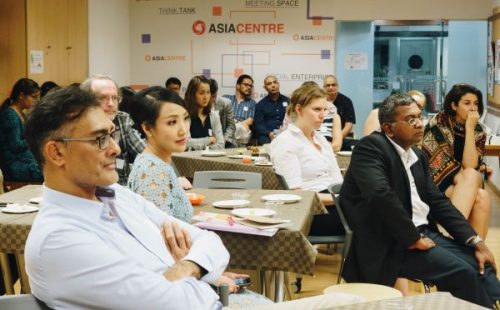
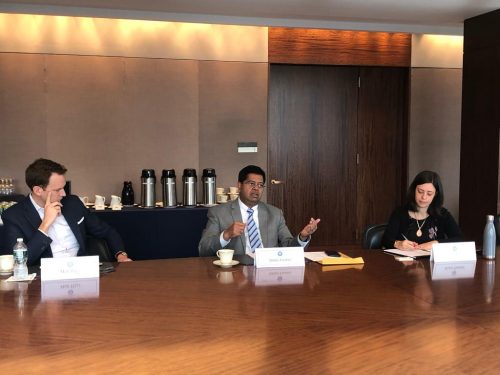
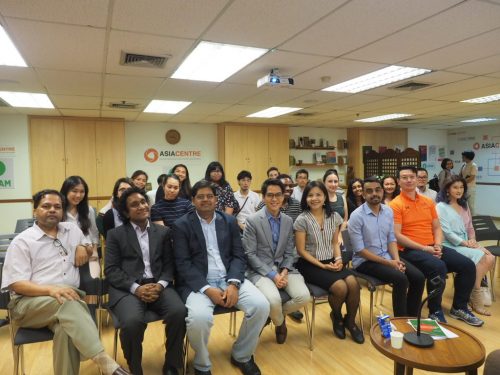
Since 2016, Asia Centre’s has undertaken a series of Malaysia-related activities to build momentum for a new branch in Johor Bahru. To date the activities include discussions on Malaysia’s political transition, co-convening events on fake news, engagement with Malaysian media and exploratory partnership meetings with institutions based in Malaysia. Collectively these efforts form the basis upon which Asia Centre Malaysia, first publicly announced in 2018, will build its programme of activities moving forward.  Asia Centre began discussing Malaysia’s political transition as early as May 2016, when the Centre hosted Professor William Case, a well-known Malaysian studies scholar, who shared his analysis of the 1MDB scandal’s impact on Malaysian politics. He argued that the stable authoritarianism practiced by Malaysia was resilient to democratic pressures. When Malaysia experienced a change in government in May 2018, the issue of political transition was revisited in June 2018, when the Centre hosted a post-election roundtable. Malaysian speakers, Dr. Mohd Azizuddin Mohd Sani (PhD), Professor of Politics and International Relations at the School of International Studies, Universiti Utara Malaysia (UUM); Lutfi Hakim, independent consultant and a former associate of IMAN Research; and Dr. Victor Karunen, former UN official with UNICEF observed that the challenge for the new government of Pakatan Harapan (PH) was its ability to usher out the politics of ‘money, race and patronage’ and to bring about a fundamental change in Malaysian politics. The discussions continued in July 2018 when Asia Centre’s co-hosted an event in Kuala Lumpur with IMAN Research and Gerakbudaya Bookshop entitled “Democratic Transition in Malaysia: Impacts on Southeast Asia”. The Malaysian speakers included Masjaliza Hamza, a sub-editor for Malysiakini, Dr. Vilashini Somiah, Head of Research, IMAN Research, and Dr. Lee Hwok Aun, a senior fellow and co-coordinator of the Malaysia Studies Programme at the Yusof Ishak Institute of Southeast Asia Studies. At that event speakers highlighted the need for Malaysia to consolidate its democratic transition through institutional reforms that will ensure independent checks and balances.  Asia Centre later added to this debate by penning an op-ed in August 2018 that discussed the establishment of a ‘Malaysian Democracy Foundation” or MDF. The op-ed argued that the MDF presents a unique opportunity to further institutionalize democracy in Malaysia as well as act as a catalyst in Southeast Asia and beyond. If established, MDF would be the first such Foundation in Southeast Asia. The debate around Malaysia’s political transition continues in Malaysia, and in November 2019, Asia Centre’s Dr. James Gomez was invited to deliver the Opening Speech at “Malaysia Transition Weekend,” organized by an NGO called Empowering Fundamental Freedom Defenders in Southeast and East Asia (EFDEA). In his speech, Dr. Gomez provided a regional overview of the challenges to democratic transitions in Asia which set the context for the discussion on Malaysia’s transition.  Apart from political transition, another topic that Asia Centre has contributed to is the issue of fake news in Malaysia. Given that Malaysia was the first Southeast Asian country to pass a fake news legislation in April 2018, Asia Centre initiated several activities around that issue. In April 2019, in partnership with University of Nottingham, Malaysia (NUM) and Gerakbudaya Bookshop, Asia Centre convened a seminar on Fake News Industry: Developments in SEA and Malaysia. Moderated by Professor Zaharom Nain of University of Nottingham, Malaysia, Kuala Lumpur-based panelists included, Jahabar Sadiq, Editor of Malaysian Insight; Dr Craig J Selby, Managing Director of public relations firm, Orchan Consulting; and Darshini Kandasamy, an Editor at Malaysiakini. At the seminar, participants reviewed media literacy and other non-legal measures put in place to tackle issues surrounding fake news in Malaysia and the wider region. In July 2019, Nottingham University, Malaysia, School of Media, Languages and Cultures organised a panel on Fake News in Malaysia at Asia Centre’s 4th International Conference on Fake News and Elections in Asia. Ngo Sheau Shi, Universiti Sains Malaysia; Azmyl Yusof, Sunway University; Zaharom Nain, Nottingham University; and Mahyuddin Daud, International Islamic University Malaysia discussed a range of issues related to law, media literacy, politics, religion and women as its related to fake news in Malaysia and exchanged views with other presenters from the region.  When Malaysia announced that it was going to abolish its Fake News bill following the change in government, Asia Centre weighed in on the debate through an op-ed. When the repeal was initially rejected by the Senate, the Centre highlighted, even with the delay around the repeal of Malaysia Fake News Bill, it offered Malaysia an opportunity to manage racial disinformation that can lead to social tensions. However, the op-ed pointed out that existing laws or new laws if enacted should not impinge on the quality of debate on this issue. In undertaking activities related to political transitions and fakes Asia Centre has often been approached by Malaysia’s BFM radio to comment on current developments in the region. Centre representatives on various times have commented on fake news issues and legislation in Southeast Asia and Singapore. Time to time the Centre was also asked to comment on elections and political transitions in Thailand. In December 2019, Asia Centre co-convened with Oxfam in Asia the Malaysia launch event of the Journalism for an Equitable Asia Award. The award is aimed at journalists to encourage them to report on issues of inequality. The aim of the Award is  to promote strong journalism and acknowledge the hard work of journalists who have persisted in reporting on inequality in spite of the challenges the media industry faces. The event was held at the Gerakbudaya Bookshop and the speakers and media was coordinated by Orchan Consulting Asia. The event was covered and reported in Malaysia’s Chinese language Sin Chew and China Press and in English in The Star.  Given the engagement with Malaysia, Asia Centre staff and interns have been making regular trips to Kuala Lumpur for events coordination and meetings as well as receiving visitors in Bangkok. As a result,  Asia Centre has been able to establish working relationships with Kuala Lumpur based academics, civil society representatives, diplomatic missions, government

Fake News and Elections in Southeast Asia

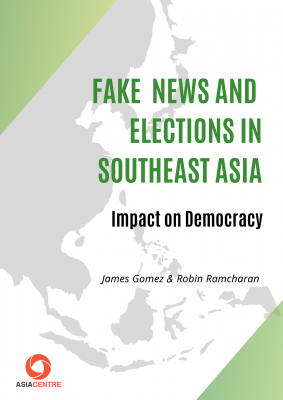
Abstract Elections in Asia are increasingly witnessing a rise in information manipulation to influence voter views and behavior. Behavioral manipulation takes place as electoral candidates, political parties and interest groups take to social media to spread fake news with the aim of discrediting their opponents and gaining support for their electoral candidates and/or political parties. In this book, the authors will assess the impact of fake news on electoral outcomes in Southeast Asia from the years 2018-2020. The aim is to provide an understanding of the evolving issues related to fake news and elections and to review its implications for democracy in Asia.

Asia Centre’s Dr. Gomez Awarded 2020 Taiwan Fellowship

Asia Centre’s Regional Director, Dr. James Gomez has been awarded Taiwan’s Ministry of Foreign Affairs (MOFA), 2020 Fellowship, to undertake research on disinformation operations, fake news and hate speech in Southeast Asia.  Known as the Taiwan Fellowship, it is awarded to foreign scholars and experts who plan to undertake part of their research at Taiwanese universities or academic institutions. The 2020 Taiwan Fellowship is the third in three years for Dr. Gomez. In 2019, Dr. Gomez received a Sumitomo Foundation Grant and in 2018 he was awarded the Korea Democracy Foundation Research Fellowship both times to undertake research on fake news in Southeast Asia. Dr. Gomez was nominated for the Fellowship by the Taiwan Economic and Cultural Office (TECO) based in Bangkok, Thailand for his work as convenor of Asia Centre’s Freedom of Expression project 2019-2022.  The award is for 12 months and will begin later in January 2020. During the Fellowship, Dr. Gomez will be affiliated with the Department of Diplomacy at National Chengchi University with short stints at other universities. Apart from research, in 2020, Dr. Gomez will also be exploring the feasibility of establishing an Asia Centre programme in Taiwan. To this end, Dr. Gomez discusses possible programme components and collaborations options with various Taiwanese organizations. The MOFA Taiwan Fellowship, Sumitomo Foundation Grant and Korea Democracy Foundation Research Fellowship underscore Asia Centre’s expertise in disinformation operations, fake news and hate speech. They also help Asia Centre build networks and extend its reach into East Asia via the awarding countries of Taiwan, South Korea and Japan. The 2020 Taiwan Fellowship comes on the back of Asia Centre’s engagement at various times with Taiwanese institutions, think-tanks and universities in 2018 and 2019.  Read more about Asia Centre Taiwanese engagement here.

Strengthening Relationships with Taiwanese Institutions, Think-Tanks and Universities

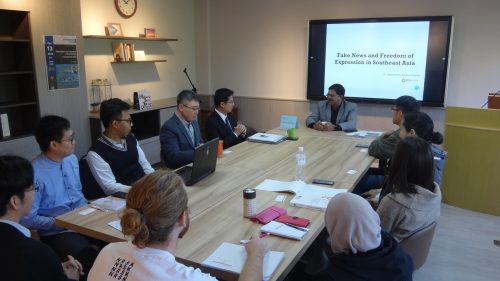
In December 2019, Asia Centre Directors Drs. James Gomez, Robin Ramcharan, and Partnership Coordinator, Charlotte Yuchun Tseng participated in a series of events and meetings in Taiwan to strengthen relationships with Taiwanese institutions, think-thanks and universities in both Taipei and Kaohsiung. Starting in Taipei with the SEASIA biennial conference from 5-7 December at Academic Sinica, Drs. Gomez and Ramcharan presented their joint paper, “The ASEAN Intergovernmental Commission on Human Rights (AICHR): Normative and Institutional Pathways towards an Enhanced Protection Role” during the panel on Human Rights in Southeast Asia. On the sidelines of the SEASIA conference, Asia Centre’s Dr. Gomez, Dr. Ramcharan and Charlotte Tseng met with Taiwan Asia Exchange Foundation’s (TAEF) Dr. Alan H. Yang, the Executive Director, Sherry H.C. Liu. Director and Senior Research Fellow and Nina Ning Yen Assistant Research Fellow, Department of International Cooperation to discuss potential partnership between the two institutions. TAEF is at policy-oriented think-tank in Taiwan with a focus on Southeast Asian and South Asian affairs. On December 4 to 7, Dr. Gomez delivered a series of evening lectures at International Master’s Program in International Studies (IMPIS) at National Chengchi University (NCCU). The lectures focused on human rights issues and the Universal Periodic Review of Southeast Asia. While at NCCU, Dr. Gomez, Dr. Ramcharan, and Charlotte Tseng met with the Department of Diplomacy’s Chair, Hong Yi Lien and Associate Professor Dr. Charles Wu to discuss collaboration. Both institutions agreed to explore signing a MOU to initiate joint activities. On 10th December, Dr. James Gomez delivered a public lecture at the College of Communication, NCCU . During the lecture, Dr. Gomez discussed the definition and categories of hate speech and outlined the legal and non-legal measures that negatively impact the exercise of Human Rights in Southeast Asia. On December 11th, Dr. James Gomez, and Council of Asian Liberals and Democrats (CALD)’s Secretary General, Austin Chen signed a MOU to enhance regional cooperation. The meeting was witnessed by Director of Department of International Affairs, Democratic Progressive Party (DPP) and member of the Legislative Yuan, Ching-Yi Lin and  Asia Centre’s Charlotte Tseng. The DPP is a member of CALD. Thereafter Dr. Gomez travelled to Kaohsiung, where Wenzao Ursuline University of Languages’ College of European and Asian Languages’ Dean, Chuang-Ching Tung signed an MOU with Asia Centre to establish cooperation on topics related to Southeast Asia. Asia Centre’s will work with Wenzao’s Department of Southeast Asia Studies to explore joint human rights teaching, co-convening conferences and facilitate internships. To wrap up the Kaohsiung visit, on December 13th, Dr. James Gomez delivered a lecture on “ Fake News and Freedom of Expression in Southeast Asia” at the National Sun Yat-sen’s Institute of Political Science. Thereafter Dr. Gomez discussed cooperation opportunities between the two institutions. Asia Centre will continue to engage with Taiwanese institutions, think-tanks and universities moving forward. Its part of the Centre’s engagement with East Asia countries, such as in South Korea and Japan.

Malaysia Launch: Journalism for an Equitable Asia

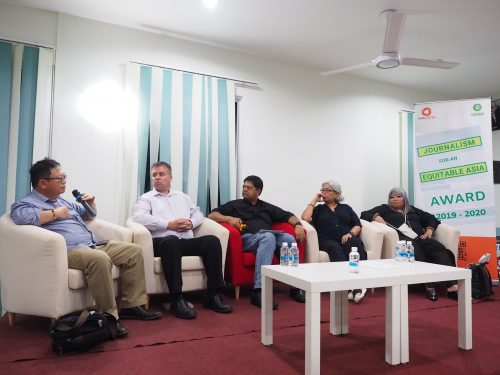
The impact of media business sustainability and fear on journalists became the point of contention during the Malaysia launch event of the Journalism for an Equitable Asia Award on 18 December 2019.  Co-convened by Asia Centre and Oxfam in Asia and supported by local partners Gerakbudaya and Orchan Consulting Asia, the event brought together 30 participants from the media, academia and civil society to discuss the challenges of reporting on inequality. The aim of organising the Journalism for an Equitable Asia Award is to promote strong journalism and acknowledge the hard work of journalists who have persisted in reporting on inequality in spite of the challenges the media industry faces.  In the session on opening remarks,  Dr. James Gomez, Regional Director, Asia Centre, highlighted that rising internet penetration and consumption of user-generated content over social media platforms via mobile devices is directing eyeballs away from quality journalism. In its stead sensational news, clickbait content, fake news and hate speech is vying for readers and viewers attention. Nipuna Kumbalathara, Media and Communications Lead, Oxfam in Asia, outlined a ‘tale of two fortunes,’ referring to Asia as a continent that has the most billionaires in the world and where 1.2 billion poor people reside. This drastic income inequality has resulted in an inequality in power. As media groups or media enterprises are often owned by powerful business magnates, this makes coverage of important and politically sensitive issues less viable. Hence, the media can no longer maintain its independence and instead practices self-censorship leading to a trust deficit among the public. Nipuna urged journalists as thought leaders and enablers to re-establish credibility by talking about issues that matter and return the power to the people to make change happen. Following on from the opening remarks, four Malaysian speakers took to the floor. Siti Kasim noted the impact of regime change in Malaysia on local journalism. She pointed out that the government has become more approachable and less abusive. However, the culture of fear, intimidation and self-censorship, a by-product of the Barisan Nasional (BN) era, still lingers.  Siti used her own experience to articulate this, pointing out that The Star refused to publish her article on the grounds that the issue she discussed was too sensitive. She also cautioned the new challenge facing both government and members of the press, which is extremists disseminating fake news with impunity. This is a 2018 post-election phenomenon that Malaysia needs to contend with. Datuk Wong Sai Wan, as the editor-in-chief of Malay Mail, offered a business viewpoint on journalism in Malaysia. He argued that the business sustainability of the media industry in Malaysia is drastically affecting the ability of journalists to report on politically sensitive issues such as inequality and social justice. “The Barisan Nasional had subsidized many Malaysian media. These media suddenly lost financial support after the BN lost the general election in 2019”. Coupled with the digital disruption and inability to regain trust, Malaysia media face serious financial difficulties and have to make business decisions to survive by shying away from sensitive issues. Hence, Datuk Wong Sai Wan worried that, by 2020, there may not be Malaysian journalists who are worthy of the award. Gareth Corsi, sub-editor, Malaysian Insight, voiced his concern of what he termed as a defunct media ecosystem in Malaysia. He argued that apart from the trust deficit, there is a quality deficit among Malaysian reporters. On many occasions, he has observed Malaysian journalists not being proactive, offer no critical insights nor investigate issues; rather they are indifferent and prefer to wait for the government’s or an organization’s press release and report in a verbatim manner. Consequently, this has contributed to low trust in the media in Malaysia. Gareth proposed that one way to regain trust is to revise and improve how journalism is taught in educational institutions. He used an example of a journalism course he took during his studies, which was designed by experienced communicators preparing course participants to operate as a front-line journalists.  Despite the decreased trust and financial viability, Dr. Hartini Zainudin, co-founder and vice president, Yayasan Chow Kit, argued that, from her experience working on the children-related issues, journalists are willing to report as it is usually not seen as a sensitive topic. Over the years she has built a rapport with them, she recognizes them as being a voice of the marginalized and the powerless, and there argued there is indeed quality in their coverage on the issue.  Dr. Zaharom Nain, Professor of Media and Communication Studies, Nottingham University, wrapped up the discussion from the floor by commenting that, in spite of irreconcilability between business sustainability and fear, he felt that quality journalism still exists in Malaysia. He said there are enough quality journalists and stories that could easily qualify for this Award. The event was made possible with support of local partners Gerakbudaya who provided the venue and logistical support, while Orchan Consulting Asia coordinated speaker and media invitations. The event was reported in The Star, Sin Chew and China press. The Malaysia launch event for the Journalism for an Equitable Asia Award is one in a series of on-site and online launch events in South and Southeast Asia: Bangladesh, Myanmar, Pakistan, Philippines, Thailand, Myanmar and Malaysia to create awareness of this Award. The call for nominations are now open and the nomination criteria can be accessed here. Asia Centre and Oxfam in Asia look forward to receiving nominations.

Asia Centre Malaysia To Enhance Collaborative Experience

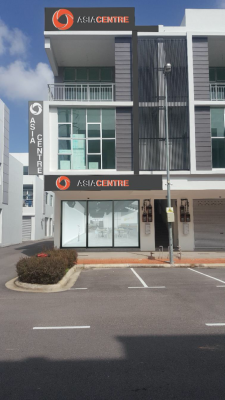
Asia Centre aims to enhance the collaborative experience of its partners at its second Centre in Johor Bahru, Malaysia. The new Centre’s design, a multifunctional facility for seamless co-working, meetings, networking and project administration, was finalised in December 2019 following discussions with interior renovation firms and feedback from partners. Asia Centre Malaysia located at ION 2, CI Medini Complex, Johor Bahru, Malaysia, will occupy a 20’ by 60’ intermediate corner three-storey lot with a total floor area of 3209 square feet. The ground floor will spot a reception counter and waiting lounge, wall mounted desks and freestanding tables and chairs, audio-visual equipment, a fully equipped pantry and serving area and toilets. The reception counter and waiting lounge serve to welcome visitors, handle queries and direct visitors.  The mounted desks and table and chair area are for co-working, meetings and networking sessions. There is podium and backdrop space supported by audio-visual equipment where guests can speak during networking events or mingle before and after the events on the first floor. The ground floor has a fully equipped pantry with kettle, fridge and microwave where drinks and food can be prepared. The bar counter at the pantry can also serve as a refreshment station for the Centre’s staff, event participants, partners and visitors. At the back, behind hidden doors, two toilets will serve ground floor users. Walking up the stairs from the ground to the first floor guests can view posters of Asia Centre’s past events on the right wall. At the first floor staircase landing, there will be a signboard for events announcements and a mixed height storage cabinet. The signboard will display event details at the first floor and indicate the meeting room where it will take place. The mixed height cabinet will serve as a storage space for items needed for events. Next to the cabinet is a door leading to toilets located separately for guests that will attend events on the first floor. From the first floor, a sliding door opens into a lounge area with sofas and chairs that can serve as waiting or discussion area for event participants. From the lounge area on the left hand side is the Meeting Room 1 which offers seating for up to 40 people and is equipped with audio-visual equipment and overhead projector for conferences, roundtables, seminars, trainings and workshops.  On the right side of the lounge area side is Meeting Room 2 which seats up to 8 people and has a Smart TV and whiteboard can serve small team discussions, audio-video calls or break-out sessions for events at Meeting Room 1. Walking up from the first floor, Asia Centre staff will arrive at the landing of the second floor. There, before entering the office area, staff can sit at the bench and take off their shoes and leave them at the shoe cabinet. On the walls of the stairwell, Asia Centre’s past event posters and wall murals will be displayed. The second floor will serve as office space for the administration and coordination of Asia Centre’s activities and projects. Entering the office space through the glass door, on the right hand side, there will be wall-mounted workstations. Up to three people can work there with the bottom drawer for storing document and personal belongings as well as cabinet space above the desks. On the opposite side, there will be wall-to-wall storage cabinets that will have on the right side with be a mini-pantry and on the left side a printer-scanner station. In the middle will be a long rectangular whiteboard where can mark and track the Centre yearly plans. The cabinets will provide ample storage room for documents and office supplies. Next to the cabinet an area with a sofa-bed and a lounge chair to serve as a relaxing space for employees to recharge and have a casual conversation with co-workers. Across the sitting area, there will be a meeting table for up to 7 people with a wall-mounted Smart TV. This will enable office staff to take audio-video calls, meet, discuss and collaborate without the need to use Meeting Room 2 on the first floor. The outdoor patio with sofas and lounge chairs will offer another place for staff to engage in discussion or to relax.  With the interior design phase complete, Asia Centre Malaysia will next seek approvals from the municipal authorities before proceeding to the renovation stage. Construction and fit-out is expected to begin early next year and will take between 4-6 months. Asia Centre Malaysia is open to receive enquiries for collaboration. Email: contact@asiacentre.org See also Asia Centre Announces Malaysia Branch Previous Next

Sumitomo Grant Aids Asia Centre’s Engagements in Japan

Asia Centre’s Regional Director Dr. James Gomez delivered 5 public lectures, signed 2 MOUs and met with academics, researchers, politicians, lawyers and civil society representatives in Tokyo, Kyoto and Osaka from 17-28 November 2019. This Japan visit is part of Asia Centre’s “Research on Fake News and Lessons from Japan for Southeast Asia,” supported by the Sumitomo Foundation. The primary purpose was to present the findings of Asia Centre’s initial baseline study on fake news in Southeast Asia to Japanese institutions.  The trip started off with a technical briefing on 18 November 2019 at the Headquarters of Liberal Democratic Party (LDP) in Tokyo, Japan hosted by Dr. Keitaro Ohno, Deputy Secretary-General and Ryuji Koizumi, Director-General of the International Bureau of Liberal Democratic Party. At that meeting, Dr. Gomez briefed the LDP parliamentary caucus on fake news legislation in Southeast Asia and its use as an intervention tool by foreign governments and possible measures to counter this.  Dr. Gomez also met with Mr. Kimiaki Kawai of the Toda Peace Institute on 19 November 2019 and Satoko Kitamura, Vice-Chair of Hate Speech Project Team and Ryo Takagai of the Japan Federation of Bar Associations on 21 November 2019. During these meetings, the parties exchanged information on each institutions’ work, discussing fake news, social media, racial discrimination and hate speech. Aside from this technical briefing, Dr. Gomez delivered 5 public lectures at different Universities in Japan. In Tokyo, Dr. Gomez spoke at Gakushuin University and at the Institute of International Relations, Sophia University on 20 and 21 November 2019 respectively. These lectures focussed on hate speech, because hate speech is a potent by-product of fake news that is giving rise to violence and communal strife; this was one of the major findings on the International Conference on Fake News and Elections (10-12 July 2019) organised by Asia Centre. Following that, three other lectures were held in Kyoto and Osaka at: the Centre for Southeast Asian Studies, Kyoto University on 25 November 2019; Graduate School of Letters, Osaka University on 26 November 2019; and at Osaka Jogakuin University on 27 November 2019. These lectures addressed “Fake News Legislation in Southeast Asia” and the lessons learned for Japan. Apart from these lectures, meetings were held with academia, civil society and other supporting institutions. During these meetings, Dr. Gomez further engaged with stakeholders on fake news and discussed partnerships regarding the Centre’s Freedom of Expression project and its 2020 conference on Hate Speech in Asia: Challenges and Solutions. The meetings were held with: Jeffrey J. Hall of Waseda University; Prof. Seong-Bin Hwang, Rikkyo University; Prof. Tadashi Anno and Assoc. Prof. Tina Burrett from Sophia University; Prof. Muranushi Michimi, Gakushuin University; Prof. Jun Sakamoto, Hosei University; Dr. Yoko Hayami, Kyoto University; Prof. Taro Mochizuki, Osaka University; Saul J. Takahashi, Osaka Jogakuin University; and Prof. Toru Oga, Kyushu University.  Rounding off the trip, as part of the Centre’s strategic engagement to formalize collaboration via MOU, the Centre signed two MOUs with institutions in Japan. On 25 November 2019, Dr. Yoko Hayami from the Centre for Southeast Asian Studies (CSEAS), University of Kyoto, signed an MOU with Asia Centre. On 27 November 2019, Prof. Eiko Kato-Otani, President of Osaka Jogakuin University signed an MOU with Asia Centre. The MOUs provide the framework for the institutions to undertake joint research, co-convene activities and facilitate visits or internships.  In sum, the Sumitomo Foundation research grant enabled Asia Centre to enhance fake news literacy among Japanese stakeholders as well as engage in partnership-building activities to facilitate collaborations. The trip follows the Centre’s recent Japan-ASEAN Roundtable on 4 October 2019 and an outreach trip in 2018 to Tokyo, Japan. In East Asia, the Centre has been building up it’s engagement starting in 2018 and 2019 with other outreach trips to South Korea and Taiwan. 

Asia Centre and Thai Media Fund Sign MOU

Dr. James Gomez, Regional Director, Asia Centre signed a Memorandum of Understanding (MOU) with Mr. Wasan Paileeklee, CEO, Thai Media Fund (TMF) on 1 November 2019 to formalise both institutions’ cooperation on activities and research to promote digital and media literacy on challenges related to online disinformation such as fake news and hate speech. The signing was witnessed by Asia Centre’s Program Coordinator, Yawee Butrkrawee; Asia Centre’s Manager, Patcharee Rattanarong; TMF’s Director of Media Literacy, Weeraphong Kangwannavakul Department and International Collaboration Officer, Atthanat Khurat. The MOU signing follows engagements between the two organisations, starting from September 2018 when Dr. James Gomez delivered a keynote address on “Fake News in Southeast Asia” at a convention organised by Thai Media Fund and the Ministry of Culture of Thailand at Burapha University, Thailand. Since this first engagement in late 2018, Asia Centre has participated in several of Thai Media Fund’s activities as speaker and/or facilitator. On 18 September 2019, Asia Centre’s Dr. James Gomez spoke on the emerging Post-Truth Ecosystem in Southeast Asia at the ‘Creative Media Partnership in Thai Society: Fostering Constructive Media Ecosystem Conference’. Organized by Thai Media Fund, the event’s opening ceremony was also presided by Minister of Culture, Ittipol Khunpluem. On 10 September 2019, as part of the Centre’s external engagement, Dr. James Gomez attended the “Defending Democracy Through Media Literacy II” International Workshop on 10-11 September  in Taipei, Taiwan. Thai Media Fund CEO, Wasan Paileeklee participated in the workshop alongside with Dr. James Gomez and showcased the concerted efforts of Thai Media Fund and the Centre to combat fake news and hate speech on online platforms in Thailand. In June 2019, Dr. James Gomez also met with Taiwan’s Digital Minister Audrey Tang  during a conference in Bangkok organised by local partners including the Thai Media Fund. The conference was organised to consolidate knowledge and foster cooperation to combat fake news in Thai society. During the conference sidelines, and Dr. Gomez also discussed with Minister Tang a follow up meeting in Taipei 2020.  In July 2019, at Asia Centre’s International Conference on Fake News and Elections in Asia, Thai Media Fund became a key partner of the conference to support a region wide exchange of views to tackle fake news issues. CEO of Thai Media Fund, Wasan Paileeklee highlighted in his opening remarks at the conference the large extent to which fake news posed a challenge to Thai society and how the right balance between legal and non-legal measures is needed to address the issue of fake news without jeopardizing individuals’ basic rights. The activities with the Thai Media Fund are hence important building blocks that has led to the November 2019 MOU signing. This MOU will result in partnership with the Centre’s 5th International Conference on Hate Speech in Asia: Challenges and Solutions to be held during 8-10 July 2020, Bangkok, Thailand.  Asia Centre looks forward to working with the Thai Media Fund.

Asia Centre broadens USA networks

In October 2019, Dr. James Gomez, Regional Director, Asia Centre visited institutions in Washington, D.C. and New York to introduce the work of the Centre and broaden its network in the United States (US). Apart from institution-to-institution level cooperation, Dr. Gomez also invited collaborations with the Centre on its 4 year project on Freedom of Expressions in Southeast Asia (SEA). During the US visit, Dr.Gomez presented findings from its International Conference on Fake News and Elections in Asia and promoted the 2020 conference on Hate Speech in Asia: Challenges and Solutions. This trip saw Asia Centre engaging with universities, policy institutes, state department officials, non-governmental organizations (NGOs) and United Nations agencies in the US. During the trip, Dr. Gomez gave 2 public talks at universities and had academic side meetings to share and extend invitations to co-convene the 2020 conference on Hate Speech in Asia: Challenges and Solutions. In Washington D.C. on 17 October 2019, Dr. Gomez spoke at George Washington University at a seminar jointly organised by the Sigur Centre for Asia Studies and the Institute for Public Diplomacy and Global Communication. He also spoke at a talk jointly organised by the Centre for Global Free Expression, School of International and Public Affairs and the Institute for the Study of Human Rights at Columbia University on 24 October 2019 in New York. At both events, he addressed the issue of “Fake News Legislation in Southeast Asia and the Impact on the Freedom of Expression”. He argued that fake news legislations run contrary to international norms on freedom of expression and are instead being used as a tool of repression by political incumbents. Dr. Gomez also had academic meetings with Executive Director of the Dangerous Speech Project, American University, Susan Benech on 17 October 2019, Professor James Robson, Harvard University’s Asia Centre on 22 October 2019 and Dr. Hawley Johnson of the Global Freedom of Expression, Columbia University on 24 October 2019 discussing possible collaboration for the Centre’s International Conference on Hate Speech in Asia: Challenges and Solutions. Dr. Gomez held closed door briefing sessions at 2 policy institutes during the trip. The first session was in Washington DC on 18 October 2019 with the Council on Foreign Relations and the second in New York on 25 October 2019 with the National Committee on American Foreign Policy. At both meetings, Dr. Gomez updated participants from academia, diplomatic missions, private foundations, various state departments and technology companies on fake news legislations’ impact on human rights in Southeast Asia. A range of NGOs also attended a briefing on the Centre’s projects and discussed possibilities for collaboration. In Washington, D.C., Dr. Gomez participated in a roundtable organised by the International Republican Institute that was attended by its staff and other INGOs representatives. During which, he briefed participants on the authoritarian practices of governments and other detractors to label INGOs’ collaborations with local NGOs as “foreign interference”. Following which, participants should be mindful of this new type of hate speech against INGOs. During the trip, Dr. Gomez met with representatives from a wide range of organisations such as the National Endowment for Democracy, Freedom House, Global Witness, International Center on Nonviolent Conflict, National Democratic Institute (NDI), PeaceTech Lab, Holocaust Museum and the American Jewish World Service to brief them on the Centre’s work.  Dr. Gomez also participated in some public events. He attended the launch of ‘Exploring New Approaches for Atrocity Prevention’ hosted at the United States Institute of Peace in Washington, D.C and later on in New York, he attended the Oslo Freedom Forum on 23 October 2019 organized by the Human Rights Foundation. During both these events, Dr. Gomez was able to network with other representatives of organisations attending the events. In line with Asia Centre’s work on hate speech and its impact on the Rohingya community in Myanmar, the trip included meetings with United Nations agencies and officials alongside organizations that advocate for an effective solution to the Rohingya refugee crisis. On 21 October 2019, Dr. Gomez met with the United Nations Office of the Special Advisor on the Prevention of Genocide to discuss collaboration on the 2020 conference on Hate Speech in Asia: Challenges and Solutions. He also attended a briefing for INGOs by Dr. Marzuki Darulsman (former Fact Finding Mission) and Khin Omar, (Progressive Voice) convened by CARE International. Dr. Gomez had separate meetings with Yanghee Lee (Special Rapporteur Myanmar), representatives of Burma Task Force and the Free Rohingya Coalition.  To discuss the Centre’s work on Freedom of Religion or Belief, Dr. Gomez met with the United States Commission on International Religious Freedom earlier on in Washington D.C., on 16 October 2019. Dr. Gomez had an opportunity to engage with the media when he was interviewed on 18 October 2019 by Men Kimseng of the Khmer Service on Voice of America. During the on camera interview, Dr. Gomez spoke on a wide range of issues including fake news in Cambodian politics and commented on Sam Rainsy’s announcement to return to Cambodia on 9 November 2019. Overall, the visits to Washington DC and New York from 14 October 2019 to 25 October 2019 enabled Asia Centre to introduce its work and initiate conversations to explore collaborations with US-based institutions. This trip furthers the Centre’s external engagement beyond Asia and broadens its network into the US.

Thailand Launch: Journalism for an Equitable Asia

The role of journalists in reporting on the scale of inequality came to the fore during the panel discussion convened on 8 November 2019 for the Thailand launch event of the Journalism for an Equitable Asia Award, organised by Asia Centre and Oxfam in Asia. The event brought together 35 participants from the media, academia and civil society to discuss the challenges of reporting on inequality. The objective of Asia Centre and Oxfam in Asia’s partnership in organising the Journalism for an Equitable Asia Award is to promote strong journalism and acknowledge the hard work of journalists who have persisted in such a role despite the travails. In the face of authoritarianism, populism and extremism in Asia, where civic freedoms are encroached on and voices against injustice are silenced, journalism’s role in promoting a healthy public discourse around human rights is vital. However, journalism faces the challenge of technological disruption. This has led to a shift in media consumption to user generated content, leading to a flood of information from numerous media sources. With shifting media and news consumption habits, strong journalism on critical issues of equality, rights and sustainability are often drowned out in favour of sensationalist, populist and politically-driven media narratives. Against this backdrop, journalism needs to be more innovative in their reporting on issues, especially that of inequality. Key points made by the experts are as follows. First, inequality in Asia is rising despite having the fastest growing economic region. In addition, the lack of attention to key issues of climate change and gender inequality in this region was observed in the welcome remarks by Nipuna Kumbalathara, Media and Communications Lead – Asia at Oxfam International. The capacity of journalists to be enablers and thought leaders in the goal of making a better world where people have equal opportunities for a better tomorrow was also reaffirmed.  Second, the development of journalism with a social conscience was noted by Dr. Robin Ramcharan of Asia Centre, who moderated the panel. He issued a timely reminder of  journalism’s role in holding governments accountable and speaking truth to power. He also implored journalists to hold good ethical practices and be good researchers for fact-based journalism.  Third, journalism should serve as a counterweight to inequality and should capture its complexities through reporting on the effects of climate change. This point was made by Dr. Jessada Salathong, a communication arts lecturer at Chulalongkorn University and a television and radio host. He argued that the current reporting on climate change only unveils the tip of the iceberg to the problem and thus called for a more critical investigation of the issue through the adoption of an intersectional lens of class and gender. With such considerations, journalism can more effectively counterbalance the disproportionate effects of climate change experienced by women and the poor — exposing more of the iceberg. Fourth, the empowering nature of journalism as a source of education and as an amplifier of the marginalised voice was further affirmed by Supinya Klangnarong, a Thai media rights advocate and former vice-chair of the Campaign for Popular Media Reform (CPMR). However, she also recognised the challenge journalists face with the digital disruption of media consumption. Moreover, declining trust in the news industry as a result of disinformation and fake news has made it tougher for journalists to effectively deliver news to the public. Fifth, the importance of robust and concrete data to tell a fuller picture of poverty was emphasised by Journalist Shaikh Ashfaque Zaman. In contextualizing the individual narratives of poverty in larger systemic structures, it shifts the onus of poverty away from these purportedly passive individuals. In search of more extensive databases, he called for collaboration with research institutes and the possibility of forming collectives. Sixth, inequality is a political choice and is not inevitable. Furthering the discussion on the issue of poverty, Max Lawson, Head of Inequality Policy at Oxfam International called for journalists to shift the spotlight from this erroneous belief by calling for an investigation into wealth, rather than the preponderant instinct to only report on the poor. Equipped with a better understanding of inequality and the possibility of change, the public can demand for more progressive policies and a more equitable world. The speakers and the audience deliberated about the need for ethical journalism moving forward and consequently, how honest reporting of poverty would look like in the age of digital disruption. Shaikh Ashfaque Zaman recognised the need to move beyond a tendency of telling individual narratives and reverting to incomplete individual depictions of poverty and social mobility and reiterated the role of data driven journalism in revealing the larger movement such stories are located within. The practice of ethical storytelling was also mentioned and its contribution to empowering the subject to narrate his or her story rather than have it be shaped on the editing floor.  In this vein, a reinvention of honest reporting is also required in the era of digital disruption. Supinya Klangnarong called for journalism to negotiate with the major media companies to effect change together. Max Lawson highlighted Oxfam’s strategy of cutting through the noise by appropriating the echo chamber and reactionary forces prevalent today. In particular, Oxfam uses ‘killer facts’, which are simple enough to evoke the readership’s emotions when reporting on poverty. To better prepare journalists, Dr. Jessada Salathong acknowledged the need for academia to recalibrate its teaching methodologies in order to deal with the new landscape, but that the same core value be imparted to students — responsibility to the public. This panel discussion is part of the launch event for the Journalism for an Equitable Asia Award co-hosted by Asia Centre and Oxfam in Asia. The award serves to acknowledge the efforts and thought leadership of journalists in shedding light on the issue of inequality and its many facets. This event is one in a series of on-site and online launch events in South and Southeast Asia: Bangladesh, Myanmar, Pakistan, Philippines, Thailand and Malaysia to create awareness of this

© 2015 ASIACENTRE, BANGKOK, THAILAND. – INFO@ASIACENTRE.ORG