5th Benedict Anderson Memorial Roundtable: COVID-19 and Vaccine Nationalism
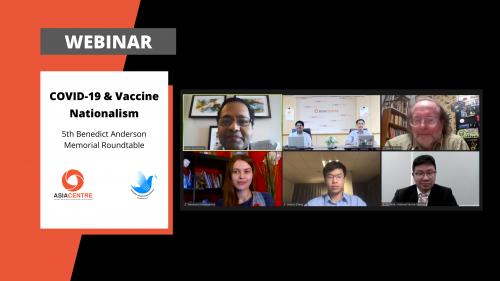
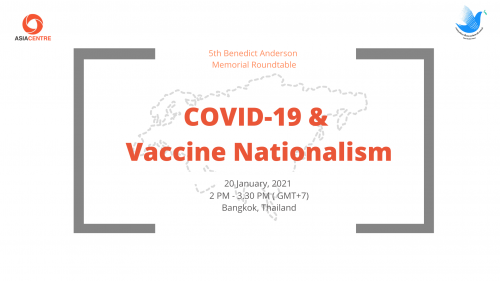
Rich countries have placed orders, received consignments and have begun inoculating their citizens, however, the reality of needing to inoculate foreign residents in their midst makes vaccination nationalism irrelevant. This was the general view emerging from Asia Centre’s webinar on 20 January 2021 entitled “COVID-19 and Vaccine Nationalism”. Asia Centre, in partnership with the Thai Media Fund and Taiwan Foundation for Democracy, convened its 5th Benedict Anderson Memorial Roundtable in remembrance of the late professor’s work on nationalism. The event was attended by 64 online participants with 798 Facebook Live views during the session. The session brought together academics, activists and health experts from all over the world to discuss the topic of vaccine nationalism. The opening remarks were given by Asia Centre’s Executive Director, Dr. Robin Ramcharan who outlined the key themes related to vaccine nationalism. He pointed out that vaccine nationalism primarily stemmed from competition to be the first to develop the vaccine and national pride in doing so. However, he asked the speakers and audience what is the reality on the ground? The first speaker was Asst. Prof. Wisit Tangkeangsirisin, Head of the Bureau of National Vaccine Capacity Development, from the National Vaccine Institute in Thailand. He provided an overview of the blueprint for COVID-19 vaccine access for Thailand. According to the national strategy he presented, there are three ways: 1) domestic R&D for vaccines; 2) technology transfer from AstraZeneca pharmaceutical firm and; 3) vaccine advance purchase agreement. He updated the audience on the progress of Thai’s vaccine development, noting that the mRNA vaccine from the Chula Vaccine Research Center is at the first clinical trial phase. The second speaker, Dr. David Moore, from Portland State University explained that nationalism is a product of the movement of people and commodities and provided insights into the rise of nationalism in the United States of America under Donald Trump’s presidency. Dr. Moore’s view was that more people are holding to ideas of national identity amidst fear of losing it to the impact of globalisation. Dechun Zhang, a PhD candidate at Leiden University was the third speaker. He presented on the development of COVID-19 vaccine in China. He listed the top three state-connected companies and their progress in the global vaccine race. He pointed out the Chinese characteristics of secrecy and non-disclosure in the way in which the vaccine was developed and distributed. This, he said, was the reason behind the growing but unspoken distrust among the Chinese population about the domestic vaccines. The final speaker was Alexandra Demitrianova, an activist from Slovakia and an Asia Centre’s Associate. She approached the topic from an European Union perspective highlighting the inequality between nations and the rising sense of nationalism within the members of the union. She said financial and political power member countries in the EU varied, and as a result, the smaller and weaker members benefit from an umbrella EU approach in acquiring vaccines for the whole block. Asia Centre’s Regional Director, Dr. James Gomez, responded to the speakers. He said, vaccine nationalism is intellectually and practically problematic because at the end of the day countries cannot limit themselves to vaccinate only their citizens. From a public health perspective, countries would have to also inoculate foreign residents within their jurisdiction to protect the whole resident population. Politically, and in terms of public relations, to deny foreign residents the vaccine would be a political and PR disaster. The key questions would be who will pay for this and what happens if poorer countries cannot afford it. This then opened the debate among the speakers and audience on how to make the vaccine equally available to all nations, especially the poorer ones. The main takeaway was vaccine nationalism cannot hold up, because this issue is global. Most countries have a significant dependency on economic cooperation with others in various forms including geopolitical alliance, movement of goods and the movement of people. This event is the 5th Benedict Anderson Memorial Round Table convened by Asia Centre. To date Asia Centre has convened the following memorial roundtables: 1st Benedict Anderson Memorial Roundtable: “Debating Imagined Communities” (2016) 2nd Benedict Anderson Memorial Roundtable: “Nationalism, Citizenship and Statelessness” (2017) 3rd Benedict Anderson Memorial Roundtable: “Gender and Nationalism in Asia” (2018) 4th Benedict Anderson Memorial Roundtable: “Chinese Nationalism and Its Impact on Southeast Asia” (2019) https://www.youtube.com/watch?v=d2a6v4mc2hI&t=191s
Civil Society Empowerment must be at the Centre of COVID-19 Recovery Efforts

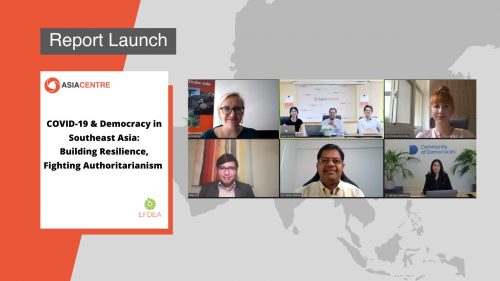
On 9 December 2020, Asia Centre released its baseline study “COVID-19 and Democracy in Southeast Asia: Building Resilience, Fighting Authoritarianism”. This report examines the state of democracy and human rights in the region, from 1 January 2020 to 30 November 2020, and the accelerated regression thereof due to COVID-19. The report was presented by Dr. James Gomez, Regional Director of Asia Centre. Following the unveiling, key themes of the report were discussed by Dr. Rebecca (Bec) Strating, Executive Director, La Trobe Asia, La Trobe University; Dr. Kristina Kironska, Researcher, Palacky University of Olomouc; Celito Arlegue, Executive Director, Council of Asian Liberals and Democrats (CALD); and Patricia Galdamez, Permanent Secretariat, Community of Democracies. Dr. Robin Ramcharan, Executive Director of Asia Centre, moderated the event. The report’s key finding notes that COVID-19 has accelerated the regressionof democracy in Southeast Asia, which has over two decades and several crises been a focus of government attacks. Government responses to crises, in line with regression over two decades, have built on one another. Building on the findings of the report, Dr. Gomez added that there is a real risk of governments expanding these temporary laws to be long-term laws and practices that will further shrink civic space. Dr. Rebecca (Bec) Strating, assessed the report’s findings under the lenses of international relations, by noting the geopolitical impact of flailing US power in the region as China’s autocratic reach expands. Dr. Kristina Kironska, expanded on the reports’ electoral democracy findings by noting how the pandemic’s emergency laws have expanded the authority and reach of “those in power”, especially in Myanmar during the country’s general elections in November. Celito Arlegue, noted that despite the far reaching presence of authoritarianism in the region, democratic practices to contain a crisis can not be argued as ineffective; and later expanded on the necessity of democracy activists and defenders to be creative and innovative. Patricia Galdamez, provided an overview of the impacts that COVID-19 has had on democracy and human rights – globally; emphasising that public access to the internet, and the protection of Freedom of Association, must be guaranteed. Following the contribution of discussants, Dr. Robin Ramcharan led the Q&A session where participants could send pressing questions to speakers. After this session, Dr. Ramcharan made his closing remarks and emphasised the importance of a strong civil society, working alongside governments, in post-COVID-19 recovery efforts. The report’s main recommendation is to shore up civil society by increasing their involvement internationally, giving them a voice at muli-lateral discussions and to ensure they are adequately resourced and supported so they can continue to occupy and operate in the civic space. COVID-19 and Democracy in Southeast Asia: Building Resilience, Fighting Authoritarianism was released to mark the United Nations’ International Human Right Day, 10 December 2020, with its theme of ensuring human rights are central to COVID-19 recovery efforts. Watch the report launch here, and download the report here. Read thematic opinion pieces based on the report’s findings in The Bangkok Post, Jakarta Post and Australian Outlook. *This report is a collaboration between Asia Centre and Empowering Fundamental Freedom Defenders in Southeast and East Asia.
COVID-19 and Democracy in Southeast Asia
Download Full Report ABSTRACT COVID-19 and Democracy in Southeast Asia: Building Resilience, Fighting Authoritarianism examines trends under which Southeast Asian governments have used crises as opportunities for their political advantage. This report, centred around the Coronavirus Disease 2019 (COVID-19), highlights the routine response from governments with the announcement of emergency decrees and laws, suspension of civil freedoms, corruption of electoral democracy, censorship, digital surveillance measures, and framing human rights activists as national security threats. Post- crises, governments then enact long term laws and policies that effectively shrink civic space. Their methods also include limiting media and journalists’ watchdog activities through fake news and defamation labels, whilst substantially contributing to the dwindling civil society funding. A set of recommendations are also prescribed for the United Nations, Governments, Donors and Civil Society Organizations. CONTENTS PAGE Executive Summary Introduction Background Laws and Policies Curbing Protests Eroding Electoral Democracy Stifling Political Criticism Attacking the Media Increasing Surveillance Funding Shifts Recommendations Conclusion Bibliography SUPPORT ASIA CENTRE Help Asia Centre speak up for human rights. Your donation can help highlight human rights violations, bring people together for action and support advocacy for human rights protection. Donate Now
Women Lead 2019-20 Journalism for an Equitable Asia Awards

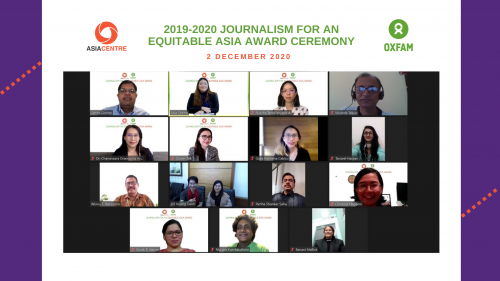
Women led at the Journalism for an Equitable Asia Award Ceremony on the 2nd of December 2020 at 2 PM – 3.30 PM (GMT+7, Bangkok). The female-dominated field of the top ten journalists were positively judged on their delivery of high-quality articles on the issues of poverty and inequality in Asia. Out of the twelve journalists, who wrote the top ten articles, eleven were women. Asia Centre and Oxfam in Asia convened an online award ceremony in place of a face-to-face event due to the ongoing COVID-19 pandemic travel advisories. For this year’s nominations, there were 100 submissions, from 7 countries in the region including Bangladesh, Malaysia, Myanmar, Pakistan, The Philippines, Thailand and Vietnam, with 25 merit awards, 10 prize awards with 3 winners all of whom were invited to attend the event. Nipuna Kumbalathara, Media and Communications Lead – Asia, Oxfam International, welcomed all to the event and dedicated the event to all the journalists who continuously use their voice against deep injustices. Mustafa Talpur, Regional Advocacy and Campaigns Manager – Asia, Oxfam International, in his keynote remarks encouraged emphasising inequalities and injustices as a political agenda in Asia and the Pacific. During the event, the 3 prize winners were announced by Asia Centre and Oxfam in Asia: Winner of the award and $1000 prize money was the Turkish journalist Ms. Didem Tali with her article “Our Mother Sold Us for One Lakh Each” published on “New Naratif”. The story about two sisters and other victims in Myanmar, who faced human trafficking clearly convinced the judges. In second place and the winners of $750 came two journalists from the Philippines, Ms. Jessica Bartolome & Ms. Donabel Magsino followed, for their story “A very long summer” published on “GMA News Online”, a group of farmers for over five months. They documented their daily struggles and how their situation worsened due to “El Niño”. In third place came Ms. Nutcha Tantivitayapitak, the Thai journalist and winner of $500 prize money reported in her article “The forest reclamation case : when the court sent the Sapwai villagers to prison and off their land”, on the case of Thai villagers who illegally lost their land and their fight against the court. Her article was published in the “Prachatai”. Dr. James Gomez, Regional Director of Asia Centre, congratulated the winners, finalists, the merit awardees and all who submitted their award tickets for speaking up against inequalities and poverty, in particular towards women as a whole through various lenses. At the same event, the launch of the nominations of the awards in 2021 was announced by Nipuna Kumbalathara, Regional Advocacy and Campaigns Manager – Asia, Oxfam International exploring the theme of inequality crisis and the pandemic. For those interested in the nominations for next year’s cycle can submit entries here: https://bit.ly/36lPkDX. We, Asia Centre and Oxfam in Asia, hope to receive your nominations soon and see you at the next award ceremony!
3rd ASEAN-Japan Roundtable: The Impact of the COVID-19 Pandemic
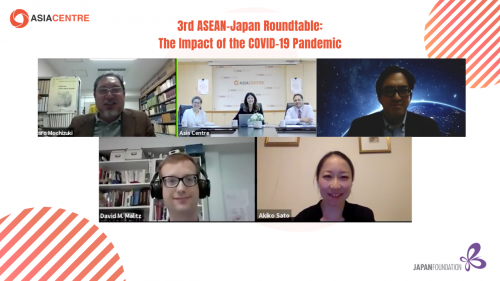
On 18 November 2020, Asia Centre, in partnership with the Japan Foundation, convened the 3rd ASEAN-Japan Roundtable on the topic of “ASEAN-Japan relations: The Impact of the COVID-19 pandemic”, the video of which can be viewed here. Experts in ASEAN-Japan relations came together to discuss the impact of COVID-19 in Japanese society and Japan’s relationship with ASEAN countries in terms of economy, geopolitical developments and people-to-people relations. Dr. Robin Ramcharan, Executive Director, Asia Centre, welcomed the speakers and participants in his opening remarks that recapped the content of the Centre’s 1st and 2nd ASEAN-Japan round tables held in 2017 and 2019. In introducing the 3rd Roundtable, Dr. Ramcharan pointed to recent developments in ASEAN-Japan relations in the context of the Japanese Prime Minister’s latest visit to Southeast Asia. The speakers at the Roundtable made the following points: Prof. Saul Takahashi, Osaka Jogakuin University: He pointed to the shift in attitude needed by Japanese policymakers to promote human dignity towards migrant workers thereby creating a strong Japan-ASEAN relationship. Prof. Takahashi said that the travel restrictions placed on foreign residents in Japan who were migrants, spouses and students was an infringement of their human rights. Dr. David Malitz, BALAC,Chulalongkorn University: He examined the shift in Japanese investment, due to COVID-19, from Thailand to Indonesia and Vietnam. Dr. Malitz’s comments further noted the shift from manufacturing towards the service, education, and human resource sectors. Dr. Saikaew Thipakorn, Director, Japan-ASEAN Studies Centre, Chulalongkorn University: She examined COVID-19’s impact on the daily lives of people in Japan and in the ASEAN countries. Dr. Thipakorn discussed the ‘new normal’, influenced by the impact of digital- literacy and divide, and further addressed self-sufficiency policies. Dr. Thipakorn noted, these developments raise questions about who should standardize digital regulation and how to promote self-sufficiency without disrupting globalisation. Akiko Sato, Human Rights Now: She examined the impact of the COVID-19 pandemic on Japan’s economy and human rights issues. Japan has experienced the human rights violations of migrant workers, children, women, persons with disabilities and privacy issues in its business sector. To rectify these issues, Ms. Sato prescribed that Japan learn from the human rights institutions in ASEAN which can build on the existing Japan-ASEAN economic relationship. Prof. Taro Mochizuki, Osaka University: He presentedthe philosophical perspective of COVID-19 as a war between citizens and soldiers. This war can lead to a shift in identity from citizen to soldier, as aligned with authoritarianism. Prof. Mochizuki emphasised that instead of using the war metaphor, civil solidarity and civic duty should be promoted while international and regional solidarity should be strengthened on a civil level. The main takeaway of the event is that the mutual collaboration between Japan and the ASEAN countries should be promoted to both maintain existing relationships and tackle the impact of the COVID-19 pandemic. However, this relationship should be based on a mutual understanding and respect of each other which currently is far from satisfactory. This event is the 3rd ASEAN-Japan Roundtable convened by Asia Centre with the support of Japan Foundation. The Centre has convened two earlier events: 2017: 1st ASEAN-Japan Roundtable: Multipolar Asia-Pacific Century, that focused on ASEAN-Japan economic and business relations in relation to human rights 2019: 2nd ASEAN-Japan Roundtable: Competing for Influence in SEA that discussed Japan’s non-economic approach to maintaining relations with ASEAN. Asia Centre looks forward to partnering with the Japan Foundation to convene future events.
Asia Centre Convenes “Infodemic” Discussion

Asia Centre, in partnership with the Taipei Economic and Cultural Office in Thailand (TECO) and the Thai Media Fund, convened a discussion on “Countering the COVID-19 Infodemic: Sharing Best Practices” on 4 November 2020. The session, which brought together speakers from Taiwan and Thailand, examined the impact of the COVID-19 pandemic creating an “Infodemic” which has challenged countries trying to tackle issues of disinformation, misinformation and too much information as there has been a surge of fake news related to COVID-19, placing vulnerable communities at risk to the public health arena and national security. Ambassador Lee, Ying-Yuan (Taiwan’s Representative to Thailand) introduced the session highlighting that the COVID-19 pandemic has spread disinformation and misinformation. He compared the intensity of the dissemination of false information as a pandemic and, thus, creating an “Infodemic”. Audrey Tang (Digital Minister, Taiwan) discussed the need for transparency where civil society and citizens, online communities and media consumers act as the solution to counter this “Infodemic”. The Minister said every individual must play a role in becoming “fact-checker” themselves. Summer Chen (Taiwan Fact Check Center), Lilly Min-Chen Lee (Global Research Program Manager, Doublethink Lab, Taiwan) and Chitpong Kittinaradorn (ChangeFusion) expressed the need for a collaborative approach to tackle COVID-19 on a global scale. The speakers demonstrated that one of the ways to collaborate was through inoculation of correct information and fact checking systems; for instance, #CoronaVirusFacts Alliance and International Fact-Checking Network (ICFN) in Taiwan that can then be utilised by organisations to tackle the virus-like spread of disinformation and misinformation. Prof. Warat Karuchit (Associate Dean, Graduate School of Communication Arts and Management Innovation, NIDA) shared his efforts to alleviate the accumulated communication crisis; for instance, one of his effective methods was to deliver policies, decrees and laws in common parlance. Therefore using key political figures and trusted organisations to transmit well designed digital content over social media platforms works well to inform the public about COVID-19 relevant information. The main takeaway from the event is the importance of fusing public and civil communities to work together and network to produce solutions. One of the proposed solutions is a coordinated act of becoming “super-correctors” – what this means is that during a heightened situation of disinformation everyone comes together to immediately respond and debunk false information. Apart from discussing solutions to the challenges of COVID-19, this event once again demonstrates the close partnership between Asia Centre, Taiwanese institutions and the Thai Media Fund and the potential for future collaborations on other projects.
5th Benedict Anderson Memorial Roundtable: COVID-19 & Vaccine Nationalism

Asia Centre will convene the 5th Benedict Anderson Memorial Roundtable entitled, ‘COVID-19 & Vaccine Nationalism’. The event, held in partnership with the Thai Media Fund, will take place next year on January 20, 2021 at 2 PM – 3.30 PM (Bangkok, Thailand, GMT+7). This event will review the implications of pre-purchase agreements being made between governments and vaccine manufacturers to secure and prioritise a country’s needs before others. In particular, it will examine how high demand for a COVID-19 vaccine, now commonly known as ‘vaccine nationalism’, will affect Asia. Since 2016, Asia Centre has convened 4 memorial roundtables to examine the work of renowned scholar, Benedict Anderson, on nationalism as well as to honour the significance of his studies on the impact of nationalism in the Southeast Asian region. His seminal work Imagined Communities invited exploration of nationalism beyond European confines. These memorial round tables hold in-depth discussions and debates exploring ideas and analysis of Anderson’s work between respected scholars, professors and lecturers across Southeast Asia. To date Asia Centre has convened the following memorial roundtables: “1st Benedict Anderson Memorial Roundtable: Debating Imagined Communities” (2016) discussed the understanding of nationalism and debated its level of relevance in contemporary society and its contribution to foster the development of Anderson’s concept ‘imagined communities’; “2nd Benedict Anderson Memorial Roundtable: Nationalism, Citizenship and Statelessness” (2017) provided an overview of Anderson’s concept of ‘imagined communities’ and interpreted his ideas to convey how nation-states and nationalism are modern constructions and citizens share a sense of community through common values and shared rights; “3rd Benedict Anderson Memorial Roundtable: Gender and Nationalism in Asia” (2018) examined Anderson’s work on nationalism, as seen through a gendered lens in order to bridge the gap between the growing discourse on nationalism and gendered perspectives and, most recently, “4th Benedict Anderson Memorial Roundtable: Chinese Nationalism and Its Impact on Southeast Asia” (2019) critically discussed Southeast Asia’s growing fear of China’s rise as a global power and its impact on the region in the age of information and disinformation. Having held 4 memorial round tables, Asia Centre aims to further Anderson’s work by exploring a new wave of nationalism, vaccine nationalism, and see how we can understand Anderson’s ideas and analysis on nationalism and contemporary issues surrounding it. Register for the Roundtable here. For more information, please feel free contact us at research@asiacentre.org
5th International Conference (2020): Hate Speech in Asia: Challenges and Solutions

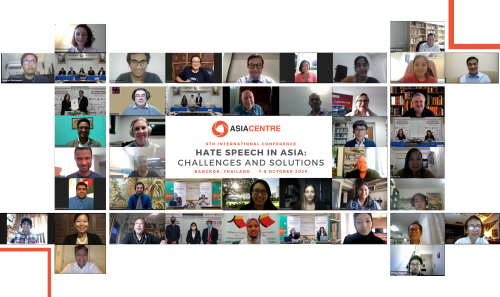
From 7 to 9 October 2020, Asia Centre convened its fifth International Conference on Hate Speech in Asia: Challenges and Solutions. Due to the ongoing COVID-19 travel and health advisories, this conference was convened as a hybrid event with participants joining in-person as well as teleconferencing from locations worldwide. The Law Faculty of Thammasat University was the location for the first day of the conference. Thereafter, starting that evening, panels were hosted in Asia Centre’s office and online. Into its 5th year, Asia Centre’s annual conference continued to grow from the previous year in spite of the pandemic. There were 18 partners who convened fifteen panels and one information session. The Centre facilitated the presentations of 47 speakers of which 45% were female. Furthermore, during these three days, a total of 40 people attended physically at the Law Faculty, Thammasat University whilst all others logged in online for all other conference sessions over the three days. Moderated by Belen Bode, Partnership Officer of Asia Centre, the conference’s first day opened with welcome remarks from Munin Pongsapan, Dean of the Law Faculty and Thammasat University; Dhanakorn Srisooksai, CEO of the Thai Media Fund; Pierre Hagmann, representative of the Swiss Embassy in Thailand; Frederic Spohr, Head of the Friedrich Naumann Foundation in Thailand and Myanmar and Robin Ramcharan, Executive Director of Asia Centre. Asia Centre’s 18 partners for this conference were the Faculty of Law at Thammasat University, Taiwan Foundation for Democracy, Thai Media Fund,and Friedrich Naumann Foundation. The panel partners were the Sanya Dharmasakti Institute For Democracy (SDID); the Embassy of Switzerland in Thailand; NIDA’s Graduate School of Communication and Innovation Management; Graduate School of Letters, Osaka University; Internews; La Trobe University; Strengthening Reconciliation Processes in Sri Lanka (SRP) Deutsche Gesellschaft für Internationale Zusammenarbeit (GIZ); Australian Human Rights Institute of the University of New South Wales; Malaysian Reform Initiative (MARI); International Republican Institute (IRI); Moonshot CVE; M Ravi Law; Council of Asian Liberals and Democrats (CALD) and the American Jewish World Service. Day One On the first day, discussants addressed how hate speech fuels conflict in Thai democracy emphasising cultural aspects; hate speech, religion, and racism in Thailand noting topics such as passive hate speech and digital literacy; philosophical perspectives of hate speech and the impact of linguistics in creating social divide; and the political weaponization of hate speech and its impact in Malaysia, Myanmar and Sri Lanka. Day Two On the second day of the conference, panelists discussed the multi stakeholder inputs needed to address some of the key symptoms of hate speech such as nationalism, xenophobia, political ideologies, religion and minority groups. The role of government, private and public sector, and civil society were further touched upon throughout the day. Social media companies, as facilitation platforms of hate speech, were examined from both narratives. The nature of gender, mobilisation tactics, youth and importance of digital were emphasised once again. Discussants also noted populist religious groups’ knowledge sharing which is displayed through hate speech campaigns sharing similar information, format and trends. Day Three The third and final day of the conference commenced with discussions on a hate speech project led by the Online Hate Prevention Institute’s Andrew Oboler. Later in the day, during the CALD panel Abhisit Veijjajiva (Former Prime Minister of Thailand) and Francis Pangilinan (Senator to the Republic of the Philippines) discussed issues related to political hate speech and the need for a neutral standard setter. The third day’s speakers also discussed the legal regulation of blasphemy with focus on the courts and prosecutors, politicians and governments. Further, the relationships between regulation and religion in incorporating cultural dimensions were examined. The role of Artificial Intelligence (AI) software to regulate hate speech on social media platforms were also noted. In terms of regulation, discussants shifted responsibility between governments and technology companies. Conference’s Key Focus Over the 3 days, the conference participants addressed amongst others the religious, cultural, ethnic, legislative, political, and technological aspects of hate speech which contribute to the multi-faceted dimension of the issue. The key focus of the conference evolved around legal and non-legal solutions that public, private and civil society stakeholders can take to mitigate the spread and harm of hate speech. Although legal measures were mainly touted there were concerns over who defines what is hate speech and the overall impact on freedom of expression. As conversations progressed, three clear commonalities in the discussants’ analysis emerged: The increasing role of social media as a hate speech facilitator; the reinvigoration of hate speech pushed by COVID-19; and the lackluster efforts from technology companies and governments alike in rectifying the issue. Panel Sessions and Conference Proceedings A range of issues related to hate speech were discussed over the course of three days. Papers submitted will be made accessible via the Conference Proceedings later in November 2020. Thereafter Asia Centre will announce a separate book project on Hate Speech in Southeast Asia. Recordings of panel sessions and a video overview of the conference are also available on Asia Centre’s YouTube channel. 2021’s 6th International Conference: COVID-19 in Asia Asia Centre and the National Institute of Development Administration also took the opportunity to announce their partnership for next year’s conference. Professor Yubol Benjarongij (NIDA’s Graduate of Communications and Innovation Management) outlined the rationale for the 6th International Conference “COVID-19 in Asia: Communication, Nationalism, Technology” from 6 to 8 October 2021. Professor Benjarongij mentioned the next conference will allow participants the timeframe to assess how COVID-19 has impacted communications infrastructures, led to the rise of nationalism and discuss how technology has changed the way we work and do business. Asia Centre is presently calling for expressions of interest to partner for the 2021 conference. To register your interest, please send an email to research@asiacentre.org
Hate Speech in Southeast Asia

Download Full Report ABSTRACT Hate speech, often disseminated online, is increasingly a problem in Southeast Asia with consequences of violence and communal strife. As a result, several countries in Southeast Asia such as Singapore, Malaysia, Myanmar and Thailand have introduced or are revising bills aimed at securing social, racial or religious harmony. Non-legal measures to foster social cohesion, interfaith dialogues and social harmony activities have also been used to address hate speech and promote cross-communal understandings. A majority of states in Southeast Asia have also signed the International Convention on the Elimination of All Forms of Racial Discrimination (ICERD) to signal their committment to to the elimination of racial discrimination and the promotion of understanding among all races. This report recommends a range of measures to alleviate these concerns. Among them, is a primary recommendation to officially recognise newer forms of hate speech and a set of secondary recommendations to promote understanding and diversity. CONTENTS PAGE Preface Acknowledgements Executive Summary Introduction Background Forms of Hate Speech Legal Measures Policies and Practices ICERD Role of Technology Companies Recommendations Conclusion Bibliography SUPPORT ASIA CENTRE Help Asia Centre speak up for human rights. Your donation can help highlight human rights violations, bring people together for action and support advocacy for human rights protection. Donate Now
Hate Speech Solutions Require Multi-Stakeholder Approach

Hate speech in Southeast Asia has evolved into new forms and requires a multi-stakeholder approach for finding sustainable solutions. Civil society, governments and technology companies need to work together to address the issue. This was the general consensus that emerged when Asia Centre launched its report, Hate Speech in Southeast Asia: New Forms, Old Rules, via webinar on July 22nd. Some 200 people registered to attend the event via Zoom which was also live streamed over Facebook and shared widely. Dr Robin Ramcharan, Asia Centre’s Executive Director presented the report. He noted, that “apart from those based on race and religion, new forms of hate speech have been directed towards foreign nationals such as migrant workers and refugees; members of the LGBTI community; and those with different political values, ideologies and affiliations.” The report’s primary recommendations include broadening the parameters to include new forms of hate speech and a set of secondary recommendations that call policies and policies not to be discriminatory and restrict freedom of expression. Technology companies are also asked to take responsibility and do more to eradicate hate speech’s spread on their platforms. Following the presentation, discussants Nukila Evanty, Executive Director, Women Working Group, Indonesia; Nur Judy Binti Abdullah, founder and executive director of Project Women and Girls Development, Brunei; Rowan Reid, Asia Programs Manager for Internews, Australia; and Gayatri Khandhadai, Asia Policy Regional Coordinator at Association for Progressive Communications, provided their reactions to the report. Nur Judy binti Abdullah, Founder and Executive Director of Project Women and Girls Development shared, “In Brunei Darussalam, the COVID-19 pandemic has led to a rise in sexual harassment experiences online. Work from home for women and online classrooms for children has made them vulnerable to sexual harassment over social media platforms. The online sexual harassment has contributed to an increase in mental health issues and our organization has helped raise awareness among women and girls to report the perpetrators to relevant authorities for proper action. Nukila Evanty, Executive Director, Women Working Group, noted that “Indonesia’s President Jokowi is relying on the ITE law’s subjective racial and ethnic discrimination terminology used in hate speech laws to favour himself and silence his critics. As a result, government spokespeople are unfazed by the consequences of their statements and are quick to link surges in COVID-19 infections to religious mass gatherings to escape their responsibilities.” Ms Evanty added, “It is important to note that the constitutional court has previously repealed penal code articles that have been used to silence criticism toward the president. The court has argued that continuing with such legal proceedings is an infringement on constitutional rights.” Rowan Reid, Asia Programs Manager, Internews, said, “Most ASEAN governments already have a questionable approach to free speech, and recently many have either introduced or are considering “fake news” laws which go beyond their stated purpose and limit political criticism and deny other human rights. Civil society needs to work with governments to ensure that new laws or changes to existing laws are suitably narrow in focus to address just hate speech and cannot be manipulated to serve other less democratic means.” Gayatri Khandhadai, Asia Policy Regional Coordinator at the Association for Progressive Communications commenting on South Asia said, “Technology companies are involved in the increased hate speech in India and Bangladesh. Fear of physical spaces and activities have led us to move entirely online. Governments such as the Indian government have used technology platforms to increase blame on foreign states and minorities for the influx of infection rates. Social media platforms, aware of these trending problems, have not adequately remedied them. In fact, any remedy given, was towards fact checking infection rates and not limiting hate speech. There is a normalisation of hate by technology companies who benefit from the financial income that the increased use of their platforms have seen during COVID-19.” Dr James Gomez, Asia Centre’s Regional Director, explained why governments cannot be the sole arbiters of hate speech. He said, “Governments in Southeast Asia have been responsible for spreading hate speech. Often they set the tone for how the media, those online and the wider population respond to others within the community.” Dr. Gomez further added, “that government rhetoric on identity and ethnicity had driven genocide and crimes against humanity in Cambodia, Indonesia, Myanmar, Philippines and Southern Thailand in the region’s recent history. Hence, stakeholders such as civil society as well as technology companies need to play a role in keeping governmental hate speech in check.” The ensuing discussion noted that the public must educate themselves to learn how to stop the spread of fake news – which governments in the region have capitalized on as hate speech to censor criticism. In addition to this, media literacy must be encouraged so as to ensure governments are not the only stakeholders that can argue critical reasoning of information. At the same time, all stakeholders must take accountability to ensure the information they spread is accurate and factual. In summing up, Belen Bode, Asia Centre’s Partnership Officer, who moderated the event, said, “Controlling hate speech cannot be an excuse to limit freedom of speech – a fundamental element of the UN declaration of human rights. Asia Centre report calls for a multi-stakeholder approach as governments should not be the only ones responding to hate speech. A ground up approach that includes civil society and technology companies would lead to more sustainable solutions. “Hate Speech in Southeast Asia: New Forms, Old Rules” can be downloaded from here, and the event’s livestream recording can be seen here link. Download Full Report