Thailand’s Computer Crime Act: Placing Digital Rights At Risk

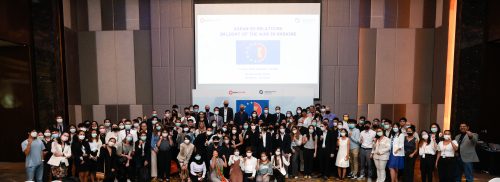
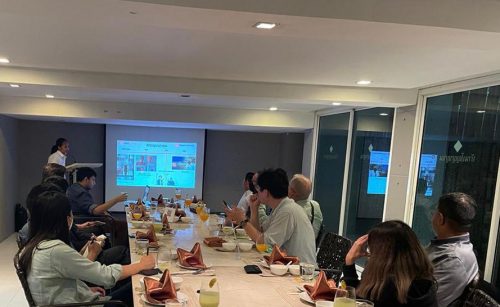
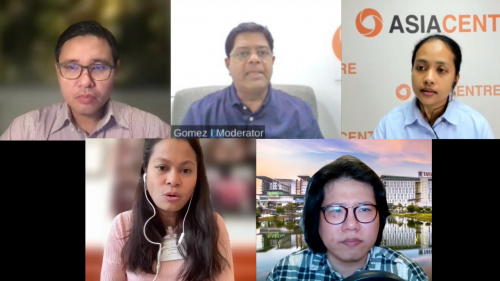
Increased internet use by Thai citizens for political expression and mobilisation gave rise to the implementation in 2007 and the later amendment in 2017 of the Computer Crime Act (CCA). In the name of national security and public order, the Act has been used to prosecute internet users placing their digital rights at risk. Asia Centre’s Researcher Korbkusol Neelapaichit made these opening remarks during the report launch of “Thailand’s Computer Crime Act: Restricting Digital Rights, Silencing Online Critic”, jointly published with EngageMedia and supported by The International Center for Not-for-Profit Law (ICNL). Korbukusol then went on to highlight the key concerns around the Act. First, the CCA contains vague and broad language without clear definitions that is open for arbitrary interpretation. Second, it gives sweeping powers to officials, who are appointed by the Minister, without transparent procedures and judicial scrutiny for the use of powers under the Act. Third, the CCA penalises internet service providers (ISPs) and technology companies even if they are not the content producers. Fourth, the Act does not provide a mechanism for protecting privacy. There is no guarantee that how traffic data kept by ISPs or accessed by the officials will be used or scoped. Fifth, some offences under the Act overlap with offences under the Penal Code. Therefore, the CCA has been used to increase punishment or impose harsher penalties against offenders. Sixth, there is a lack of public awareness on the implications of the CCA. The public do not know how seriously the CCA violates their fundamental rights. As a result, the CCA has continuously been criticised for its disproportionate use to criminalise individuals and silence political dissent. Asia Centre’s analysis forecasts that the digital rights situation in Thailand is likely to worsen if the proposed CCA amendment by the Ministry of Digital Economy and Society (MDES) to introduce a single internet gateway is realised. This announcement has raised concern that freedom of expression, especially of independent media, journalists and human rights activists will be at risk. The report launch was attended by over 25 people that included representatives from diplomatic missions, development aid agencies, the media, respondents interviewed for the report and staff from Engage Media and Asia Centre. Read the full report here. The Thai version can be found here. You can also watch a TikTok video of the report launch event here.
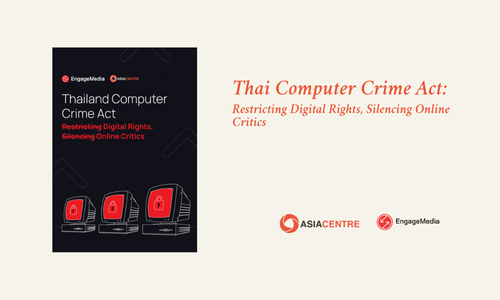
Thailand Computer Crime Act: Restricting Digital Rights, Silencing Online Critics

Download Full Report Download (in Thai) Thailand Computer Crime Act: Restricting Digital Rights, Silencing Online Critics reviews the provisions of the 2007 Computer Crime Act (CCA) and its 2017 amendment, as well as their impact on digital rights in Thailand. Containing harsh penalties and vaguely-worded provisions subject to extensive interpretation by authorities, the CCA removes critical content from the internet, harasses and prosecutes those who speak out and puts pressure on ISPs and tech companies to carry out orders. Instead, the report recommends that the Thai government review and amend rights-infringing sections of the CCA and ensure they comply with international human rights standards. Tech companies and local CSOs must also maintain a firm stance on safeguarding freedom of expression online.
Dr. Gomez in Doha: “Harmony laws” foster hate against minorities

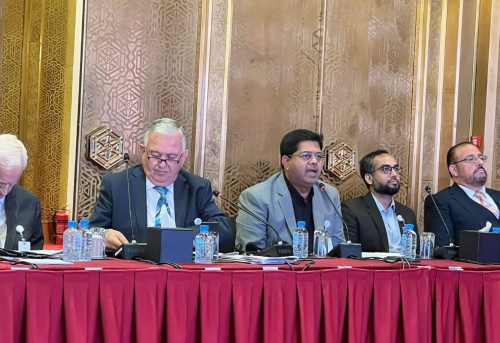
“Harmony laws”, while well-intentioned, their implementation has inevitably led to the spread of hate speech directed at minorities in Southeast Asia. This is primarily due to the use of these laws against ethnic-religious minorities and those seen as a threat to the majority group. This was the finding that Asia Centre’s Regional Director, Dr.James Gomez, highlighted in his keynote speech delivered at the 14th Doha Interfaith Conference titled “Religion and Hate Speech: Between Scriptures and Practice” which took place on 24-25 May 2022 in Doha, Qatar. His speech, based on his conference paper, titled “Legislating Hate Speech in Southeast Asia: Impacts and Recommendations” (read here) was drawn from two of Asia Centre reports: Hate speech in Southeast Asia, New forms, Old Rules and Harmony Laws in Southeast Asia: Majority Dominance, Minority Repression. Dr. James Gomez was one of several keynote speakers invited by the Doha International Center for Interfaith Dialogue (DICID), a Qatar-based institution founded in 2007. DICID encourages and supports dialogue between religions and peaceful coexistence among adherents of different religions. This is the second occasion that Asia Centre’s Dr. James Gomez was a speaker at a DICID event. He spoke in October 2021 at a virtual symposium titled “Interfaith Dialogue on Conflict Transformation: towards a Paradigm of Change”. The symposium, held in partnership with the Nordic Center for Conflict Transformation, heard Dr Gomez provide an overview of “harmony laws” discriminating against ethnic-religious minorities in Southeast Asia. The 2022 DICID conference also provided Asia Centre’s Dr. James Gomez the added opportunity to meet and discuss future collaboration with Nordic Center for Conflict Transformation’s Noufal Abboud as noted in their March 2022 Memorandum of Understanding, which the two organisations signed to partner on activities and projects between the Middle East and Southeast Asia regions. Hence, on 26 May 2022, both Dr. James Gomez and Mr.Noufal met with Dr. Ghassan Elkahlout, Assistant Professor and Head of Conflict Management and Humanitarian Work, and other representatives of the Center for Conflict and Humanitarian Studies at the Doha Institute for Graduate Studies. They discussed possible collaborations between the institutions. Separately, Dr. James Gomez was also able to meet with Keneshbek Sainazarov, Director of Asia, Search for Common Ground to discuss a research project on Freedom of Religion or Belief in Southeast Asia. While, Mr. Noufal Abboud, met with Dr. Moataz El Fegiery of the Human Rights Program of the Doha Institute for Graduate Studies, to discuss collaboration possibilities. With Doha, Qatar being based in the Middle East and straddling both Asia and Europe, Asia Centre hopes to deepen its engagement with Doha-based institutions moving forward.
Electoral Reforms Can Ensure Multiparty Democracy In Southeast Asia
A range of electoral reforms are needed if multiparty democracy is to take root in Southeast Asia. Reforms related to electoral laws, the media, independence of election management boards and the voting age formed the broad suite of ideas that emerged from speakers of the parallel session “Multiparty Democracy in Southeast Asia” during the 2022 Gwangju Democracy Forum convened by Asia Centre. Co-convened with the May 18 Foundation – a South Korean organisation founded in commemoration of the May 18 Uprising – the 19 May 2022 online event was as part of the Gwangju Democracy Forum, an annual international conference held by the Foundation. This is the second occasion where Asia Centre has co-convened a panel during the Gwangju Democracy Forum. It first convened a panel in 2021, entitled “Freedom of Expression and Democracy in Asia”. Watch the 2021 panel discussion here. You can also read the article titled “Freedom of Expression A Fundamental Right” here. In his opening remarks and introduction of the panel, Dr James Gomez, Regional Director of Asia Centre said the key question to address is whether electoral systems in the region are a force for democracy or a force for authoritarian consolidation. For Southeast Asia, despite the plethora of elections at multiple levels, there is an increasing tendency that they end up with illiberal outcomes. Executive Director of the Council of Asian Liberals and Democrats (CALD) Celito Arlegue discussed the result of the Philippines presidential election in 2022, following Bongbong Marcos’s victory. He noted Bongbong’s social media image revamp that had contributed to his electoral win. The election result underlines the weakening of political parties as independent institutions in favour of established political dynasties in the Philippines. Korbkusol Neelapaichit, a Research Coordinator at Asia Centre, updated on the Bangkok governor’s election and its implication for the upcoming general election. She highlighted that while women voters outnumber men voters, women candidates are underrepresented for the election as there are only 6 of them out of 31 candidates. She also pointed out that women candidates, especially in the South, have been facing gendered attacks. She predicts that this bias towards women has the risk of repeating itself at the national elections. Speaking from the Cambodian perspective, Sokunthea Chhan, Media Development Director of the Cambodian Center for Independent Media (CCIM), focused on the media’s role in the upcoming commune elections scheduled for 5 June 2022. She emphasised the important role of independent media in helping political parties voice and broadcast their opinion. However, in the run-up to the communal elections, there continue to be restrictions on the activity of independent media. Senior Lecturer at the School of Media and Communication, Taylor’s University in Malaysia, Dr. Benjamin Loh Yew Hoong, discussed the introduction of youth voters (aged 18-21) into the Malaysian election system. Due to the lack of media literacy, he said youth risk being susceptible to disinformation during elections. He voiced his concerns that disinformation could herald the possible return of disgraced elites – naively well received by the youth – to power. The panel discussion served as an important launching pad for Asia Centre 8th International Conference scheduled for 23 to 25 August 2023 titled “Democracy And Elections in Asia”. In his closing remarks, Dr. Gomez announced the issue of multiparty democracy is a theme, the Centre will track over the next couple of years. Please stay tuned for Asia Centre’s International Conference on Multiparty Democracy In Asia in 2023. Meanwhile, see the update for the Centre’s 7th International Conference: Freedom of Expression in Asia, to be held on 24-26 August 2022. Visit the Facebook events page for the Conference here.
Asia Centre’s Steps Up its Engagement in Geneva

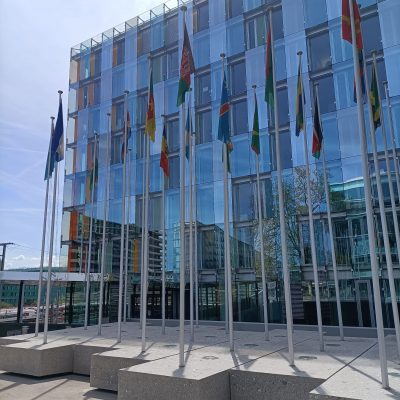
Giving effect to its 5-year strategic plan to 2027, to step up its engagement with UN human rights mechanisms and international organisations, Asia Centre undertook an outreach mission to Geneva, Switzerland during April 2022. This mission stems from the Centre’s continuous growth over the past seven years which has seen it achieve the following: Recognition as a research institute in the regional and Thai landscape on democracy, rights and geopolitical issues, Establishment of a branch in Malaysia, Production of seminal, policy-oriented knowledge products on democracy and human rights in the region, Building networks across the region on critical issues (business and human rights, freedom of expression, freedom of religion or belief and human rights mechanisms), Engaging in policy oriented advocacy aimed at achieving progressive social impact, Participating in policy processes that promote human rights through civil society and parliamentary networks in Southeast Asia and in research networks in South Asia, and Advising Thai-based foreign embassies on regional affairs. Similar missions were undertaken by Asia Centre to Australia, China, Japan, New Zealand, South Korea, Taiwan, India and the United States between 2015 and 2022. A forthcoming mission to Canada will take forward such strategic outreach. Spearheaded by Dr. Robin Ramcharan, the Centre’s mission to Geneva from 7 to 22 April followed a similar mission in 2020, prior to the pandemic. On this occasion, the Centre secured its access to the Geneva International and to UN premises. It also explored collaboration with think tanks and IOs in Geneva. Building on existing relationships and work the UN mechanisms and civil society organisations in Southeast Asia, it seeks to take its advocacy to a higher plane through the establishment of a representation office in Geneva and building coalitions with like-minded think-tanks and CSOs. Dr. Ramcharan discussed the Centre’s work and strategy with Ambassador Salman Bal, who heads the Geneva International, a platform that services major international organisations and NGOs in Geneva. This was undertaken with a view to setting up a representation office. The Centre therefore filed its registration papers with the Centre d’Acceuil de la Genève International (CAGI), or Geneva Welcome Centre. This step signifies clearly the Centre’s intention to step up its human rights dialogue with stakeholders from the regional level to the international level, to contribute to upholding universal human rights norms and to realizing progressive change at the ground level. Dr. Ramcharan also met with a number of organisations and think tanks, including the Geneva Human Rights Platform of the Geneva Academy for International Humanitarian Law and Human Rights. He and Mr. Domenico Zipoli of the Platform explored collaboration on projects aimed at increasing the compliance of states with their obligations to human rights treaty bodies. He also explored potential collaboration on rule of law and justice issues with Mr. Marc Cassayre, Permanent Representative in Geneva of the Rome-based International Development Law Organisation (IDLO). Both the Centre and IDLO share common interests in a producing knowledge tools on key justice issues. He informed other Geneva-based institutions about the work of the Centre, including the World Intellectual Property Organisation (WIPO). Mr. Tshimanga Kongolo of the WIPO Academy was apprised of the work of the Centre. The WIPO engages on global issues connected to intellectual property rights such as the traditional knowledge of indigenous peoples, the right to health and the right to a clean environment. This outreach, builds on Asia Centre’s prior engagement with Geneva-based organisations in February 2020.
Disinformation Winner of 2022 Philippines Presidential Election
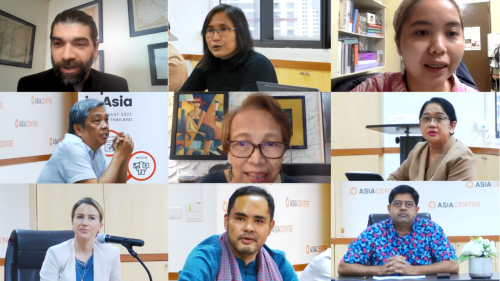
Disinformation, and lots over it over social media, was the predicted winner of the 2022 Philippines Presidential Elections. This was the sentiment of speakers and respondents as well as the results of 2 online polls on 3 May 2022 during an event to commemorate World Press Freedom Day. Entitled, “2022 Philippines Presidential Election: Fake Accounts, Bots, and Trolls”, Asia Centre, in collaboration with the Friedrich Naumann Foundation for Freedom Southeast and East Asia convened a roundtable discussion to assess the impact of social media on mainstream media and election campaigning. (Watch the TikTok here, the event video here, and see event photos here) Officiated by Vanessa Steinmetz, the regional project coordinator at the Friedrich Naumann Foundation for Freedom Southeast and East Asia, and Dr. James Gomez, regional director of Asia Centre, the event welcomed the speakers, reactors, and participants to examine how social media platforms were impacting the election campaign. Setting the stage, Marites Vitug, editor-at-large at Rappler, said disinformation over social media has been used by the lead presidential candidate Ferdinand “Bongbong” Marcos Jr. and his supporters since the 2016 vice-presidential election to positively branding of Bongbong, while negatively affecting his rival Leni Robredo. Krixia Subingsubing, journalist from Philippine Daily Inquirer, expanded the analysis by pointing out that trolls and bots are part of a larger disinformation machinery that includes influencers, celebrities, and even government agencies that are working together to manipulate the public opinion or media outlets by using misleading content. Greg Kehailia, country director of Internews Philippines, explained that since 2016, actions have been taken by Filipino stakeholders to combat disinformation, but it has become a huge problem for the 2022 Presidential Election as fake news is more numerous, more tailored, and more widespread. Eunice Barbara of Inquirer.net, pointed out that professional journalists face challenges in debunking disinformation over social media. She said that the fact-based reporting by mainstream media is actually seen as biased by a large swath of the electorate, making it even more difficult to counter disinformation. Reacting to the speakers, Joel Mark Barredo, Executive Director of SHAPE-SEA, said that disinformation is dismantling the democratic infrastructure that has been rebuilt following the ouster of Ferdinand Marcos. He suggested cutting demand for the disinformation “industry” through accountability and critical consciousness of fake news. Dr. Analiza Perez-Amurao, of the Humanities and Language Division at Mahidol University International College, raised questions on the role of social media companies in addressing disinformation. Referring to her background as an educator, she pointed to the importance of media and digital literacy for the youth. Ed Legaspi, Former Executive Director of SEAPA focused on the role of the election commission and rules governing election propaganda in the Philippines. He said to date the role of COMELEC has been poor and late in addressing the problem of disinformation during elections. He recommended that this weakness be addressed for future elections. From the discussion during the event, it was clear that during the 2022 Philippines Presidential Election campaign disinformation has spiked over compared to the 2016 elections. There is a real risk disinformation might become mainstream, and mainstream media sidelined. Fact-checking and media literacy, while important, are proving inadequate in tackling the issue effectively. The event was covered by BenarNews, read ‘Filipino journalists, experts allege online attacks, disinformation from Marcos camp’
Analysing the direction of Thai press freedom on World Press Freedom Day

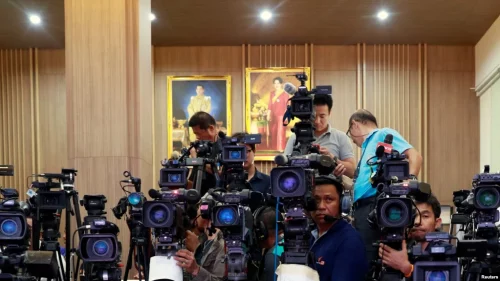
Reporters wait for the general election results in Bangkok, Thailand, March 24, 2019. REUTERS/Soe Zeya Tun Dr. James Gomez, Regional Director of Asia Centre, was interviewed about the state of press freedom in Thailand and Southeast Asia in an article ‘Analysing the Direction of Thai Press Freedom on World Press Freedom Day’ by VOA Thai published on 3 May 2022. Dr. Gomez said the regional trend of governments using laws related to defamation, ‘fake news’, Single Internet Gateway, media ethics – which collectively results in the media self-censoring on critical issues – is similarly being played out in Thailand. Read the full article (in Thai) here.
COVID-19 and Infodemic in Southeast Asia

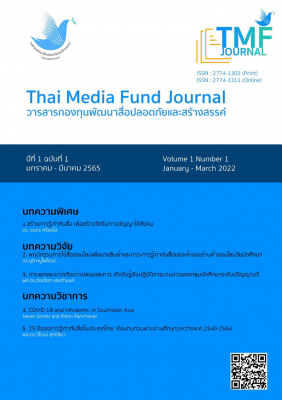
Download Full Report In the academic article “COVID-19 and Infodemic in Southeast Asia” published in the first issue of Thai Media Fund Journal, Dr. James Gomez and Dr. Robin Ramcharan examine COVID-19 related ‘infodemic’ from 2020 to mid-2021. They take stock of how the ‘infodemic’ has adversely disrupted access to accurate public health information in Southeast Asia by and assess existing non-legal measures that have been used in response to the infodemic. Strategies reviewed in the article include: information sharing, fact checking, responses of technology companies, quality journalism and media information literacy (MIL) – each with shortcomings of their own. The situation in the region calls for a concerted effort to develop MIL education as a long-term guarantee against infodemic; while other strategies noted in the article must also be developed to accompany MIL. See other articles (in Thai) in the first issue of TMF’s Journal here.
COVID-19 and Infodemic in Southeast Asia

Download Full Report In the academic article “COVID-19 and Infodemic in Southeast Asia” published in Thai Media Fund Journal, Dr. James Gomez and Dr. Robin Ramcharan examine COVID-19 related ‘infodemic’ from 2020 to mid-2021. They take stock of how the ‘infodemic’ has adversely disrupted access to accurate public health information in Southeast Asia by and assess existing non-legal measures that have been used in response to the infodemic. Strategies reviewed in the article include: information sharing, fact checking, responses of technology companies, quality journalism and media information literacy (MIL) – each with shortcomings of their own. The situation in the region calls for a concerted effort to develop MIL education as a long-term guarantee against infodemic; while other strategies noted in the article must also be developed to accompany MIL.
Journalists Tell of Growing Asian Inequality

An op-ed based on the 2021-2022 Journalism for an Equitable Asia Award, jointly convened by Asia Centre and Oxfam International, was published in Cambodianess on 13 April 2022. The two authors – Dr. James Gomez, Regional Director of the Centre and Mustafa Talpur Asia Regional Advocacy & Campaigns Lead, Oxfam – pointed to the worsening inequality during the COVID-19 pandemic, especially of the marginalised communities across the continent. Called to attention by Dr. Gomez and Talpur are journalists working to shed a light on these realities, who require support and encouragement. Read the piece here.