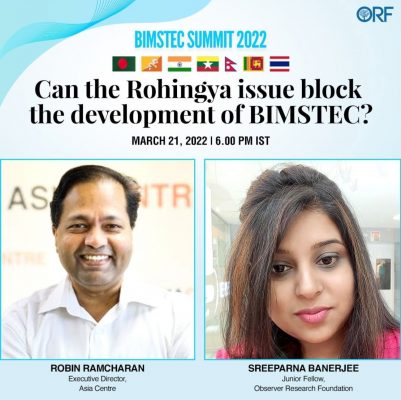
Can the Rohingya issue block the development of BIMSTEC?

Dr. Robin Ramcharan, Executive Director of Asia Centre, was interviewed by Sreeparna Banerjee from the Observer Research Foundation on 21 March 2022. Dr. Ramcharan discussed the current state of Rohingyas and displaced communities in Myanmar. Stating that BIMSTEC members should consider value connectivity and humanitarian aid, Dr. Ramcharan mentions that members should also aim to achieve Sustainable Development Goal pledges. To help alleviate the suffering of Rohingyas, Dr. Ramcharan suggests that BIMSTEC should support each other financially and politically. Watch the interview here.
Journalists’ Freedoms Can Be Re-Ignited

On 22 March 2022, 2021-22 Journalism for an Equitable Asia Award prize winner Phoung Vantha from Cambodianess spoke to Dr. James Gomez, Regional Director, Asia Centre, about the Centre’s latest report Media Freedoms in Southeast Asia: Repeal Restrictive Laws, Strengthen Quality Journalism. The discussion was on the situation of media freedoms in Cambodia and what a roadmap for media development should look like. Read the article here.
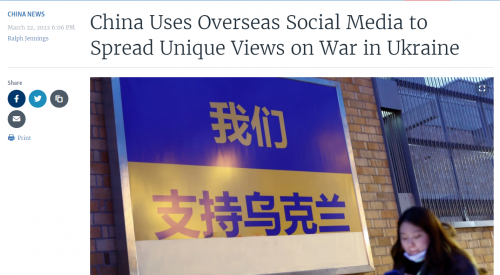
China Uses Overseas Social Media to Spread Unique Views on War in Ukraine

On 22 March 2022, Dr. James Gomez, Regional Director of Asia Centre, was interviewed for an article ‘China Uses Overseas Social Media to Spread Unique Views on War in Ukraine’ by Ralph Jennings of VOA News. He commented on the use of advertisements by Chinese state-controlled media and recommends that the placer of the ads (who are not necessarily government agencies themselves) should be identified and traced back to the CCP. Read the article here.
Strengthening Quality Journalism to Fight Online Disinformation

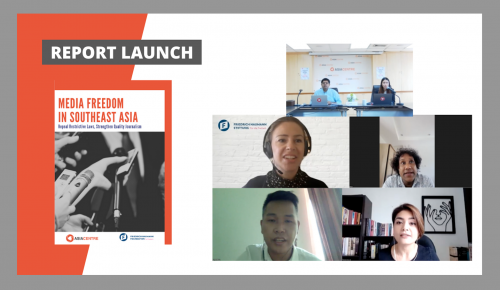
As the majority of news production and consumption shifts to social media so has government control. “Media Freedom in Southeast Asia: Repeal Restrictive Laws, Strengthen Quality Journalism,” outlines how fake news legislation is used to silence media organisations and journalists who produce and disseminate critical content online. Launched by Asia Centre and the Friedrich Naumann’s Foundation on 15 March 2022, the report recommends that governments focus on strengthening media organisations rather than silencing them. Through these efforts journalists can counterbalance online disinformation through verified information and quality journalism. Tech companies can help by not feeding hate and using algorithms to spread fake news. Discussing the impact digitalisation has on journalists, Vanessa Steinmetz, Regional Project Coordinator of the Friedrich Naumann Foundation, began the report launch by explaining how online disinformation makes it hard for journalists to express freely. She believes the report is a starting point of a bigger discussion to overcome problems for journalists to work in more free conditions. Explaining different types of disinformation, Dr. James Gomez, Regional Director of Asia Centre, explained that governments are using anti-fake news laws to punish media organisations and journalists who critically call out bad government policies. He shared statistics, such as increasing Press Freedom Censorship scores and dropping Internet Freedom rankings across Southeast Asia to drive home the message. Pointing to the need for civil society and awareness organisations to lead the charge for media freedom, Tehmina Kaoosji, an Independent Broadcast Journalist, said that all of the report outcomes resonate deeply with the type of actions around media restrictions. She explained how the collapse of the democratically elected government early in the pandemic in Malaysia resulted in the increase of anti-fake news laws and restrictions for media broadcasters and journalists. Nipuna Kumbalathara, Communications Expert at EarthRights, highlighted the oxymoron of how national security is used as an excuse to repress media freedoms and freedom of expression. Instead of repressing the media and activism, he suggested governments should invest in encouraging free and open discussions around issues such as political corruption and the climate crisis. He stressed the need for future discussions on how to involve people beyond civil society organisations in these discussions. Stating the report is essential in highlighting key issues of media and press freedoms, Sao Phal Niseiy, Editor in Chief of Cambodianess, pointed out the importance of fighting the decline of quality journalism and ensuring that rights and freedoms of journalists are not taken away. He said a broader discussion on how to tackle media freedom challenges and make a better future for journalists is needed. The report launch was concluded by Nalinrat Tingoum, Programme Coordinator of Asia Centre by highlighting that the report is available for download on the website. Asia Centre and the Friedrich Naumann Foundation will begin the promotion of their report through social media posts, podcasts, infographics and videos. Stay tuned to our social media for the updates. Watch the report launch here. Download the report here.
Asia Centre and Indonesian Parliament’s Expert Agency Sign MoU
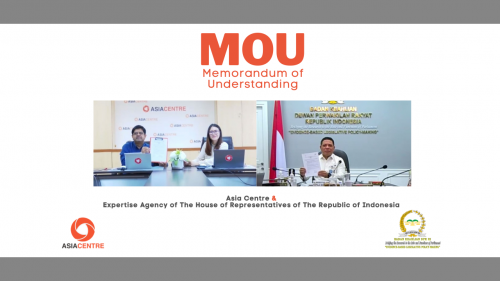
On 14 March 2022, Asia Centre and The Expertise Agency of The House of Representatives of The Republic of Indonesia signed a 5 year Memorandum of Understanding (MoU). Through the MoU, both organisations pledges to jointly undertake the publishing of research outputs, execute teaching and training programmes, develop course outlines and materials, and support each other to promote joint activities. Built off of a few years of engagement between the two organisations, the MoU formalises the path for future collaborations and joint projects. The Expertise Agency first participated in Asia Centre’s 3rd International Conference on Businesses in Human Rights in 2018 through the discussion of building synergies with other national state institutions on human rights, and later attended Asia Centre’s 6th Conference in September 2021 as a panel partner. In February 2021, Asia Centre’s Dr. James Gomez and Nikula Evanty conducted an online training for the Agency’s staff on drafting policy papers for legislative agendas. The MOU ceremony was conducted over Zoom and attended by representatives of Asia Centre and The Expertise Agency. Welcome remarks were made by Dr. Inosentius Samsul, Head of the Expertise Agency of The Indonesian House of Representatives and Dr. James Gomez, Regional Director of Asia Centre. Dr. Samsul explained how Asia Centre’s international conferences would encourage “officials here to get along on an international scale,” and would help Indonesia capture developing international issues. Dr. Gomez reminded all present that the MoU was built on an ongoing relationship of a few years, and solidifies the long term partnership. Nukila Evanty, an Advisory Board Member of Asia Centre, suggested collaborations on developing research outputs and training programmes to further talks on global issues. Agus Wijayanto of Westminster Foundation for Democracy (WFD) mentioned the opportunity for future discussions on democracy and freedom of expression. Focusing on collaborations on the issue of business and human rights, Dr. Robin Ramcharan, Executive Director of Asia Centre, congratulated the two organisations on their official partnership. The ceremony was widely reported on The Expertise Agency’s social media and website, highlighting the importance of the MoU. The Expertise Agency will be a panel partner in Asia Centre’s 7th International Conference on Freedom of Expression in Asia on 24-26 August 2022. Apart from the Conference, the two parties will explore other partnerships moving forward. Stay tuned for future work and collaborations between Asia Centre and The Expertise Agency of The House of Representatives of The Republic of Indonesia. Sign up for Asia Centre’s 7th International Conference on Freedom of Expression here.
China Dictates Messaging About What’s Happening in Ukraine

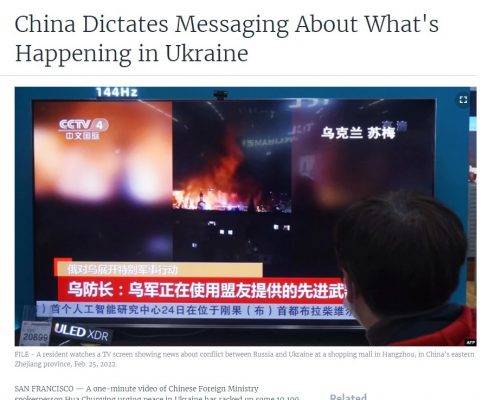
On 7 March 2022, Dr. James Gomez, Regional Director of Asia Centre, was interviewed for an article ‘China Dictates Messaging About What’s Happening in Ukraine’ by VOA News. He commented on how the CCP have been controlling the narrative of the Ukrainian crisis. Read the article here.
Continued Unemployment Furthers Inequality

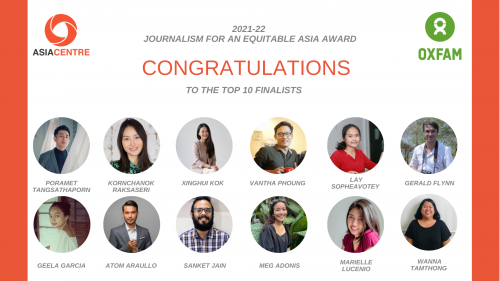
The second year of the COVID-19 pandemic pushed the world into further unemployment and inequality. Reporting under the theme, ‘Inequality – Threat to Lives and Livelihoods,’ the journalists discussed how disadvantaged communities such as women, ethnic groups, religious and gender minorities, migrant and informal workers found themselves languishing in unemployment as a result of the pandemic. The journalists’ articles were shared during the 2021-22 Journalism for an Equitable Asia Award. Watch the event here. The top 10 finalists from Asia wrote about how COVID-19 impacted the lives and livelihoods of disadvantaged groups. These groups included minorities such as women, ethnic, gender and religious minorities, and migrant and informal workers. Lockdowns, unequal access to vaccines, and a greater risk of illness and death forced vulnerable groups into poverty and created greater inequality in Asia. Disadvantaged groups have difficulty adapting to the outcomes of the pandemic. With many living in close quarters, it is hard to quarantine and social distance. While wealthy elites are able to afford private healthcare, minorities have limited access to basic health care, soap, and clean water. These disadvantaged groups face discrimination that further prevent them from accessing health services. Vaccine inequality has led to some minorities still waiting to receive a vaccine, which ultimately slows down pandemic recovery of Asian countries. In its third year, the Award received over 150 nominations filed by journalists based in Bangladesh, Cambodia, India, Indonesia, Malaysia, Myanmar, Nepal, Pakistan, Philippines, Singapore, Thailand, and Vietnam. The award is to recognise journalists whose articles highlight the issue of inequality among disadvantaged groups against the backdrop of the COVID-19 pandemic in Asia. John Samuel, Regional Director in Asia, Oxfam in Asia, in his opening remark, recognized and appreciated the efforts of journalists to fight inequality and injustice. He described how the pandemic exacerbated inequality and injustice in Asia and globally, noting that 148 million people worldwide went into poverty. He discussed the importance of journalists writing for an equitable Asia in unprecedented times over the past two years through increasing poverty, inequality, authoritarianism, and crony journalism. He commented on the courageousness of journalists for standing up for an equitable Asia, and stated that he stands with them. Dr. James Gomez, Regional Director, Asia Centre, in his opening remarks Dr. James Gomez, Regional Director, Asia Centre, in his opening remarks said that re-employment post COVID-19 would be key to Asia’s vulnerable communities somewhat halting the ever increasing inequality gap. The hard part would be after that, trying to close the income gap. Hence, as countries declare themselves endemic, they should also be announcing measures to support these vulnerable communities to get back on their feet and address the widening inequality in the community. The top 3 prize winners and top 10 journalists received certificates. The top three prize winners received $US 1,000 (1st Prize), $US 750 (2nd Prize), and $US 500 (3rd Prize) respectively. The top 11 to 15 finalists were given merit awards. The top 10 finalists of this year were announced by the Master of the Ceremony Nalinrat Tingoum. The finalists were: Kok Xinghui from Singapore with her article, “Coronavirus: why vaccine inequality in Asia threatens the world’s recovery, Meg Adonis from the Philippines with her article, “Yet another challenging year for public school teachers,” Poramet Tangsathaporn and Kornchanok Raksaseri from Thailand with their article, “Patpong ‘on its last legs‘,” Lay Sopheavotey from Cambodia with her article, “Trade Unions: Women Workers Need Support During Pregnancy and Postpartum,” Sanket Jain from India with his article, “Covid 19 and The Desperate Lives of India’s Sugarcane Workers,” Wanna Tamthong from Thailand with her article, “How to Make a Killing: Overpriced Covid-19 Tests for migrant labourers,” and Geela Garcia from the Philippines with her article, “Who peels your garlic: Inside Manila’s informal economy.” Shiza Malik announced the top three winners of the Journalism for an Equitable Asia Award. Atom Araullo from the Philippines won the first prize for his article, “The Hunger Pandemic.” The article explains how the COVID-19 pandemic has contributed to increasing hunger and food insecurity in the area of Manila, the nation’s capital. Araullo begins by writing about the stories of those who rely on pagpag, which are food scraps, to feed themselves. Lockdowns have led to high unemployment rates and an increasing struggle for those in impoverished communities to feed themselves and their families. Government cash aid in response to the pandemic was not enough to help these vulnerable groups. Araullo discusses the works of international non-governmental organisations and Filipino citizens to try and aid the fight against poverty and hunger throughout the pandemic. Marielle Lucieno from the Philippines secured the second prize for her article, “The gold trap: COVID-19 is pushing more Filipino children into hazardous work.” The COVID-19 pandemic has reversed efforts to eliminate child labour made by the government and non-government organisations. Lucieno writes about children in the village of Malaya, who were freed from child labour in 2017, but many children were forced back into work during the pandemic to help their struggling families. The Philippine government had committed to remove 2 million children from child labour by 2022 and end child labour by 2025, but COVID-19 will prevent the attainment of these goals. Vantha Phoung, Lay Sopheavotey and Gerald Flynn from Cambodia obtained the third prize for their article, “Locked Down and Out of Work: Desperation Sets in among Garment Workers.” Inequalities that garment workers face such as unequal access to sanitation services and clean water led to many COVID-19 outbreaks in factories. The writers describe how garment factory owners did not have any obligation to provide support to their employees during the COVID-19 lockdown. Many factories refused to pay their workers severance pay, resulting in garment workers facing poverty and debt throughout the pandemic. The writers acknowledged that NGOs, CSOs and unions called on the government to introduce a social protection system to protect garment workers from further wage stealing and inequalities. Shiza Malik, Regional Communications and Media Lead in Asia of Oxfam International, announced the top 5 merit
Asia Centre and Oxfam Announce 2021-22 Journalism Award Finalists

Asia Centre and Oxfam in Asia are pleased to announce the finalists for the 2021-22 Journalism For an Equitable Asia Award. The Award recognises the work of journalists who wrote on the threat of inequality to the lives and livelihoods of disadvantaged groups including women, ethnic, religious and gender minorities, and migrant and informal workers. The Journalism for an Equitable Asia Award aims to not only recognize these journalists, but also to encourage more journalists to write for a fairer Asia. Here are the finalists: Miss Meg Adonis is a 25-year-old writer in the Philippines. She was a journalist for the Philippine Daily Inquirer, the country’s largest newspaper, where she told the stories of education stakeholders bearing the brunt of the Philippines’ haphazardly implemented remote learning setup. Seeking justice for their plight, she spoke to overworked yet underpaid public school teachers, burnt out students, and professionals whose months-long work for the government remain uncompensated. Her stories helped bring the public’s attention to the country’s learning crisis and seek accountability from the government. Read her article: “Yet another challenging year for public school teachers” here. Mr. Vantha Phoung and Ms. Lay Sopheavotey are journalists working at Thmey Thmey News. Mr. Vantha has covered social issues, human rights and the environment, including impacts on health, climate change solutions and illegal logging. Ms. Sopheavotey has covered issues on social protection, workers’ rights, human trafficking among others. Mr. Gerald Flynn is a freelance journalist based in Phnom Penh, where he produces in-depth stories exploring Cambodia’s social, political and environmental issues for local, regional and international outlets. The three journalists have collaborated to write an article. Read their article: “Locked Down and Out of Work: Desperation Sets in among Garment Workers” here. Miss Xinghui Kok is a senior reporter at the South China Morning Post. She works on the Asia desk and is based in Singapore, from which she closely monitors and reports on developments in the city-state and the surrounding region. Xinghui works across beats, from politics, macroeconomics and business, to health and social issues. She worked for local papers in Singapore before joining the Post in 2020. Read her article: “Coronavirus: why vaccine inequality in Asia threatens the world’s recovery” here. Miss Geela Garcia is a freelance multimedia journalist and peasant advocate based in Manila, Philippines. Her photographic work focused on inclusive development, documents stories of women, food sovereignty, and the environment, with the aim to write history from the experience of its makers. Her writing and photography appear on South China Morning Post, Philstar, Bulatlat, Thomson Reuters Foundation, and Rappler among others. Read her article: “Who peels your garlic: Inside Manila’s informal economy” here. Ms. Lay Sopheavotey is a political student. Her passion for democracy, human rights and social work led her to become a journalist. Since 2019, she has started working as a young female journalist at Thmey Thmey. She has been covering issues such as social protection, workers’ rights, and human trafficking among others for more than two years. Gradually, she sees social issues in more detail and more importantly, citizens who need social protection. To build awareness on social protection for citizens, she decided to write in detail about citizens’ challenges and needs. Therefore, her article focuses on informal workers, union leaders, and vulnerable women and children. Read her article: “Trade Unions: Women Workers Need Support During Pregnancy and Postpartum” here. Mr. Sanket Jain is an award-winning independent journalist and a documentary photographer based in India’s Maharashtra state, and a Senior Fellow at People’s Archive of Rural India, where he is documenting vanishing livelihoods and dying art forms from rural India. His work has been featured in more than 30 national and international publications. Sanket, who spends most of his time in the countryside, has been extensively reporting on the transition rural India is undergoing through the lived experiences of everyday people. You can read his stories at www.sanketjain.in Read his article: “Covid 19 and The Desperate Lives of India’s Sugarcane Workers” here. Mr. Poramet Tangsathaporn is a new journalist from Bangkok Post with one year experience in journalism. He is passionate in fighting for human rights for the marginalised in Thailand, especially the LGBTQ+ community, sex workers, PHIV, women, drug users and working class, by writing to reveal how they are being neglected or subordinated in societal and national level and point out solutions. The purpose of these writings aims to ignite social change and policy change to improve their lives at a national level and ultimately, at a global level. His goal in his journalism career since day one is, “to make the unheard heard.” Ms. Kornchanok Raksaseri is a Thai journalist who has covered almost every field from business and lifestyle to politics and social issues. She was a Political Editor for The Nation, Assistant Managing Editor for Econ News and Deputy News Editor for Bangkok Post. Now she works with Zero Covid Thailand as a content provider and campaigner aiming to eliminate COVID-19 from her country. The two journalists have collaborated to write an article. Read their article: “Patpong ‘on its last legs’” here. Mr. Atom Araullo is a journalist and documentary filmmaker. He currently hosts GMA Network’s “The Atom Araullo Specials” and “I-Witness.” He also anchors State of the Nation, a nightly newscast on GTV. Araullo’s work revolves around disaster reporting, climate change, conservation, conflict, and social issues. In 2017, he co-founded FYT, an independent media organization that promotes community and explanatory journalism. He previously worked as an anchor and reporter of ABS-CBN News. Araullo is also the National Goodwill Ambassador for UNHCR, the UN Refugee Agency. He earned a degree in Applied Physics at the University of the Philippines. Read his article: “The Hunger Pandemic” here. Ms. Wanna Tamthong (Tan) is a journalist of Prachatai, an independent newspaper in Thailand. A former law student turned journalist who came up with a number of questions on what is going on in her hometown, the quality of life, women rights, migrant labours, youth, democracy, and the future
Harrowing tale of a disappeared

On 4 February 2022, Dr. James Gomez’s book review piece on “Silencing Of A Laotian Son – The Life, Work And Enforced Disappearance Of Sombath Somphone” is published in the Bangkok Post. Reviewed by a fellow Singaporean, the book by Somphone’s Singaporean wife, Ng Shui Meng, is a record of her husband’s kidnapping and struggles against injustice. The book proves yet again the prevalence of enforced disappearances, especially in Southeast Asia, and the unimaginable fate that victims face. It signals that actions are needed to prevent enforced disappearances, to hold the perpetrators to account, and to seek justice for the victims and families. Read the book review here.
A Very Long Resistance in Myanmar?

Dr. James Gomez, Regional Director of Asia Centre, was interviewed in a podcast “A Very Long Resistance in Myanmar?” by BFM Radio on 7 February 2022. It has been a year since the coup in Myanmar, and since then, public protests have persisted. Dr. Gomez discussed the political unrest in the country and give his opinion on whether the unrest will develop into a civil war. Listen to the podcast here.