Asia Centre Delivers Digital Literacy to over 100 Master Trainers

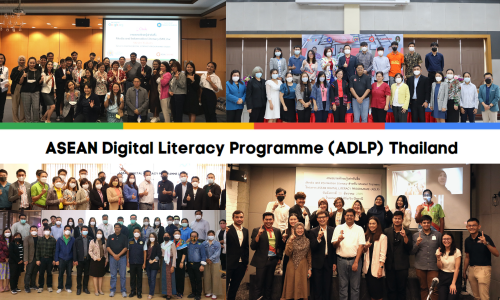
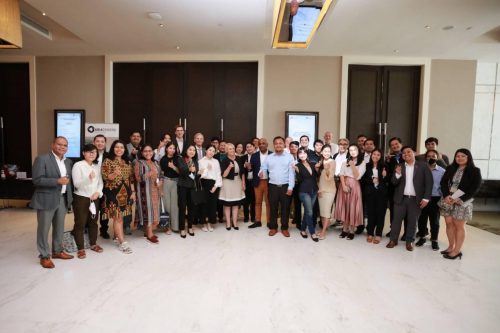
In December 2022, Asia Centre successfully delivered 5 training sessions to over 100 Master Trainers in Thailand. The thrust of the training involved helping Thai participants to go beyond click-bait disinformation, recognise other types of disinformation that encompass hate speech, political and state-sponsored fake news and use the appropriate tools (fact-checking, quality journalism, media literacy and ethics) to deal with them. To this end, Asia Centre, in collaboration with ASEAN Foundation and with support from Google.org, formed a consortium with Uttaradit Rajabhat University, Rajamangala University of Technology Suvarnabhumi, Prince of Songkla University, Maejo University, and Chulalongkorn University to deliver the “ASEAN Digital Literacy Programme (ASEANDLP). The Programme is part of a region-wide effort to produce capable trainers who can raise awareness and take action against disinformation and fake news. The first training (see TikTok and Photo Album) kicked off on 9 December 2022 at Uttaradit Rajabhat University in Uttaradit province in northern Thailand, joined by 23 participants that included academic staff of the university, teachers from neighbouring primary and secondary schools, government officers from provincials public health office and Uttaradit Shelter for Children and Families under the Ministry of Social Development and Human Security and youth leaders. The following week on 12 December 2022, the second training session (see TikTok and Photo Album) was held at Rajamangala University of Technology Suvarnabhumi(RUS) and attended by 24 participants from the institute of research and development, department of student affairs and various faculties, including agricultural, education, engineering and architecture, liberal arts and science and technology. Few were based in Rajamangala University of Technology’s other nearby campuses, such as Wasukri, Suphanburi and Nonthaburi. The overview of the training was also reported in the news section of RUS’ official website. The trainings picked up pace from 20 December when the third training session (see TikTok and Photo Album) was convened by Prince of Songkla University (PSU) (Pattani). Comprised of 18 people, 15 onsite and 3 online participants from Phatthalung and Narathiwat provinces. They included lecturers, primary school teachers and heads of student organisations and heralded largely from PSU’s Faculty of Education and Walailak University. A number of participants were Muslims reflecting the religious demographic of the Thai South. On the next day, on 21 December, the fourth training session with 23 participants (see TikTok and Photo Album) was held at the Central Library of Maejo University (Chiang Mai) and joined by academic staff from the Faculty of Information & Communication, Faculty of Science, Faculty of Fisheries Technology and Aquatic Resources, Faculty of Liberal Arts, and Faculty of Nursing. The training session also attracted academics from Maejo University’s other provincial campuses, such as Maejo University Phrae Campus and Maejo University Chumphon Campus. 22 December was the last MT training session in Thailand, and it was held at Chulalongkorn University (Bangkok) (see TikTok and Photo Album) for 27 participants. Hosted by the Faculty of Communication Arts, apart from its own academic staff, others included participants from other universities and academic institutes in Bangkok and other provinces such as Nakhon Pathom, Nakhon Si Thammarat (Southern Thailand) and Nonthaburi. Rangsit University, Dhurakij Pundit University, Phranakhon Rajabhat University, Nakhon Si Thammarat Rajabhat University, Panyapiwat Institute of Management, Thammasat University, Nakhon Pathom Rajabhat University, Suan Sunandha Rajabhat University, Mahidol University International College, Ramkhamhaeng University. The training also attracts attendees from the governmental Digital Economy Promotion Agency, media sectors such as the Thai Journalists Association and Thai PBS, and the business sector, especially tech companies. With these on-site training sessions completed, the Master Trainers will move on to deliver training for approximately 100 end beneficiaries each to complete the programme and receive their certificate of completion. An outcome of this consortium approach to delivering the training sessions is that Asia Centre and the five universities will sign a joint MoU on 12 January 2023 in Bangkok, Thailand. The aim is to explore further partnerships to undertake joint media literacy and other related activities. If you are interested to collaborate with the Asia Centre or access its expertise in the area of disinformation and media literacy, do email contact@asiacentre.org
Asia Centre and International IDEA Sign MoU

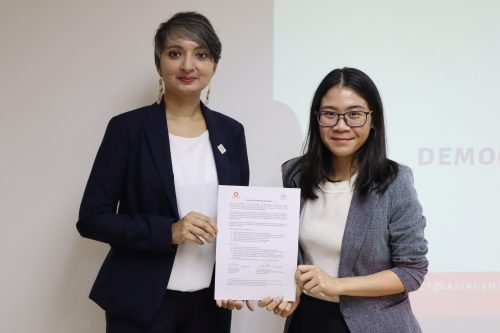
On 8 December 2022, Asia Centre and International IDEA signed a Memorandum of Understanding (MoU). The MoU established a formal partnership between the two organisations and facilitated a specific agreement to be partners for Asia Centre’s International Conference on Democracy and Elections in Asia, to be held in Bangkok, 23-25 August 2023. Click here to learn more about the 8th International Conference. Nalinrat Tingoum, Programme Coordinator of Asia Centre, and Seema Shah, Head of Democracy Assessment Expertise of International IDEA, exchanged the agreement for the two organisations to co-partner for Asia Centre’s 8th International Conference. The “exchange” took place during the 8 December 2022 Asia Centre and International IDEA closed-door consultation on ‘Digital Authoritarianism in Southeast Asia’. The consultation gathered more than 20 participants from diplomatic missions, UN agencies, INGOs, CSOs and new media experts who track digital authoritarianism in the region. Among the issues discussed were the trend towards segregating the internet, the type of digital attacks authoritarian regimes mount on the internet, the weaponisation of internet-related laws against individuals and CSOs and the increasing surveillance of online activities. The consultation members also noted that the issues of digital authoritarianism through the use of internet laws, internet shutdowns, single gateway and state-sponsored disinformation have become more critical in Southeast Asia as the region heads toward elections in 2023 and 2024. One key recommendation was the need to build a coalition of stakeholders from different sectors to devote more effort to keeping the internet as a “free space”. Hence, it was noted as timely that both Asia Centre and International IDEA are partnering for the Centre’s 8th International Conference on Democracy and Elections in Asia, 23-25 August 2023. This partnership was seen as the starting of future collaborations and the expansion to include more partners. One of the activities leading up to the MoU was Asia Centre’s Dr. James Gomez’s participation in the Democracy in Asia and the Pacific 2023 Outlook Forum held by International IDEA and the Association for Elections and Democracy (Perludem) on 5-6 December 2022 in Bali, Indonesia. In the Forum’s Session 5 ‘Disinformation and Media Integrity’, Dr. Gomez delivered a presentation on the rise of disinformation and its relation to the distrust in media. The idea to explore collaboration between the two organisations began when Leena Rikkila Tamang, Director of Asia and the Pacific Programme of International IDEA visited Asia Centre on 7 October 2022 to discuss plans for possible joint projects including baseline studies, seminars and partnering on Asia Centre’s 8th International Conference. International IDEA is Asia Centre’s 2nd title partner to co-convene the 8th International Conference. During the 7th International Conference, Asia Centre signed a co-convening agreement with the Faculty of Political Science and Public Administration, Chiang Mai University. Click here to read the write-up of the MoU with Chiang Mai University. If you would like to collaborate with Asia Centre and sign an MoU, email us at contact@asiacentre.org.
What has changed in the Malaysian media landscape since the 2018 General Election

Andrew Ong is the editor at Malaysiakini, the most read news website in Malaysia. He works on legislation, policy and environment. In his spare time, he explores data and makes automation tools for his colleagues. This podcast episode was recorded on 18 October 2022 as part of the “Media Freedom in Southeast Asia” series hosted by Asia Centre in collaboration with the Friedrich Naumann Foundation for Southeast and East Asia.
Asia Centre Kicks-off Media and Information Literacy (MIL) Trainings in Malaysia

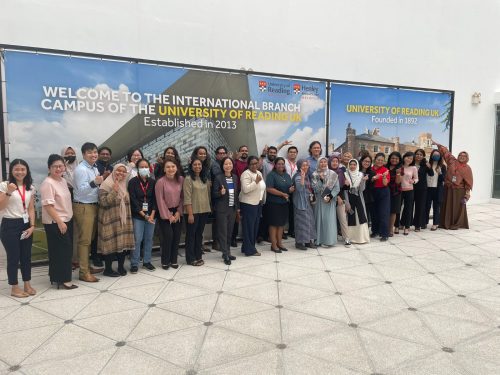
Asia Centre has begun convening Media and Information Literacy (MIL) Trainings for Master Trainers in Malaysia. In collaboration with Google and ASEAN Foundation, these trainings, which make up the “ASEAN Digital Literacy Programme (ADLP)”, seek to build resilience against disinformation among underserved communities in Malaysia. Aiming to train around 200 people, the first training session was held on the 23rd of November 2022 for 32 academic staff of the University of Reading Malaysia (UoRM), followed by another joint session with the International Islamic University of Malaysia (IIUM), UniKL and Taylor’s University Malaysia for its 15 students and lecturers. The training were led by Asia Centre’s regional director Dr James Gomez, who is a communication academic and policy expert and supported by the Centre’s team that included Nalinrat Tingoum, Program Coordinator, Korbkusol Neelapaichit, Research Coordinator and Lina Sakina Salim, Asia Centre Malaysia Coordinator. The Master Training comprises two parts: part 1 constitutes a total of 20 hours of instruction and learning, and part 2 constitutes the delivery of 3 hours of training to 100 end beneficiaries per master trainer. The 20 hours of instruction are delivered both online and on-site; Fourteen hours are online including the prerequisite 3 hours of pre-training readings, 1 hour of pre-evaluation, followed by 5 hours of online self-study, 3 hours session of preparation for EB Training and last 2 hours of evaluation as well as 6 hours of onsite training. The 6 hours on-site allows Master Trainers to acquire insights and skills in tackling disinformation through two instruction sections: Media and Information Literacy Evolving perception of mass media and the rising popularity of social media Malaysia’s statistics on social media presence and usage Advantages and Disadvantages of Internet and Social Media Platforms Types of information disorders, with a special focus on Disinformation Online Safety Types of Disinformation Tactics of Disinformation; algorithms, filter business, coded messaging and deep fakes Ways of Tackling Disinformation The on-site training also includes interactive sessions where participants identify real-life examples of disinformation in Malaysia, examine how such incidents impact the public, assess any weakness in current measures to combat disinformation and propose solutions to improve the situation. During the training, participants from the University of Reading Malaysia, in their interactive sessions, cited examples of the false ‘Melaka Disneyland news’, ‘Poodle and Romance Scams’ and conflicting reports by Astro Awani and CNA regarding the appointment of Anwar Ibrahim as the new Malaysian Prime Minister’. Meanwhile, the joint session between IIUM, UniKL and Taylor’s University cited examples of the Tiktok viral videos circulated during the 15th General Election and false COVID-19 testing methods and reflected upon strategies political parties and their supporters used for campaigning through social media, particularly in reaching out to the younger demographics. The training sessions ended with a briefing on the delivery of End Beneficiaries Training, informing participants of the expected deliverables post-training, mainly to conduct a 3 hours programme for 100 end beneficiaries, consisting of 1 hour Pre-Reading, 1 hour online training and 1 hour post evaluation. Following the two trainings and to pitch more master training sessions, the Asia Centre team visited Tunku Abdul Rahman University of Management and Technology (TAR UMT) and INTI International University & Colleges (Nilai Campus) on 25 November 2022 to discuss potential partnerships for the MIL (ToT) training. TAR UMT has expressed interest in partnering with Asia Centre to provide MIL training for Trainers to its (i) academic staff under the Centre for Continuing and Professional Education (CPE) and (ii) student leaders through the Student Career Development Centre (SCDC). Meanwhile, INTI has indicated its preference to partner with Asia Centre in hosting the MIL training for Trainers for the university campuses within Nilai, Negeri Sembilan, such as the Islamic Science University of Malaysia (USIM) and Manipal International University (MIU). Both institutions have also offered to connect Asia Centre to their respective branches around Malaysia to assist in expanding the outreach. Asia Centre looks forward to delivering more master training sessions in the next few months and supporting these trainers to deliver their End Beneficiaries Training within their communities. If you are personally interested in this training or want to bring this training to your institutions, sign up to indicate your interest here, or visit our Facebook page.
Regional Parliamentary Network on BHR ‘Important’, Say Lawmakers

A regional network where lawmakers and political party representatives could undertake research, coordinate advocacy, exchange best practices and develop capacity among one another will contribute to the duty of the state to protect human rights as set out by the UN Guiding Principles on Business and Human Rights (BHR). This has not yet existed. This was the gap identified by parliamentarians across Southeast and East Asia in the training ‘Business and Human Rights for Parliamentary and Political Party Representatives’ organised by Asia Centre with the support of Friedrich Naumann Foundation (FNF) Southeast and East Asia from 28–30 November 2022. Following through the findings of the book Business and Human Rights in Southeast Asia: Developing National Action Plans (2021) edited by Asia Centre with the support of FNF, the training was participated by lawmakers from Cambodia, Indonesia, Philippines, Mongolia, Singapore, Taiwan, Timor-Leste and Thailand, as well as representatives from the Council of Asian Liberals and Democrats (CALD) and the ASEAN Parliamentarians for Human Rights (APHR). The event was joined by trainers with expertise in BHR who developed parliamentarians’ understanding of BHR, relevant international standards, and the implementation progress of the agenda in the region. The training also included discussions on BHR as it relates to urban development and housing, on the intersection of religious freedom and BHR, and on the roles of Human Rights Defenders in ensuring businesses comply with human rights standards. These discussions focused on where parliamentarians should be placed in scrutinising BHR implementation. The final session of the training provided an opportunity for participants to opine on the way forward. Crystallising the training sessions and the various side conversations they had with their regional colleagues, lawmakers indicated a clear need for a platform where they could undertake situational assessments, coordinate advocacy, engage business stakeholders, raise awareness among the population and build the capacity of implementers. Such a platform – a ‘Regional Parliamentary Network on Business and Human Rights’ – would be a first for the region. A Network already existed in the civil society sector, and the progress of a ‘BHR Treaty’ at the UN level has provided a good opportunity for parliamentarians to step up as one key player in this area. James Gomez, Regional Director, Asia Centre, concluding the 2-day training, remarked on the next steps that should be taken to form a base for further regional action. A baseline assessment will be needed to identify the needs of the region and current resources. Capacity-building will be required; and monitoring is also crucial – parliaments are to serve as watchdogs for compliance of the business sector and the government to the BHR guidelines. All in all, this would require finding parliamentary ‘champions’ across the region that, in concert, could advocate the BHR agenda. This training built upon its 3rd International Conference (2018): “Business and Human Rights: Holding Governments Accountable in Asia” and Asia Centre books Business and Human Rights in Asia: The Duty of the State to Protect (2020) and Business and Human Rights in Southeast Asia: Developing National Action Plans (2021). To find out more about the event, read the event concept note and the event programme. See pictures taken from the event on Asia Centre’s LinkedIn page. Asia Centre is a civil society research institute established in 2015 in Bangkok, Thailand. It works on issues of business and human rights, freedom of expression and democracy in Asia. If you would like to collaborate with the Centre, send an expression of interest to contact@asiacentre.org.
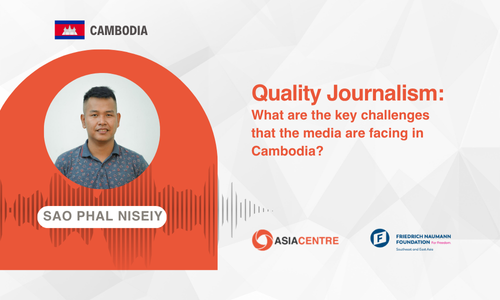
Quality Journalism: What are the key challenges that the media are facing in Cambodia?

Sao Phal Niseiy is an Editor-in-Chief of Cambodianess and a Deputy Chief Editor at Thmey Thmey, Phnom Penh-based media. He primarily covers foreign affairs and climate-related issues. This podcast episode was recorded on 7 October 2022 as part of the “Media Freedom in Southeast Asia” series hosted by Asia Centre in collaboration with the Friedrich Naumann Foundation for Southeast and East Asia.
What are the current challenges that the media are facing in Thailand?

Noppatjak Attanon is an Editor-in-Chief for workpointTODAY, a Thailand-based online news publisher with over 10 million followers. He is currently leading a team of more than 20 journalists, covering issues on politics, economics, business, world affairs and human rights. He has also worked with BBC Thai in London. This podcast episode was recorded on 18 October 2022 as part of the “Media Freedom in Southeast Asia” series hosted by Asia Centre in collaboration with the Friedrich Naumann Foundation for Southeast and East Asia.
How has the shift in the media ecosystem affected media freedom in the Philippines?

Marites Vitug is an Author and Editor-at-large at Rappler with over 40 years of experience in journalism. She has published a number of books on justice and political affairs in the Philippines. Marites is currently working on her book project on former President Rodrigo Duterte’s 6 year administration and the Philippines-China relations. This podcast episode was recorded on 29 September 2022 as part of the “Media Freedom in Southeast Asia” series hosted by Asia Centre in collaboration with the Friedrich Naumann Foundation for Southeast and East Asia.
รายงานเวทีเสวนา: ผู้หญิงนักปกป้องสิทธิมนุษยชนในไทย

หัวข้อเสวนา: ผู้หญิงนักปกป้องสิทธิมนุษยชนในไทยองค์กร: สถานเอกอัคราชทูตสวิตเซอร์แลนด์ประจำประเทศไทยกิจกรรม: งานประชุมนานาชาติครั้งที่ 7 ของสถาบันวิจัย Asia Centre ในหัวข้อ Freedom of Expression in Asiaวันที่/เวลา: 25 ตุลาคม 2565 11.00 น. ถึง 12.30 น.สถานที่: โรงแรม Radisson Blu Plaza Bangkok พิธีกล่าวต้อนรับ เมื่อวันที่ 25 สิงหาคม 2565 Conradin Rasi อุปทูตรักษาราชการชั่วคราวของสถานเอกอัคราชทูตสวิตเซอร์แลนด์ประจำประเทศไทย กล่าวในพิธีเปิดงานงานประชุมว่า รัฐบาลสวิตเซอร์แลนด์ให้ความสำคัญกับการปกป้องสิทธิมนุษยชนในประเทศและต่างแดน โดยกำหนดให้ประเด็นต่อไปนี้มีความสำคัญลำดับต้นในด้านสิทธิมนุษยชนของประเทศ 1) การยกเลิกโทษประหารชีวิต 2) การต่อต้านการทารุณกรรม 3) การปกป้องชนกลุ่มน้อย 4) การปกป้องเสรีภาพในการแสดงออก เขาอธิบายว่าเสรีภาพในการแสดงออกเปรียบเสมือนเสาหลักที่คอยค้ำจุนกระบวนการประชาธิปไตยในสังคมที่มีความหลากหลายอย่างสวิตเซอร์แลนด์ เขาเน้นย้ำว่าเสรีภาพในการแสดงออกกำลังตกอยู่ภายใต้แรงกดดันที่เพิ่มมากขึ้นและตระหนักถึงบทบาทของนักปกป้องสิทธิมนุษยชนในการส่งเสริมและปกป้องเสรีภาพในการแสดงออก สถานเอกอัคราชทูตจึงยินดีเป็นอย่างยิ่งที่ได้สนับสนุนงานประชุมนานาชาติของ Asia Centre และเวทีเสวนาหัวข้อผู้หญิงนักปกป้องสิทธิมนุษยชนในไทย เวทีเสวนาหัวข้อผู้หญิงนักปกป้องสิทธิมนุษยชนในไทย โดยสถานเอกอัคราชทูตสวิตเซอร์แลนด์ประจำประเทศไทย ผู้ร่วมเสวนาได้แก่ คุณอังคณา นีละไพจิตร ผู้เชี่ยวชาญของสหประชาชาติด้านการบังคับหรือสูญหายโดยไม่สมัครใจและอดีตกรรมการสิทธิมนุษยชนแห่งชาติ และคุณชลธิชา แจ้งเร็วจากกลุ่มฟื้นฟูประชาธิปไตย ดร. สุรัชนี ศรีใยจากคณะรัฐศาสตร์ จุฬาลงกรณ์มหาวิทยาลัย รับหน้าที่เป็นพิธีกร อังคณา นีละไพจิตร อังคณาเริ่มต้นโดยตั้งข้อสังเกตต่อเหตุโจมตีผู้หญิงนักปกป้องสิทธิมนุษยชน (WHRDs)ในไทย ในอดีต ผู้หญิงนักปกป้องสิทธิฯ ถูกข่มขู่โดยการทำร้ายร่างกาย แต่ในปัจจุบันผู้หญิงนักปกป้องสิทธิฯ จำนวนเพิ่มขึ้นต้องเผชิญกับการคุกคามผ่านกระบวนการยุติธรรมโดยภาครัฐและตัวแสดงที่ไม่ใช่ภาครัฐ นอกจากนี้ ในช่วงไม่กี่ปีที่ผ่านมา การคุกคามออนไลน์โดยปฏิบัติการข่าวสาร (Information Operations – IOs) ที่ได้รับการสนับสนุนจากรัฐยังได้ก่อตัวเป็นวิธีการโจมตีรูปแบบใหม่ เธอยกตัวอย่างการโจมตีสามประเภทที่เธอต้องทุกข์ทน สำหรับการทำร้ายทางกายภาพ เธอเล่าว่ารถของเธอถูกปากรรไกรใส่จนได้รับความเสียหายในเช้าตรู่ของวันที่ 12 เมษายน 2565 เธอเชื่อว่าผู้ก่อเหตุกระทำการดังกล่าวเพื่อแสดงความไม่พอใจต่อการรณรงค์ด้านสิทธิมนุษยชนของเธอ ในกรณีการคุมคามผ่านกระบวนการยุติธรรม เธอถูกบริษัทแห่งหนึ่งฟ้องข้อหาหมิ่นประมาท เนื่องจากบริษัทดังกล่าวถูกกล่าวหาว่าบังคับใช้แรงงานชาวเมียนมาร์ผู้ซึ่งอังคณาให้การช่วยเหลือขณะที่เธอดำรงตำแหน่งกรรมการสิทธิมนุษยชนแห่งชาติในปี 2562 สำหรับการคุกคามออนไลน์ อังคณาเล่าว่ามีโพสต์และรูปภาพที่มีข้อความเหยียดเพศและขาดมนุษยธรรมที่โจมตีเธอแพร่กระจายอยู่ในโลกออนไลน์ เธอเชื่อว่าปฏิบัติการข่าวสาร (IOs) ที่ได้รับการสนับสนุนจากกองทัพคือผู้อยู่เบื้องหลังโพสต์เหล่านี้ ความคิดเห็นของเธอสอดคล้องกับรายงานของเฟซบุ๊กที่ถูกเผยแพร่ในเดือนพฤษภาคมปี 2564 ที่ระบุว่าเฟซบุ๊กได้ปิดบัญชีที่มีความเกี่ยวข้องกับกองทัพไทยและมีส่วนในการเผยแพร่ข้อมูลชวนเชื่อไปทั้งสิ้น 185 บัญชี การโจมตีในรูปแบบดังกล่าวส่งผลต่อความเป็นอยู่ของอังคณา ทำให้เธอต้องใช้ชีวิตภายใต้ความกังวล ความเครียด และความกลัวว่าจะมีคนมาทำร้าย และยังก่อให้เกิดความเสียหายต่อเกียรติคุณชื่อเสียง ทำให้เธอสูญเสียความเชื่อมั่นในตัวเอง และสร้างบาดปาดแผลในจิตใจ อังคณาเห็นว่าแม้จะมีเครื่องมือภายในประเทศที่ลงโทษผู้กระทำผิด แต่ผู้หญิงนักปกป้องสิทธิฯ ยังต้องเผชิญกับอุปสรรคที่คอยขัดขวางไม่ให้พวกเธอได้รับความยุติธรรม เช่น การเข้าถึงหลักฐาน บ่อยครั้งเจ้าหน้าที่ตำรวจผลักภาระให้เธอเป็นผู้ค้นหาหลักฐานซึ่งเธอไม่สามารถเข้าถึงได้ เจ้าหน้าที่มักไม่สนใจหรือผลัดวันประกันพรุ่งในการทำคดีที่เกี่ยวข้องกับผู้หญิงนักปกป้องสิทธิฯ ในหลายกรณี การสืบสวนจบลงโดยที่ไม่สามารถหาผู้กระทำผิดได้ การต่อสู้คดียังผลาญเงินออมของพวกเธอไปกับการจ่ายธรรมเนียมศาลและค่าทนาย ยิ่งไปกว่านั้น ผู้หญิงนักปกป้องสิทธิฯ ต้องรับผิดชอบค่าใช้จ่ายในการรักษาปัญหาสุขภาพจิตที่เกิดขึ้นจากการถูกโจมตีอีกด้วย ชลธิชา แจ้งเร็ว ชลธิชากล่าวว่านับตั้งแต่การลุกฮือของเยาวชนในปี 2563 รัฐบาลได้ใช้มาตรการรุนแรงในการการดำเนินคดีกับผู้หญิงนักปกป้องสิทธิฯ เธออธิบายว่าบทบาทของผู้หญิงในการนำขบวนการเคลื่อนไหว ไม่ว่าจะเป็นการชักชวนผู้หญิง กลุ่มบุคคลที่มีความหลากหลายทางเพศ (LGBTQ) และวัยรุ่นมาเข้าร่วม หรือการผลักดันประเด็นเกี่ยวกับผู้หญิงให้เป็นวาระของขบวนการ ทำให้รัฐบาลพุ่งเป้าการโจมตีไปที่ผู้หญิงนักปกป้องสิทธิฯ เพื่อทำให้ขบวนการเคลื่อนไหวหยุดชะงัก ผู้หญิงนักปกป้องสิทธิฯ ต้องรับมือกับการคุมคามและเหยียดหยามบนโลกออนไลน์จากปฏิบัติการข่าวสาร (IOs) ที่สนับสนุนโดยกองทัพและกลุ่มอนุรักษ์นิยมสุดโต่ง การคุมคามดังปรากฎในรูปความคิดเห็นที่เหยียดเพศและคุมคามทางเพศ ข้อความขู่เอาชีวิต และรูปภาพปลอมหรือรูปภาพตัดต่อ ในกรณีของชลธิชา บทสนทนาปลอมระหว่างสองบัญชีที่แอบอ้างว่าเป็นเธอและนักการทูตชาวสหรัฐฯ ได้แพร่หลายบนอินเตอร์เน็ต ชักจูงให้เชื่อว่าทั้งคู่มีความสัมพันธ์ลึกซึ้งและกำลังวางแผนปลุกปั่นความรุนแรงในหมู่ผู้ประท้วงเยาวชน นอกจากนี้ ผู้หญิงนักปกป้องสิทธิฯ ยังโดนสอดแนมโดยรัฐบาล ที่ใช้เครื่องมือต่าง ๆ เพื่อติดตามความเคลื่อนไหวของของพวกเธอ ตั้งแต่การติดตาม GPS สปายแวร์ เช่น Pegasus ไปจนถึงการสะกดรอย หนึ่งในเหตุการณ์ที่น่าตกใจคือ เจ้าหน้าที่ฝ่ายความมั่นคงใส่ชื่อนักกิจกรรมหญิงที่มีอายุเพียง 13 ปี ในฐานะบุคคลเฝ้าระวังในรายการความมั่นคงแห่งชาติ อีกหนึ่งกลวิธีที่รัฐบาลใช้ข่มขู่นักปกป้องสิทธิฯคือการใช้เครื่องมือทางกฎหมาย ชลธิชาอธิบายว่ากฎหมายสองมาตราที่ใช้เอาผิดนักปกป้องสิทธิฯได้แก่ มาตรา 112 (กฎหมายหมิ่นพระบรมเดชานุภาพ) และมาตรา 116 (กฎหมายยุยงปลุกปั่น) แห่งประมวลกฎหมายอาญา กฎหมายสองมาตรานี้มีโทษร้ายแรง และแม้ว่าศาลอนุญาตให้นักปกป้องสิทธิฯได้รับการประกันตัว นั้นก็ต้องแลกมากับการยอมรับเงื่อนไขที่จำกัดการใช้เสรีภาพในการแสดงออกของพวกเธอ หนึ่งในเงื่อนไขประกันตัวของชลธิชาคือการที่เธอต้องใส่เครื่องติดตามอิเล็กทรอนิกส์ (Electronic Monitoring devices – EM devices) ที่ข้อเท้า เธอกล่าวว่าการใส่ EM เป็นการตีตราว่าเธอเป็นอาชญากร ทั้งยังทำให้เธอกลายเป็นคนหวาดระแวงว่ามีคนกำลังสอดส่องเธออยู่ตลอดเวลา ช่วงถาม-ตอบ ถาม: ผู้หญิงนักปกป้องสิทธิฯ ในไทยร่วมมือกับผู้หญิงนักปกป้องสิทธิฯ ในประเทศอื่น ๆ ในภูมิภาคเอเชียเพื่อเสริมสร้างการพิทักษ์สิทธิหรือไม่ (ถามโดย Herynah Andrianarahina) ตอบ: มีการติดต่อและแลกเปลี่ยนแนวทางการรับมือกับการคุกคามโดยเจ้าหน้าที่รัฐระหว่างผู้หญิงนักปกป้องสิทธิฯ ในไทยและผู้หญิงนักปกป้องสิทธิฯ ในกลุ่มพันธมิตรชานม (Milk Tea Alliance) อย่างไรก็ตาม ความร่วมมือดังกล่าวเป็นไปแบบหลวม ๆ (ตอบโดย ชลธิชา แจ้งเร็ว) ถาม: รู้สึกอย่างไรที่ต้องสวมใส่ EM และถูกจับตามอง (ถามโดย Aminul Islam) ตอบ: ชลธิชารู้สึกว่าตนถูกพรากความเป็นส่วนตัวไป เธอออธิบายต่อว่าแม้กระทรวงยุติธรรมได้รับรองกับเธอว่าเจ้าหน้าที่ของกระทรวงฯ เท่านั้นที่สามารถเข้าถึง EM ที่เธอใส่ได้ แต่ในความเป็นจริง เจ้าหน้าที่ตำรวจกลับได้รับข้อมูลพิกัดของเธอ เธอยังรู้สึกไม่ปลอดภัยเมื่อต้องใส่ EM ในที่สาธารณะ ด้วยเกรงว่าผู้อื่นจะตัดสินหรือโจมตีเธอ (ตอบโดย ชลธิชา แจ้งเร็ว) ถาม: ปัจจุบัน คุณอังคณามีบทบาทอย่างไรในสหประชาชาติ (ถามโดย Vinhou Va) ตอบ: ปัจจุบัน อังคณาเป็นสมาชิกคณะทำงานสหประชาชาติด้านการบังคับหรือการสูญหายโดยไม่สมัครใจ (UN Working Group on Enforced or Involuntary Disappearances) (ตอบโดย อังคณา นีละไพจิตร) ถาม: คุณชลธิชาเคยถูกคุกคามในที่สาธารณะจากการใส่ EM หรือไม่ (ถามโดย Vinhou Va) ตอบ: ชลธิชาไม่เคยถูกคุกคามทางร่างกายในที่สาธารณะ อย่างไรก็ตาม เธอถูกข่มเหงทางวาจาว่า ‘ทำผิดกฎหมาย’ จากคนที่จำเธอได้จาก EM ที่เธอใส่ (ตอบโดย ชลธิชา แจ้งเร็ว) ข้อเสนอแนะ ข้อเสนอแนะจากการแลกเปลี่ยนความคิดเห็นบนเวทีมีดังต่อไปนี้ รัฐบาลไทยจักต้องปฏิบัติตามปฏิญญาสากลว่าด้วยสิทธิมนุษยชน ต้องมีการออกกฎหมายต่อต้านหรือป้องกันการฟ้องปิดปาก (Strategic Lawsuits against Public Participation – SLAPP) ผู้หญิงนักปกป้องสิทธิฯ ทุกคนต้องสามารถเข้าถึงกองทุนยุติธรรม และกองทุนดังกล่าวต้องครอบคลุมค่าใช้จ่ายที่เกิดขึ้น รวมถึงค่าใช้จ่ายในการบำบัดทางจิตใจ รัฐบาลไทยจักต้องปฏิบัติตามข้อเสนอแนะที่เกี่ยวข้องกับผู้หญิงนักปกป้องสิทธิฯ จาก กระบวนการทบทวนสิทธิมนุษยชน (Universal Periodic Review – UPR), คณะกรรมการต่อต้านการทรมาน (Committee against Torture – CAT), คณะกรรมการว่าด้วยสิทธิทางเศรษฐกิจ สังคม และวัฒนธรรม (CESCR), ICCPR, และอนุสัญญาว่าด้วยการขจัดการเลือกปฏิบัติต่อสตรีทุกรูปแบบ (Convention on the Elimination of All Forms of Discrimination against Women – CEDAW) ต้องมีกฎหมายที่เอาผิดการคุกคามที่ตั้งอยู่บนพื้นฐานเพศสภาพโดยเจ้าหน้าที่รัฐและระเบียบการของกองกำลังฝ่ายความมั่นคงที่คำนึงถึงเพศสภาพ ชุมชนองค์กรภาคประชาสังคมจักต้องตระหนักถึงความเสี่ยงเฉพาะทางที่ผู้หญิงนักปกป้องสิทธิฯ ต้องเผชิญ สรุป จากประสบการณ์ส่วนตัวของอังคณาและชลธิชา สามารถสรุปได้ว่าผู้หญิงนักปกป้องสิทธิฯ ในไทยกำลังเผชิญกับความท้าทายที่เจาะจงเพศสภาพในรูปแบบของการทำร้ายทางกายภาพ การคุกคามออนไลน์ และการคุกคามผ่านกระบวนการยุติธรรม จึงจำเป็นอย่างยิ่งที่ข้อเสนอเนอแนะที่กล่าวไปในข้างต้นในถูกนำไปปฏิบัติเพื่อปกป้องผู้หญิงนักปกป้องสิทธิฯ และสนับสนุนการต่อสู้เพื่อสิทธิมนุษยชนของพวกเธอ
Panel Report: Women Human Rights Defenders in Thailand

Panel Title: Women Human Rights Defenders in Thailand Organisation: Embassy of Switzerland in Thailand. Programme: Asia Centre’s 7th International Conference – Freedom of Expression in Asia Date and Time: 25 August 2022 11.00 AM – 12.30 PM Venue: Radisson Blu Plaza Bangkok Welcome Remarks Conradin Rasi, Chargé d’Affaires a.i, gave his welcome remarks on 25 August 2022. He stated that the Swiss government emphasises the protection of human rights in the country and abroad. Switzerland defines the following as human rights priorities: the abolition of the death penalty, the fight against torture, the protection of minorities and the protection of freedom of expression. He explained freedom of expression is a pillar that buttresses democratic progress in a diverse society such as Switzerland. He noted that freedom of expression is under increasing constraints, and recognises the role human rights defenders play in promoting and protecting freedom of expression. Therefore, the Embassy is pleased to support the Asia Centre conference and support a panel. Panel: Women Human Rights Defenders in Thailand by the Embassy of Switzerland in Thailand The speakers of the panel were Angkhana Neelapaijit, a UN Expert and former National Human Right Commissioner Thailand and Chonthicha Jangrew from Democracy Restoration Group. The panel was moderated by Dr. Surachanee Sriyai from Faculty of Political Science, Chulalongkorn University. Angkhana Neelapaijit Angkhana began by giving her observation on attacks against women human rights defenders (WHRDs) in Thailand. In the past, WHRDs were threatened with physical assaults. Now more WHRDs are facing judicial harassment by the Thai state and non- state actors. Online bullying by state-sponsored Information Operations (IOs) has also emerged as a new tactic in recent years. She proceeded to give examples of three types of attacks that she has endured. For physical assault, she narrated that her car was smashed in the early morning of 12 April 2022. She believed that the attacker committed the offence to express his objection against her human rights campaigns. For judicial harassment, she was sued by a company for criminal defamation. The company was accused of using forced labour of Myanmar workers whom Angkhana supported in her role as Thailand National Human Rights Commissioner in 2019. For online bullying, Angkhana said that online posts and pictures containing inhumane and sexist messages against her circulate in cyberspace. She believes that these posts are fabricated by military-supported IOs. This is concurrent with a report from Facebook in May 2021, which states that it had taken down 185 Thai military-affiliated accounts engaging in information-influencing activities. These forms of attacks have affected her well-being. She lives in constant anxiety and pain, fearing that someone might attack her. They have tainted her reputation, lowered her self-esteem and left psychological trauma with her. According to Angkhana, while internal mechanisms to punish wrongdoers are in place, WHRDs are confronted with arduous barriers that constrain them from receiving justice. One of which mentioned by Angkhana is access to evidence. Citing her own experience, police authorities often push the burden of finding evidence to which she does not have access. Authorities tend to ignore and procrastinate cases involving WHRDs. In many cases, the investigations yield no results. Fighting cases can exhaust WHRDs’ savings. Such expenses are, among others, court fees and lawyer fees. WHRDs also have to spend their money on psychological treatment. Chonthicha Jaengraew Chonthicha explained that since the youth uprising in 2020, the government has employed draconian measures to persecute WHRDs. The roles of WHRDs to the movement, Chonthicha explained, are leading the movement, attracting female, LGBTQs and young people to join the movement and pushing women-related issues onto the movement’s agendas. Given these roles, the government has targeted WHRDs in order to derail the movement. WHRDs have to endure online bullying and harassment from military-led IOs and the ultra conservatives. These can come in the forms of sexist and sexual harassment comments, life-threatening messages and fake, edited pictures. In the case of Chonthicha, a fabricated chat between two accounts posing as her and a US diplomat was circulated on the internet. The chat suggests that the two have an intimate relationship and are planning to incite violence among young protestors. WHRDs have found themselves under close surveillance. The government has employed various tools to track movements of WHRDs, ranging from GPS tracking, spyware such as Pegasus and stalking. In one shocking instance, security authorities put the name of a female activist as young as 13 year-old in the national security lists as a monitored person. Another tactic used by the government to intimidate WHRDs is through legal means. Chonthicha explained that the two repressive legislations mostly used to prosecute WHRDs are Section 112 (Lèse-majesté law) and Section 116 (sedition law) of the Criminal Code. The two legislations carry harsh punishment. And even though the court grants bail to WHRDs, they still have to accept disproportionate bail conditions that constrains them from exercising freedom of expression. Chonthicha is obliged to wear an Electronic Monitoring (EM) on her ankle as part of bail conditions. She said that the EM has labelled and stigmatised her as a criminal. She is paranoid by the feeling that she is being watched all the time. Question and Answers Question: Are Thai WHRDs collaborating with other WHRDs in Asia to strengthen their advocacy? (asked by Herynah Andrianarahina) Answer: Chonthicha answered that Thai WHRDs connect with other WHRDs in the Milk Tea Alliances and learn from each other on how to handle harassment by state authorities. However, the cooperation is not strong. Question: How does it feel to wear an EM and to be watched? (asked by Aminul Islam) Answer: Chonthicha feels that her privacy is deprived. She explained that even though the Ministry of Justice assured her that only its officials have access to her EM, the reality is that her location is shared with police authorities. She also feels insecure wearing an EM in public, fearing that people will judge or attack her. Question: What are Angkhana’s current roles in the UN? (asked by Vinhou Va)