Youth and Disinformation in Malaysia: Strengthening Electoral Integrity

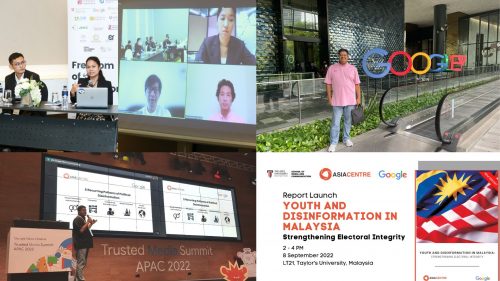
Download Full Report Youth and Disinformation in Malaysia: Strengthening Electoral Integrity identifies the potential risks from disinformation that youths are likely to face in the 15th General Election (GE15) to be held latest by September 2023. A review of media reports and studies that referenced the last 5 general elections, revealed 5 recurring patterns of disinformation clustering around: sexual orientation and promiscuity; corruption; electoral integrity; women politicians and foreign interference. To date, legal and non-legal measures remain largely ineffective against political disinformation. Provisions in existing laws are vague and place authority in the hands of the government who can use…

Continue ReadingYouth and Disinformation in Malaysia: Strengthening Electoral Integrity

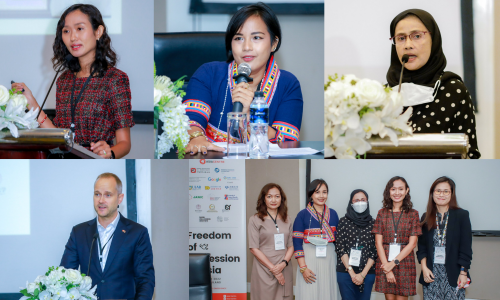
7th International Conference (2022): Freedom of Expression in Asia

From 24 to 26 August 2022, Asia Centre convened its 7th International Conference: ‘Freedom of Expression in Asia’. Following the relaxation of COVID-19 restrictions, participants and panellists flew from different regions to join the Conference held at the Radisson Blu Plaza Hotel, Bangkok. Meanwhile, those who could not join in-person due to travel and health advisories participated remotely via Zoom.Into its 7th year, Asia Centre’s annual conference continues to grow with the 2022 Conference having 16 partners: Taiwan Foundation for Democracy; Friedrich Naumann Foundation for Freedom, Thailand; Embassy of Switzerland in Thailand; Google Asia Pacific; International Development Research Centre (IDRC);…

Continue Reading7th International Conference (2022): Freedom of Expression in Asia

Internet Freedoms in Thailand

Download Full Report Internet Freedoms in Thailand reviews and analyses legislation that impacts internet freedoms in Thailand. These include provisions in the Constitution, Penal Code, the Computer Crime Act, the Cybersecurity Act, and the Emergency Decree. As this report shows, many provisions under these laws contain vague language enabling wide interpretation, impose harsh punishment, and give far-reaching power to the authorities. Today, internet freedoms in Thailand remain under threat, a product of continuous restrictions accelerated since the 2014 coup. These laws are used to justify removing or blocking content criticising the monarchy and establishment, prosecuting internet users, and harassing activists,…

Continue ReadingInternet Freedoms in Thailand

MIL in Post-Pandemic Southeast Asia: Approaches to Measuring Effectiveness in the Academic Literature

Download Full Report Dr. James Gomez and Dr. Robin Ramcharan, Directors of Asia Centre, authored an article “MIL in Post-Pandemic Southeast Asia: Approaches to Measuring Effectiveness in the Academic Literature” in Thai Media Fund Journal. The article reviews scholarship on the effectiveness of media information literacy (MIL) to distil its models and assesses its utility as a concept. Based on the review, eight questions regarding MIL are expanded upon in the article to provide a framework for policymakers, civil society programmers and researchers in their effort to design stronger MIL programmes.

Continue ReadingMIL in Post-Pandemic Southeast Asia: Approaches to Measuring Effectiveness in the Academic Literature

Asia Centre’s New Research Hub

Asia Centre will consolidate its research work under a new Hub, as the team expands to publish more books, baseline studies, policy papers, and opinion pieces. Part of this work will involve making submissions to the UN, following the granting, in 2021, the UN’s ECOSOC Special Consultative Status. The Research Hub, housed in a 131 sqm office on the 20th floor of the Chamnan Phenjati Business Center, and located 200m away from Rama 9 MRT Station, has a mixture of open working spaces and meeting rooms. Fitted with the latest video-conferencing technology, the Hub will enable the Asia Centre Team…

Continue ReadingAsia Centre’s New Research Hub

 Ukraine Challenges Do Not Damper ASEAN-EU Relations

The ongoing war in Ukraine has accelerated several key challenges to the ASEAN-European Union (EU) relationship. These challenges include the EU’s unclear role in mediating the great power relationship in the wider Indo-Pacific region, a difference in approach towards regional integration, trade negotiations hampered by the political contexts of ASEAN states, and non-aligned over human rights issues that prevented the deepening of relationships. Despite these challenges, there is a desire within both regions to work towards maintaining and strengthening this strategic partnership. This was the primary sentiment that emerged from the conference “ASEAN-EU Relations in light of the War in Ukraine”, co-convened…

Continue Reading Ukraine Challenges Do Not Damper ASEAN-EU Relations

Thailand’s Computer Crime Act: Placing Digital Rights At Risk

Increased internet use by Thai citizens for political expression and mobilisation gave rise to the implementation in 2007 and the later amendment in 2017 of the Computer Crime Act (CCA). In the name of national security and public order, the Act has been used to prosecute internet users placing their digital rights at risk.Asia Centre’s Researcher Korbkusol Neelapaichit made these opening remarks during the report launch of “Thailand’s Computer Crime Act: Restricting Digital Rights, Silencing Online Critic”, jointly published with EngageMedia and supported by The International Center for Not-for-Profit Law (ICNL). Korbukusol then went on to highlight the key concerns…

Continue ReadingThailand’s Computer Crime Act: Placing Digital Rights At Risk

Thailand Computer Crime Act: Restricting Digital Rights, Silencing Online Critics

Download Full Report Download (in Thai) Thailand Computer Crime Act: Restricting Digital Rights, Silencing Online Critics reviews the provisions of the 2007 Computer Crime Act (CCA) and its 2017 amendment, as well as their impact on digital rights in Thailand. Containing harsh penalties and vaguely-worded provisions subject to extensive interpretation by authorities, the CCA removes critical content from the internet, harasses and prosecutes those who speak out and puts pressure on ISPs and tech companies to carry out orders. Instead, the report recommends that the Thai government review and amend rights-infringing sections of the CCA and ensure they comply with…

Continue ReadingThailand Computer Crime Act: Restricting Digital Rights, Silencing Online Critics

Dr. Gomez in Doha: “Harmony laws” foster hate against minorities

“Harmony laws”, while well-intentioned, their implementation has inevitably led to the spread of hate speech directed at minorities in Southeast Asia. This is primarily due to the use of these laws against ethnic-religious minorities and those seen as a threat to the majority group.  This was the finding that Asia Centre’s Regional Director, Dr.James Gomez, highlighted in his keynote speech delivered at the 14th Doha Interfaith Conference titled “Religion and Hate Speech: Between Scriptures and Practice” which took place on 24-25 May 2022 in Doha, Qatar. His speech, based on his conference paper, titled “Legislating Hate Speech in Southeast Asia: Impacts…

Continue ReadingDr. Gomez in Doha: “Harmony laws” foster hate against minorities

Electoral Reforms Can Ensure Multiparty Democracy In Southeast Asia

A range of electoral reforms are needed if multiparty democracy is to take root in Southeast Asia. Reforms related to electoral laws, the media, independence of election management boards and the voting age formed the broad suite of ideas that emerged from speakers of the parallel session “Multiparty Democracy in Southeast Asia” during the 2022 Gwangju Democracy Forum convened by Asia Centre.Co-convened with the May 18 Foundation – a South Korean organisation founded in commemoration of the May 18 Uprising – the 19 May 2022 online event was as part of the Gwangju Democracy Forum, an annual international conference held…

Continue ReadingElectoral Reforms Can Ensure Multiparty Democracy In Southeast Asia