Human Rights, Economic Ties Drive Decisions to Boycott – or Not – 2022 Olympics

Dr. James Gomez, Regional Director of Asia Centre, was interviewed for a piece “Human Rights, Economic Ties Drive Decisions to Boycott – Or Not – 2022 Olympics” published on Voice of America on 4 February 2022. Opining as to why the winter Olympics has attracted many countries, despite some boycotting the game, Dr. Gomez said that most still look towards China as an indispensable market and source of funding, and as a result, they cannot publically distant themselves from China. Read the article here. Read the piece in Chinese here.
Thailand Government to Meet Southern Separatist in KL

On 4 January 2022, Dr. James Gomez, Regional Director of Asia Centre, discussed the background and context to an upcoming peace talk between the Thai government and the BRN (Barisan Revolusi Nasional), facilitated by the Malaysian government. In the BFM Radio podcast show, Dr. Gomez made the point that the issue in Thailand’s deep south has evolved from an ethno-nationalist separatist movement to one around identity politics with Islam as an important religious marker. Listen to the podcast here.
Media Freedom in Southeast Asia: Repeal Restrictive Laws, Strengthen Quality Journalism

Download Full Report Media Freedom in Southeast Asia: Repeal Restrictive Laws, Strengthen Quality Journalism examines the use of fake news legislation to crack down on legitimate journalistic expression. Seeking to control the flow of information in the online space, governments have enacted these laws to monitor and control the internet infrastructure over which information critical or unflattering of the government can be disseminated. The laws contain vaguely-worded provisions penalising the act of spreading disinformation or information that authorities consider harmful to national security, public order and social harmony. While the negative dimensions of online content are of concern, the increased use of these legislation erodes media freedom. Instead, the report recommends that the focus should be on promoting the responsible use of online media platforms that can empower credible actors to counterbalance online disinformation through verified information and strengthen quality journalism.
Media Freedom in Southeast Asia: Repeal Restrictive Laws, Strengthen Quality Journalism

Download full report Media Freedom in Southeast Asia: Repeal Restrictive Laws, Strengthen Quality Journalism examines the use of fake news legislation to crack down on legitimate journalistic expression. Seeking to control the flow of information in the online space, governments have enacted these laws to monitor and control the internet infrastructure over which information critical or unflattering of the government can be disseminated. The laws contain vaguely-worded provisions penalising the act of spreading disinformation or information that authorities consider harmful to national security, public order and social harmony. While the negative dimensions of online content are of concern, the increased use of these legislation erodes media freedom. Instead, the report recommends that the focus should be on promoting the responsible use of online media platforms that can empower credible actors to counterbalance online disinformation through verified information and strengthen quality journalism.
Business and Human Rights: More Stakeholder Participation Needed in Southeast Asia

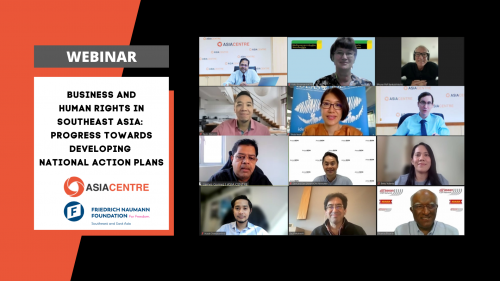
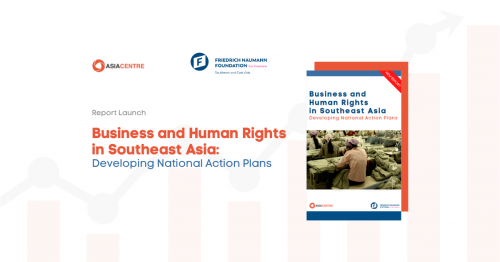
While welcoming the uptake of the BHR agenda across Southeast Asia, panelists in the online forum: ‘Business and Human Rights in Southeast Asia: Progress Towards Developing National Action Plans’(NAPs) emphasised gaps in advocacy on business and human rights across the region. Collectively they noted the need for more stakeholder participation from parliamentarians, business organisations and other non-governmental organisations in NAPs development processes. The event, co-convened by Asia Centre and the Friedrich Naumann Foundation for Freedom, was held on 15 December 2021, 10.00 AM – 4.00 PM Bangkok Time, to mark the launch of the joint publication: ‘Business and Human Rights in Southeast Asia: Developing National Action Plans’. The event focused on identifying the way forward for the progressive adoption of NAPs in the region. In welcoming speakers and participants at the start, Moritz Kleine-Brockhoff, Head of Regional Office Southeast and East Asia, Friedrich Naumann Foundation For Freedom, noted that a decade after the adoption of the United Nations Guiding Principles (UNGPs) on BHR there has been an uptake of the UNGPs in Southeast Asia. This was also highlighted by Dr. Robin Ramcharan, Executive Director, Asia Centre, who presented the key findings of the book. He said that countries in the region have been undergoing, albeit slowly, NAP-development processes in the past few years, following the footsteps of Thailand, which adopted one in 2019, and other Asian countries. Hence, the BHR and NAPs are becoming part of a widening human rights architecture in the region, though progress has been slowed down by political certainty in places like Indonesia and Malaysia and also by the current COVID-19 pandemic. He noted further key findings of the book, namely: that regional NAPs development still faces challenges in that key stakeholders, notably parliamentarians and business organisations, have not yet been involved in NAPs processes; that there has been a lack of awareness and interest in the BHR agenda among these two sectors; that NAPs must be better aligned with international human rights standards; that through language that is closely aligned with international human rights instruments and best practises, NAPs can play a role in deepening a culture of human rights and democracy in the region, which has seen a regression in both areas in the last decade. NAPs are tools to hold both States and their businesses accountable. These points were echoed across two panels of experts. The first panel, from 10 AM to 12 PM on ‘The State of NAPs Development in Southeast Asia’ was joined by Paolo Zamora, Programme Manager, Council of Asian Liberals and Democrats and Vicky Bowman, Head of the Myanmar Centre for Responsible Business. Tricia Yeoh, CEO, Institute for Democracy and Economic Affairs, moderated the panel. The second panel, from 2 PM to 4 PM was a roundtable discussion ‘Business Organisations and NAPs: Prospects for Advancing the BHR Agenda’. It was joined by Betty Yolanda, Asia Regional Manager, Business and Human Rights Resource Centre, Thomas Thomas, CEO at ASEAN CSR Network, Edmund Bon Tai Soon, Lawyer, AmerBON, Saul Takahashi, Asia Centre Advisory Board and Professor of Human Rights and Peace Studies at Osaka Jogakuin University. Husai Chantarawirod, Regional Programme Officer, Regional Office Southeast & East Asia, Friedrich Naumann Stiftung, moderated the discussion. Echoing important elements of NAP development that are treated in the book, both panels pointed: the need for greater inclusivity and transparency in the development of NAPS, which must involve parliamentarians in the drafting and monitoring of NAPs; setting up strong mixed regulatory frameworks on BHR in addition to providing incentives for Business Organisations (BOs); and the inclusion of Civil Society Organisations (CSOs) as well as National Human Rights Institutions (NHRIs) as key stakeholders in the NAPs development processes to better advance national BHR agendas. The book’s Chapter 2 by James Gomez and Robin Ramcharan of Asia Centre noted these challenges to the uptake in the UNGPs in the region. Speakers acknowledged that NAPs processes are rightly Executive-driven but pointed to the need for greater inclusivity of stakeholders, notably parliamentarians who can hold governments to account in upholding their human rights obligations. Chapter 3 of the book by Paolo Zamora and Francis Abaya of CALD drew attention to the missing role of Parliamentarians. The lack of interest and understanding of BHR among BOs have resulted in their low involvement in implementing NAPs. Having NAPs as a starting point, future BHR agendas could aim at offering a ‘smart mix’ of regulations that already exist for BOs along with guidelines on voluntary action that could be made. Chapter 4 of the book by Thomas Thomas for IDEAS treats the reluctance of BOs to engage on the BHR agenda. Panelists, echoing the book’s findings, pointed to the need to be as inclusive as possible and to involve CSOs and NHRIs in National Baseline Assessment (NBAs) to ensure a comprehensive assessment of the needs of each jurisdiction. The lack of consultation can lead to the exclusion of critical issues that feature across all countries including environmental degradation, the rights of indigenous peoples, and the protection of human rights defenders – among other issues that CSOs and NHRIs have brought up. Gender issues are often excluded from consideration. In his Closing Remarks, Dr. James Gomez, Regional Director, Asia Centre said there is a need for greater awareness of and training on the BHR agenda and how stakeholders can effectively contribute to NAP development processes. This calls for national and regional awareness building and for the development of toolkits to better guide small and medium size businesses, which are the backbone of most economies. The concluding Chapter 5, by Asia Centre, summarises pathways for future action for parliamentarians and for better engaging BOs. The discussion and the book are part of Asia Centre’s ongoing work on National Human Rights Institutions and BHR in Southeast Asia. They were follow-ups to the Centre’s 3rd International Conference on ‘Business and Human Rights: Holding Governments Accountable in Asia’ in 2018 and to its previous work, Business and Human Rights in Asia: The Duty of States.
Business and Human Rights in Southeast Asia: Developing National Action Plans

Download full report Abstract This work examines the progress made in Southeast Asia towards developing National Action Plans (NAPs) on Business and Human Rights (BHR). A decade after the adoption of the United Nations Guiding Principles (UNGPs) on Business and Human Rights, has there been an uptake in NAPs in the region? What are the various NAPs development processes and platforms across the region? Have all stakeholders been consulted? What are the obstacles to deepening the NAPs processes and the BHR agenda in the region? This work finds that: 1) An initial grudging uptake by States has engendered a cascade in slow-moving NAP-developing processes; 2) Following Thailand’s lead in adopting a NAP in 2019, others are poised to do the same, notably in Indonesia and Malaysia, though efforts have been delayed by the COVID-19 pandemic and political uncertainty; 3) While national commissions on human rights and civil society organisations had initially taken the lead in pushing for NAPs on BHR, buttressed by the earlier adoption of NAPs in other parts of the world, Southeast Asian States began to consider NAPs processes within the past few years; 4) Key stakeholders have been largely absent from the NAPs development processes across the region: parliamentarians and business organisations – the former due significantly to the lack of awareness of the BHR agenda and non-participation in Executive-led processes and the latter due to lack of interest in and understanding of the BHR agenda; and 5) A key challenge to NAPs development processes is their alignment to international human rights standards. This work was produced in partnership with the Friedrich Naumann Foundation for Freedom, who like the Asia Centre, seeks to build awareness of BHR in the region. This work is part of Asia Centre’s exploration of the regional human rights architecture. Table of contents Chapter 1: Introduction – Business and Human Rights in Southeast Asia Chapter 2: Challenges of NAP Development in Southeast Asia Chapter 3: National Action Plans On Business And Human Rights In Southeast Asia: What Role For Parliamentarians? Chapter 4: The Role of Business Organisations in Developing National Action Plans On Business And Human Rights in ASEAN Chapter 5: Conclusion – The State Of NAPs in Southeast Asia: Recommendations and the Way Forward
COVID-19 Disportionately Impacts Women’s Rights

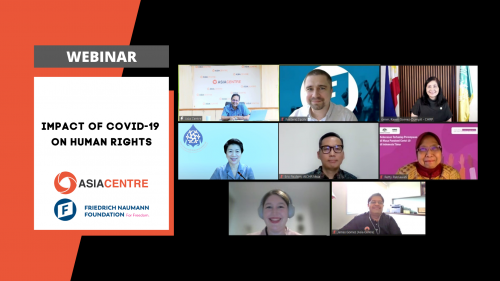
Commissioners from different human rights bodies highlighted that during the pandemic, women disportionately faced various challenges. Despite the operational difficulties, the various commissions nevertheless have tried their level best to call out these COVID-19 related rights violations. Officiated by Frederic Spohr, Head of Friedrich Naumann Foundation in Thailand and Myanmar, these and other issues were highlighted during the International Human Rights Day Roundtable Discussion ‘Impacts of COVID-19 on Human Rights’ on 9 December 2021. The discussion was part of Asia Centre’s ongoing work on National Human Rights Institutions (NHRIs) in Southeast Asia. It held its 2nd International Conference on ‘National Human Rights Institutions in Southeast Asia: Challenges of Protection’ in 2017. In 2020, it co-published with Palgrave Macmillan a book on ‘National Human Rights Institutions in Southeast Asia: Selected Case Studies’. The Centre has also engaged with the National Human Rights Commission of Thailand and its Regional Centres. In 2021, it participated in ‘The Official Launch of the Regional Center for Human Rights Study and Coordination’ at the Faculty of Political Science, Ubon Ratchathani University. Moderated by Asia Centre’s Executive Director, Dr. Robin Ramcharan, the discussion was joined by human rights commissioners who included: Lorraine Finlay of the Australian National Human Rights Commission (AHRC), Retty Ratnawati (Komnas Ham Perempuan), Karen Gomez-Dumpit of the Commission on Human Rights of the Philippines (CHRP), Pornprapai Ganjanarintr, Chairperson of NHRCT (appearing via video: see full video and script) and Eric Paulsen, Malaysian Representative to the ASEAN Intergovernmental Commission on Human Rights (AICHR). Through the discussions, impact on the rights of women during the pandemic featured prominently. Collectively, the commissioners noted issues of gender-based violence against women during lockdowns, such as increased domestic violence. Worsening the situation was that shelters providing care for victims of violence were forced to shut down, without governments providing alternative primary channels for refuge. Pregnant women faced difficulties accessing health services. The commissioners also pointed out that workers in women-dominated fields continue to be exploited. Further, they highlighted the criminalisation of Human Rights Defenders (HRDs), especially of women HRDs. Indeed, more broadly across the regions, HRDs faced increased prosecution for their criticisms of Governments’ mismanagement of the pandemic. Children, and youth more broadly, also faced serious challenges with accessing services that address mental health given the deep psychological impact of isolation during lengthy lockdowns. The elderly were also affected in that the pandemic restrictions, including lockdowns, did not properly address their situation and, more generally, the disabled in society. The net effect of the measures to handle the pandemic was to deprive them of critical health and social services. These challenges have compelled human rights commissions to take actions in protecting human rights. These actions include engaging with governmental agencies to ensure policies are up to human rights standards, providing trustworthy information to the public and continuing to monitor and establish mechanisms to receive complaints of rights violations. It was noted that the commissions faced significant operational challenges in meeting their mandates, notably investigating complaints, to provide protection services for their constituents. They were also subject to the same lockdown measures and restrictions on assembly. Finally, attention was called to the work of AICHR, the ASEAN-level human rights body, which has continued to work on human rights issues amidst the pandemic, with its activities and events constrained by the existing framework to promote human rights. Nevertheless, it was able to issue a press statement by Representatives reaffirming the rights of peoples to access quality health-care services and medical facilities – underlining the principle of proportionality in the restriction of human rights during states of emergency. Asia Centre’s Regional Director, Dr. James Gomez, in his vote of thanks, stressed the Centre’s intention to continue tracking the work of regional and national human rights mechanisms. He noted that there is a need to publicise the good work of the commissions as the public is still unclear of what they do and their effectiveness. The event was co-convened by Asia Centre and the Friedrich Naumann Foundation for Freedom, Thailand. Earlier at the start of the proceedings, tributes were paid to the late Chito Gascon, former Chair of the CHRP who succumbed to COVID-19. You can view the event’s livestream recording here. Asia Centre works on issues related to human rights commissions in the region. If you would like to collaborate with the Centre on this and other human rights concerns, send an expression of interest to contact@asiacentre.org.
Asia Centre Pens Agreement With Naresuan University

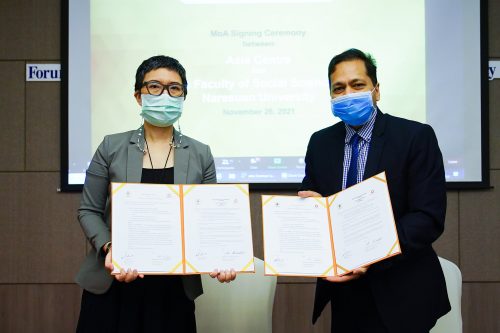
On 26 November 2021, Dr. Robin Ramcharan, Executive Director, Asia Centre and Dr. Napisa Waitoolkiat, Dean of the Faculty of Social Sciences, Naresuan University, Thailand signed a Memorandum of Agreement (MOA) to establish a framework of future cooperation. The MOA marked the collaboration between the organisation in a two-part event on ‘Strengthening the Milk Tea Alliance: Building Democracy and Freedom through Speakers and Discussion’ supported by the Taiwan Foundation for Democracy. The first, was held on 26 November 2021 at the Topland Hotel in Phitsanulok, Thailand and the second, on 1 December 2021 at Asia Centre in Bangkok, Thailand. Dr. James Gomez, Regional Director, Asia Centre, during the events, provided an overview of the global state of democracy and the rising authoritarianism of Asia, and highlighted some of the key movements in the region. Pointing to the findings of Asia Centre’s baseline study: ‘COVID-19 and Democracy in Southeast Asia: Building Resilience, Fighting Authoritarianism’, he said governments have been taking actions against such movements, especially during the COVID-19 pandemic. Dr. Gomez suggested holding joint activities such as ‘democracy festivals’ to increase awareness and understanding of democracy and human rights in Asia. Both events also included inputs from Pongpop Dansamanchanchai, Alumnus, Faculty of Social Sciences, Naresuan University, who encouraged the building of Thai democracy networks and highlighted decentralising democratic norms to other regions in the country. In the first event, Sai Htong Kham, Education University of Hong Kong updated on the situation in Myanmar and the ongoing protests there, where he stressed the importance of regional solidarity. In the second event, Toe Kyi, a 1988 generation activist, said although the price for democracy is high, through the ongoing civil disobedience movement, it was clear that people in Myanmar are willing to pay this price for their freedom from military rule. Sugreeya Wannayuwat, a Thai political activist, explained the value of regional alliances like the Milk Tea Alliance that connected Thai democracy movements and brought its issues onto the world stage. In addressing questions for next steps, Dr. Gomez said that those interested in developing concrete action plans can undertake evidence-based research, capacity building activities and advocacy campaigns to strengthen democracy. For those working in authoritarian environments, efforts can start with informal communication and advocacy, and providing people the opportunity to learn about democracy. Digital tools can also be used to coordinate activities and share knowledge. However, he cautioned, as did other speakers, that these efforts come with risks and those leading these initiatives should be prepared to weather the consequences. Following the events, Asia Centre discussed collaboration with the Faculty of Social Sciences, Naresuan University for the year 2022, including possible partnership in organising the 7th International Conference, Freedom of Expression in Asia, 24-26 August 2022. Asia Centre undertakes evidence-based research, organises events, undertakes advocacy and signs MOUs with organisations with whom it has a track record of cooperation. The Centre has several ongoing MOUs with INGOs, NGOs, universities and parliamentary networks. If you would like to collaborate with the Centre and sign an MOU, send an expression of interest to contact@asiacentre.org Asia Centre works on human rights issues related to freedom of religion or belief, hate speech and racial discrimination. If you would like to collaborate with the Centre on evidence-based research, co-coveneing activities or other projects. Send an expression of interest to contact@asiacentre.org
Media Spotlight Can Help Address Vaccine Inequality

Vaccine inequality is a growing concern in Asia, where the biggest challenge in keeping the pandemic at bay is the vaccination rates of a country. Hence, verified information on vaccine’s efficacy, and the equity of vaccine provision and distribution is important in putting a spotlight on the underlying inequalities that affect efforts to combat the COVID-19 pandemic. This concern was the main theme of the webinar: “Vaccine Inequality and Worsening Inequalities in Asia” co-convened by Oxfam International and Asia Centre on 24 November 2021, 3:00 PM – 4:30 PM. The event was part of Oxfam International and Asia Centre’s efforts to discuss the issue of vaccine inequality and open the nominations for the 2021-2022 Journalism for an Equitable Asia Award – now in its 3rd year. In her opening remarks, Shiza Malik, Regional Communications and Media Leads—Asia, Oxfam International, welcomed the panel with a brief overview of the Journalism for an Equitable Asia project which encourages journalism that highlights inequality in Asia. The focus of the “2021-2022 Journalism for an Equitable Asia Award” is on recognizing works that report on the disparity of vaccine allocation, unaffordable costs of healthcare, and preventable deaths. Max Lawson, Head of Inequality Policy, Oxfam International, explained that COVID-19 pandemic has worsened economic inequalities: rich countries were getting more vaccines and recovering faster in a big part from hoarding the vaccines. Existing patent models have also helped pharmaceutical companies to profit from and limit access to vaccines that were developed with taxpayers’ money. Consequently, he urged the need for small countries to have the capacity to acquire or manufacture cheap, license-free vaccines. Inkara Mukatova, Program Officer, Civil Society Development Association, gave an overview of the COVID-19 situation in Central Asia. Disinformation on death rates and quality of vaccines has hidden the true extent of the problem in the region and has created vaccine hesitancy among Central Asians. The geopolitics of the region has also meant that governments’ hands are tied with Russian and Chinese vaccines which may not be as effective as others. What would help Central Asia is commitments and cooperation on a global level that ensures access to effective vaccines to those most in need. Dr.James Gomez, Regional Director, Asia Centre, presented a regional overview that showed the correlation of vaccination rates and death rates in Asian countries. Apart from differences in vaccination rates between sub-regions in Asia, he also pointed to the challenges and discrepancies within countries when accessing vaccines. He stressed the need for comprehensive plans to provide vaccines in preventing additional COVID-19 related deaths. Thereafter, Dr. Gomez introduced the 2021-2022 Journalism for an Equitable Asia Award. He said the nominations are open now and the submission deadline is on 31 January 2022. Eligible journalists must have published two or more pieces about healthcare inequality between 1st January 2021 and 31st January 2022, and the articles submitted for nomination should be at least 650 words in length, in English. Nominated articles will be judged by a Judging Panel of media and inequality experts, representatives from the Asia Centre, Oxfam International, and independent practitioners. The top 3 winners will receive cash awards, the top 10 journalists will be invited to participate in the awards ceremony, and merit certificates will be given to the journalists ranked from 11st to 15th places. The award ceremony will be held on 22 March 2022 in Bangkok, Thailand. Discussion during the Q&A largely centred on the role of journalism. It was recognised that journalists can be part of wider efforts by local communities and civil societies to ensure fact-based understanding of vaccines. Additionally, it was noted that journalists can shed light on attempts by governments to manage information during the pandemic. Hence, journalists and the media can hold governments to account even as they try to silence criticism. In his closing remarks, Mustafa Talpur, Regional Advocacy and Campaign Leads—Asia, Oxfam International, highlighted the importance of journalists picking up people’s concerns and bringing them to the spotlight. In this way, he said, journalists can help pave way for a more equitable Asia. The 2021-2022 Award is third in the series of the Journalism for an Equitable Asia project in partnership with Oxfam International. You can view the 2019-2020 award ceremony and brief summary of the winning articles here; for the 2020-2021 award, you can visit here. You can learn more about the award and nominate your favourite articles here. The event’s live stream recording can be seen here. Asia Centre works on human rights issues related to freedom of religion or belief, hate speech and racial discrimination. If you would like to collaborate with the Centre on evidence-based research, co-coveneing activities or other projects. Send an expression of interest to contact@asiacentre.org
Anti-Discrimination Laws Needed To Protect Minorities
Anti-discrimination laws and independent commissions are needed to protect minorities disadvantaged by legal measures that are claimed to be enacted to maintain social harmony. This was a major recommendation arising from the discussion during Asia Centre’s launch of its new baseline study “Harmony Laws in Southeast Asia: Majority Dominance, Minority Repression” The study, in partnership with the Association for Progressive Communications (APC), was released during an online event on 22 November 2021 as part of the 7th annual Southeast Asian Freedom of Religious Belief (SEAFORB) Conference. The report reviews how “harmony” and other laws in Malaysia, Myanmar, Philippines, and Singapore have limited freedom of religion or beliefs (FoRB) and accentuated racial discrimination. In her welcoming remarks, Pavitra Ramanujam, Project Coordinator, APC, pointed to the growing ethno-religious authoritarianism in the region that has resulted in crackdowns on minorities, activists, and journalists. She highlighted the importance of analyzing impacts of new legal measures to address issues related to religious, racial harmony, and hate speech. Dr. Balazs Szanto, Senior Researcher, Asia Centre, in his welcome remarks, said the study was coming at a very important time where intolerance has creeped into the global political landscape, including the Southeast Asian region. Dr. James Gomez, Regional Director, Asia Centre, presented the new report. He said that the suite of “harmony” and other laws perpetuate the dominance of the ethno-religious majorities in the four countries studied. The intersectionality of religion and ethnicity facilitates an environment that props up majoritarian groups and suppresses the voicing of grievances by minority communities. Dr. Gomez recommended passing anti-discrimination laws and establishing indepednet anti-discrimination commissions to monitor, track and seek remedies to discriminatory laws and policies. Lutfi Hakim, Asia Centre Associate and Columnist, discussed the situation in Malaysia where racial discrimination are tied with religious intolerance as the Malay-Muslim majority pushes back against the religious practices of non-Muslims. He added that a lack of understanding of discrimination and public sensitivity of the issue among the majority population created difficulties for governments in creating a reform on religious and racial issues. He concluded that conversations on human rights need to take place to for change towards unity and tolerance of different groups. Khin Mai Aung, Advisory Board Member, Asia Centre, explained that the current political developments in Myanmar are a result of majority rule without systemic protection of minorities. It came about from a system where rights of minorities were continuously peeled away. The increasing use of harmony laws after the coup seized power have been oppressing ethno-religious minorities. Asst. Prof. John Phillip Binondo, Lecturer at De La Salle University Manila, presented four issues which hindered racial harmony in the Philippines: the absence of official data about the ethno-religious diversity, the lack of independent bodies to assess legal measures, the profiling of the Muslims and indigenous people, and the role of the Catholic Church. He stated that robust studies on ethnic inequality as well as a better understanding across ethnicity and religion are needed to overcome these systematic racial and religious issues. Subhas Nair, a rapper, offered his lived experience as a “brown skin” minority in Singapore. He explained that in the city-state minority representation rules create an idea of ‘model minority’ leaders who are tokenised in service of the ethnic majority rather than actually work for the community they are supposed to represent. Furthermore, through a process of reverse engineering, Singapore’s Ethnic Integration Policy in public housing delivers a Chinese majority voting base. He ended by emphasising the importance of having measures to create racial equity and to hold the government accountable. Among the questions raised by the participants included was the possible merits of limiting FoRB to harmonize societies or whether FoRB will spark violent protests like that in the US. The speakers responded by saying that laws that restrict FoRB are counterproductive to the goal of reaching tolerance of different beliefs and ethnicities. They added that oftentimes the US is used as a bogeyman for not having anti-discrimination measures in the first place. After the presentations, a key focus of the Q&A session was whether the main responsibility for ethics lies with the individual, organisation, society or was it structural. The discussion pointed to an need for individual responsibility as well as an accompanying change needing to happen at the societal level to influence the institutional level. Since journalists remain in a tough position, the voices of NGOs and the public are crucial to push for stronger ethics. Their support and their demands will be the main drivers of change. Therefore, observers and readers also share a responsibility in promoting ethical reporting. “Harmony Laws in Southeast Asia: Majority Dominance, Minority Repression” can be downloaded from here, and the event’s live stream recording can be seen here. Asia Centre works on human rights issues related to freedom of religion or belief, hate speech and racial discrimination. If you would like to collaborate with the Centre on evidence-based research, co-coveneing activities or other projects. Send an expression of interest to contact@asiacentre.org