Asia Centre Strengthens South Korean Engagement

To strengthen relationships with South Korean academia, civil society and other supporting institutions and as part of Asia Centre’s efforts to engage with the Korean government’s Southern policy, in 2019 from 2-9 June, Dr. James Gomez visited Seoul, South Korea to attend two conferences and several partnership meetings. From June 3th to 5th Dr. Gomez was a discussant at the conference entitled Democracy, National Identity and Foreign Policy dialogue on 3th of June, where he was part of a panel that reviewed developments in Indonesia, Malaysia and Myanmar. From 4th to 5th June Dr. Gomez participated in a second conference entitled the Value Diplomacy Dialogue where he discussed Value Hedging in the Southeast Asian context. Organised by Columbia University and the National Endowment for Democracy, both the events were led at the ASAN Institute of Policy Studies in Seoul. From 6 to 8 June, Dr. Gomez met with Secretary-General Kweon Ohkun of The Korean Press Arbitration Commission (PAC) to discuss how the Commission addressed issues of fake news. After the meeting, PAC agreed to send 6 participants to Asia Centre’s Int. Conference on Fake News and Elections in Asia from 10-12 July in 2019. Dr. Gomez also visited the Korean Democracy Memorial Hall to understand the democratic history of South Korea. Thereafter he met with officials of the Democracy Foundation to discuss possible collaborations. The visit in June 2019 builds on a series of earlier engagements in the past three years that involved Asia Centre’s participation in activities in South Korea as well as visits from Koreans to the Asia Centre in Thailand. Formal engagement began when Dr. Jonathan Woodier joined the Centre’s Advisory Board in December 2016. A professor then at Sol International School of Media and Communications Arts at Woosong University, South Korea. Soon after on 17 January 2017, students from Korea University, accompanied by their professor Dr. Park Bun Soon, visited the Centre. During their visit, Asia Centre’s Dr. Robin Ramcharan discussed ASEAN integration challenges and developments related to the regional human rights mechanisms. Engagement with South Korean institutions picked up in 2018, when Dr. Jonathan Woodier and Dr. Andreas Zingerle presented a paper on the topic of Smart Cities and Human Rights in East Asia at Asia Centre’s International Conference on Business & Human Rights on 12-13 July that year in Bangkok, Thailand. In the same year, Dr. James Gomez, Chair, Board of Directors at Asia Centre won a Research Fellowship from Korea Democracy Foundation (KDF) to undertake research on “fake news”. He presented his findings on “Fake News and Electoral Democracy in Asia: at the Asia Democracy Conference in August 2018 in Sri Lanka. Later in 2018, Dr. Robin Ramcharan, Executive Director, represented Asia Centre at a panel discussion on “Peacebuilding and Sustaining Peace” at the 8th World Human Rights Cities Forum – 세계인권도시포럼, 18-21 October 2018, in Gwangju, Republic of Korea. Since 2016, as part of Asia Centre’s regional outreach, the Centre has been engaged with South Korean universities, think-tanks and civil society organisations. Asia Centre plans to continue its people-to-people engagement with South Korea moving forward.
Disinformation Accelerates Human Rights Abuses in Conflict Situations

Disinformation contributes to an acceleration of human rights abuses in situations. Discussing the case of Rwanda, former US Ambassador to Rwanda, Margaret McMillion argued that lack of trust in transparent information contributed to genocide in that country in 1994. During the crisis many journalists were exiled in order to maintain the government narrative about the situation in Rwanda. The former US Ambassador to Rwanda made these remarks during her keynote address at Asia Centre’s 4th Anniversary on the 19 June 2019. In a 45 minute address, she outlined human rights abuses during the Rwanda genocide and the reconsiliation process that followed afterwards. She added that the free flow of information is still lacking in Rwanda today despite its progress to relative peace. Following the keynote address, two other speakers took to the floor. Tanathorn Tananont, Attorney at Human Rights Lawyers Association, spoke about Strategic Lawsuits Against Public Participation or SLAPP. He pointed out that the majority of such cases in Thailand are related to political issues. He further said that defense against such lawsuits is prohibitively expensive which works in favor of prosecutors. Hence, SLAPP is being used as an intimidation tactic by governments as well as the police department to further they own goals. Zhongzuan Wu, researcher at Asia Centre, said that China places strong emphasis on economic, security and political goals rather than human rights. Hence when confronted, China becomes defensive and maintains a strong non-interference stance in domestic policy from the international community. He argued that human rights regime and conflict resolution mechanisms challenged by China’s non-participation need strengthening. Dubbed “Nite for Rights”, the evening’s discussion centred around the theme Disinformation and Human Rights Abuses in Conflict Situations. The presentations were followed by networking and informal discussions in which participants exchanged views on rights issues across the region. Some 40 people from various backgrounds including academics, students, civil society representatives and media representatives attended the event. The activity was promoted and marketed by 6 international students from Stenden Thailand and supported by Nabah, Kingsmen Hospitality and Taiwan Foundation for Democracy. Asia Centre welcomes queries on collaboration, please email contact@asiacentre.org
Asia Centre signs MOU with Soochow University’s Human Rights Centre

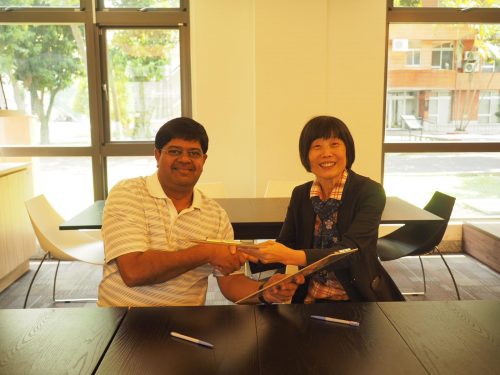
Dr. James Gomez, Chair, Board of Directors, Asia Centre and Professor Jau-hwa Chen, Director, Chang Fo Chuan, Centre for the Study of Human Rights, Soochow University, signed a Memorandum of Understanding (MOU) on 12 May 2019, in Taipei, Taiwan. The MOU signing stems from Asia Centre’s participation in previous activities at Soochow University. For instance in November 2018, Dr. Gomez presented at a roundtable discussion the findings from the Centre’s book “The UPR of Southeast Asia: Civil Society Perspectives”. In March 2019, Dr. Gomez visited the Chang Fo Chuan, Centre for the Study of Human Rights at Soochow University to discuss Asia Centre’s participation in two meetings entitled, “Workshop on Advocacy of Asian Human Rights Court”. These workshops planned for May and July 2019 in Taiwan aim to explore the establishment of a Asian Human Rights Court or mechanism to seek redress for human rights violations. During this visit an initial discussion was also held to sign an MOU between the two Centres to facilitate further cooperation. The partnership was signed following the successful completion of the first Workshop of Advocacy for Asian Human Rights Court from 9-12 May 2019 in which Dr. James Gomez and Yawee Butrkrawee from Asia Centre participated. The second Workshop of Advocacy for Asian Human Rights Court will take place from 11 to 14 July 2019 and will focus on business and human rights, especially women’s rights, in the context of APEC. The 5 year MOU between the two Centres will cover collaborations in research, events, trainings and internships. The MOU signing forms part of Asia Centre’s strategy to engage externally and build more partnerships globally.
Orientation on Fake News and Disinformation in Southeast Asia

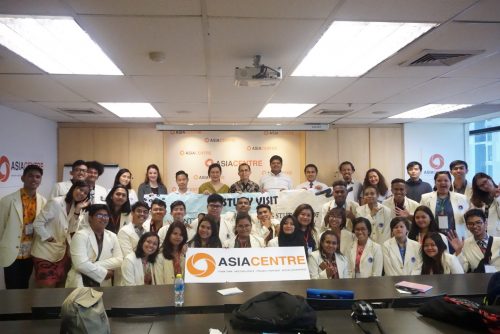
On Monday 29 April 2019, Asia Centre hosted Indonesian Embassy’s Education and Cultural Attaché Prof. Dr. Mustari M.Pd. and a group of International Relations students from Satya Wacana Christian University, Indonesia as part of the Centre’s engagement with Indonesia. The visit started with an introduction about the work of Asia Centre by Yawee Butrkrawee (Programme Coordinator), followed by a presentation on the Centre’s three year project on Fake News and Freedom of Expression in Southeast Asia, provided by Tessa Alleblas (Research & Grants Officer). Lively discussions with the students ensued and focused on how exactly fake news is defined, global media and communication trends and the way fake news has affected important matters in Indonesia. The students voiced their opinions on what exactly fake news was and how it manifested on various incidents in Indonesia such as the run-up period to the general election, during natural disasters as well as the accident when the Lion Air Flight 601 crashed into the Java Sea. Yawee Butrkrawee also shared his observation on Thai politics and the recently held elections, drawing a similar comparison on how fake news and disinformation affected democractic institutions and practices. The students enthusiastically exchanged ideas on how fake news has influenced critical juncture and public individuals during the gubernatorial elections in Jakarta in 2017, which was plagued by fake news. The latter half of the discussion focused on how we can combat fake news and the students provided some interesting approaches where they suggested that the government should be the one providing factual information and that citizens themselves also have a responsibility in the sense that they need to critically analyse the data that is provided to them before considering any of it to be true. Furthermore, technology companies should be involved and help suspend or block any suspicious, fake accounts spreading malicious and misleading information through social media platforms. The visit was a comprehensive exchange of ideas where everyone shared a piece of their thoughts and viewpoints. Asia Centre and Satya Wacana Christian University signed an MOU on 5 March 2019. Asia Centre looks forward to continued interactions and future collaboration with Satya Wacana Christian University. Asia Centre hosts student groups on a regular basis and welcome such exchanges, and looks forward to further exchanges with students and academics in Indonesia and beyond.
Media Literacy As a Tool Against Fake News in Malaysia

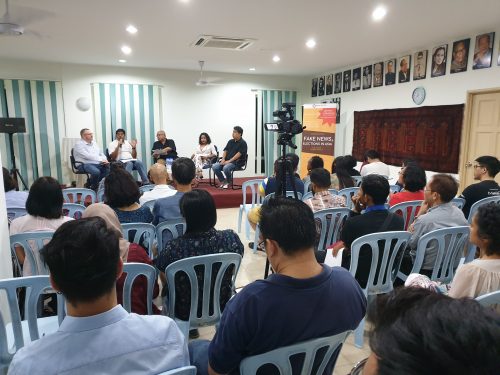
Media literacy could be the new stratagem for Malaysia instead of the Fake News Bill, however the role of governments in such programmes needs to be carefully evaluated. On Tuesday 16 April Asia Centre, University of Nottingham and Gerakbudaya Bookshop jointly organized the seminar entitled the Fake News Industry: Developments in SEA & Malaysia. Participants examined the various non-legal measures put in place to tackle issues surrounding fake news affecting Malaysia and the wider region. Apart from fact-checking, the suggestion that gained most traction was media literacy programmes. Some of the ideas concerned going beyond media literacy for university students to training both young children in schools as well as their educators to help discern authentic news from fake ones. Participants suggested that media literacy trainers could be from different disciplines such as academics, teachers, NGOs specialists, journalists as well as parents. The panelists were Dr James Gomez, Chair, Board of Directors of Asia Centre; Jahabar Sadiq, Editor of Malaysian Insight; Dr Craig J Selby, Managing Director of public relations firm, Orchan Consulting; and Darshini Kandasamy, an Editor at Malaysiakini. The roundtable was moderated by Professor Zaharom Nain of University of Nottingham, Malaysia. Dr James Gomez started the discussion with a regional overview of fake news legislation with some recent highlights from Singapore. He commented how governments try to manage the eroding trust of the people and how media literacy can be fake news put out by governments. Jahabar Sadiq spoke from a media owner’s perspective and gave colorful anecdotes of his experience with fake news. He pointed out that nowadays media is preoccupied with calling out what news is fake rather than publishing news. The media is therefore also in some ways indirectly involved in promoting media literacy. Darshini Kandasamy addressed the media’s own role in dealing with fake news and disinformation. She said many people are not media literate and that’s why people forward messages even if they don’t know whether it is true or not. She noted that there is a lack of media literacy among the older generations. Craig J Selby spoke about the fake news industry from the public relations and trust communications angle. He mentioned that increasingly corporate brands are being affected by fake news and this can jeopardize brand value. Craig ended with the note that laws need to be revised in such a way that people are educated to combat fake news and know what is authentic before making statements or videos “viral” Professor Zaharom Nain, who moderated the discussion, welcomed the panel’s strong arguments and suggestions in favor of media literacy. Media literacy programmes can help people spot fake news. However, he pointed out that limited resources, lack of sustainability of media literacy programmes, and the mere fact that governments play a role in leading media literacy programmes are issues that have to be considered. At the end of the day such literacy programmes need to achieve the real goal of combating fake news, a lot of which are also spread by governments. The Seminar, which attracted over 60 participants, is part of Asia Centre’s ongoing 3 year project on fake news. The occasion was an opportunity for Asia Centre to engage with a Malaysian audience and deepen its existing relationship with local partners Gerakbuday and University of Nottingham. During his visit to Malaysia, Dr. James Gomez had the opportunity to discuss fake news legislation in the region and its impact on elections with presenter Lyn Mak on the programme Pressing Matters, 89.9 BFM, The Business Station, Malaysia. https://www.bfm.my/…/pr…/pm-james-gomez-director-asia-centre Those interested in Asia Centre’s Int. Conference on Fake News and Elections in Asia can sign up at https://goo.gl/forms/Pef1TKvG1OYJIjxl2 or email research@asiacentre.org
Vague Fake News Laws Lead To Over Criminalisation In South East Asia

Since 2017, ASEAN member states have either introduced new legislation, revised existing laws or are using current regulations to penalise individuals and organisations for disseminating fake news often citing the need to curb hate speech as a primary reason. However, the definition of what is “fake” in the provisions of these legal measures is vague. Furthermore, the government’s central role in defining what is fake news within these laws deepens the problem. A key issue is that once these legislations are in place, it allows individuals and organisations to be accused of transgressing such laws. As most laws on fake news carry hefty fines and severe jail terms, it becomes a weapon of choice for accusers to silence critics. As a result, these laws, rather than proving to be an effective tool against disinformation, have become political weapons and result in over criminalisation. What are the main consequences of these laws? Firstly, the vaguely worded laws allow complaints to be easily filed by opponents against each other. Often this is done by politicians from incumbent regimes against their critics using hate speech and defamation as reasons. In the politicalarena, especially during critical junctures such as elections, accusations of disseminating fake news or disinformation are aimed to dislodge the momentum of opponents’ political campaigns, trigger dissolution of opposing political parties or nullify votes that have already been cast. Secondly, it allows complaints to be filed by government agencies. Here, criticisms or voicing opinions against public office holders or public institutions become a criminal offense. Such actions are directly contrary to the principle of holding government officials publicly accountable. Instead of being answerable to the public and subject to scrutiny and transparency checks, public officialsand institutions may use these laws to criminalise critics. Thirdly, such laws may criminalise technology companies such as platform service providers. Governments want to hold technology companies accountable for being the platforms over which disinformation is spread. Even though, these companies often protest that such legislations impact freedom of expression, they have nevertheless begun to remove content and block pages as well as suggest smart regulation. At the heart of problem lies the issue of trust, or, to be specific, the trust in public officials and institutions. Hence, ordinary citizens share personal encounters or look for alternative sources because they do not trust the information that comes from government officials and state-controlled media. In Southeast Asia, government officials tend to shield themselves and their institutions from criticisms by framing censures for their actions as fake news. Add to this governments’ efforts to eradicate “fake news” through vague laws, it then further dilutes the already worn out trust. Silencing critics in the name of fake news increases self-censorship which in turn impacts freedom of expression. This is huge problem, because it essentially criminalises free speech which is a basic human right. So as long as what constitutes fake news is vaguely defined in laws and governments are central to defining what is “fake”, it will result in over criminalisation. This increases self-censorship and impacts freedom of expression rather than solving the fake news problem. Asia Centre’s seminar The Fake News Industry: Developments in SEA & Malaysia, 16 April, Gerakbudaya, Malaysia, will discuss recent efforts to combat fake news, disinformation and misinformation by media, government and technology companies in Southeast Asia. The Centre will examine these and other issues at its upcoming conference on Int. Conference on Fake News and Elections in Asia, 10-12 July 2019 in Bangkok, Thailand. Register online to present or participate at https://goo.gl/forms/Pef1TKvG1OYJIjxl2 Dr. James Gomez is Chair, Board of Directors, Asia Centre. He is also the convener of Asia Centre’s upcoming International Conference on Fake News and Elections in Asia, 10-12 July, Bangkok, Thailand. For more information about the conference email: research@asiacentre.org
IFC #5: Southeast Asia in the Age of Disinformation

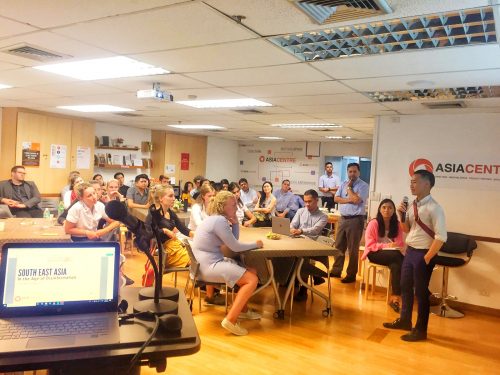
On 21 March 2019, Asia Centre and Stenden Thailand co-hosted the fifth International Faculty Club which focused on Southeast Asia in the Age of Disinformation. In Southeast Asia, there are more than 400 million Internet users. Since January 2019, internet penetration is 63% and social media penetration is 61%. These numbers show that people increasingly consume media on digital media and social media platforms, instead of traditional media. As content creation on social media is immediate and not subject to regulations, it can easily be used to spread fake news and disinformation. The IFC gave insight into how disinformation is incorporated in mainstream and social media platforms. Speakers from different disciplines presented on a variety of emerging issues and research areas. Oliver Thompson, the Centre’s research intern from Griffith University, Australia gave a brief overview about “The New Colombo Plan Scholarship” which gives Australian students the opportunity to undertake studies and internships in the Asia-Pacific. Maika Brouwer, Gaby von Picartz and Marit van Eeden from Stenden University presented on the nature and evolution of disinformation. They noted that disinformation is nothing new and continues to mislead the audience. The lower the press freedom in a region, the greater the chances of disinformation being spread. Disinformation is not something that can be solved but only limited. The best weapon against disinformation is knowledge and education. The inoculation theory helps people achieve resistance to persuasion. Chris Oestereich, a faculty member at Thammasat University’s School of Global Studies, shared some of the findings from his research regarding disinformation around the Brexit campaign, while also discussing legal and societal challenges those events uncovered. He provided a brief yet crisp history about how David Cameron called the EU referendum in the year 2016 and then resigned when the results came in and a list of the problems around Brexit disinformation. Chris is adamant that Facebook should take responsibility for all of its wrong-doings. He stated that with social media, we have built space to a new type of information war for which our governments are unprepared for. Yawee Butrkrawee, Asia Centre’s Programme Coordinator, spoke about disinformation in regard to Thai politics and the much anticipated elections. Yawee put forward his opinions on how disinformation could cause great political turmoil. Disinformation in politics is aimed at inflencing the minds of the voters causing them to change their votes. The low cost of circulating disinformation in social media has magnified this issue. Michael Picard, an independent researcher specialising in armed violence and arms control issues, provided a captivating talk about his research on firearms in South East Asia. He said that the Southeast Asian nations are among the largest procurers of small firearms with Thailand being the most thoroughly armed with almost 10 million guns in civilian hands. Thailand has a history of armed violence tied to political upheavals. Disinformation is deviling governments causing political unrest, generating violence. The Q&A session that followed the presentations deliberated on disinformation and its root causes. Broadly, the consensus was there really isn’t a solution to resolve disinformation but the situation isn’t completely hopeless. ‘Media Literacy” was seen as a crucial skill in the digital age. The influence of media should never be underestimated, hence it is important that the citizens of Southeast Asia and around the world should start climbing the ladder of media literacy. The IFC attracted over 40 participants from various disciplines. Asia Centre will continue to engage with the community through the IFC in 2019 and seek new, innovative research and projects being undertaken in Bangkok, the region and also globally. Upcoming events of the centre in Kuala Lumpur, Malaysia are The Fake News Industry: Developments in SEA & Malaysia on 16 April 2019 and in Bangkok, Thailand Asia Centre’s fourth anniversary “Nite for Rights” on 19 June 2019. The Centre will also hold the International Conference on Fake News and Elections in Asia. To submit abstracts email: contact@asiacentre.org. For more information visit Asia Centre’s website. Previous Next
Asia Centre signs MOU with NSHM Knowledge Campus in Kolkata

Dr. James Gomez, Chair, Board of Directors, Asia Centre and Cecil Anthony, Chief Mentor, NSHM Knowledge Campus signed a Memorandum of Understanding (MOU) on 8 March 2019 in Kolkata, India to further cooperation between the two institutions. The signing took place during NSHM Knowledge Campus’s International Conference on Media and Society on 8 and 9 March 2019. During the Inauguration Session of the event, Dr Gomez said that the MOU can help NHSM Knowledge Campus extend its reach to Southeast Asia. At the International Conference, Asia Centre was the official partner for the Technical Session “Media & Human Rights” on 9 March 2019. During the Technical Session, Ms. Tessa Alleblas, the Centre’s Research and Grants Officer highlighted the legal trends to combat fake news and its impact on freedom of expression in Southeast Asia. The MOU marks the second that Asia Centre has signed with an institution in Kolkata, India, the previous being with Calcutta University. There are plans to sign a third MOU with the Kolkata Chapter of the Observer Research Foundation later in March 2019. The MOU signings with institutions in Kolkata are part of the Centre’s strategy to engage at the people-to-people level with India’s Act East Policy towards Southeast Asia.
Asia Centre seals MOU with Indonesia’s Satya Wacana Christian University

Dr. James Gomez, Chair, Board of Directors, ASIA Centre and Professor Neil Semuel Rupidara, Rector, Satya Wacana Christian University signed a Memorandum of Understanding (MOU) on 5 March 2019 in Semarang, Indonesia. The MOU outlined the area of collaborations that covered research, joint events, trainings and internship. The partnership was signed following the two entities’ first joint general studies panel. Entitled “Religion, Media and Politics in Southeast Asia”, the event was organised in collaboration with the Faculty of Social Science and Communications, Faculty of Theology and the Centre for the Study of Religion, Pluralism and Democracy. Attended by 100 students and staff, the panel discussed religion and politics in practice in Indonesia and the role of social media in propagating fake news and hate speech for voter mobilization in the run up to the 17th April 2019 presidential election. As a follow up to the MOU and the first joint activity, Satya Wacana Christian University will organise a student study tour to Asia Centre on 29 April 2019.
ASIA Centre inks MOU with Calcutta University

Dr. James Gomez, Chair, Board of Directors, Asia Centre and Professor Sonali Chakravarti Banerjee, Vice Chancellor, Calcutta University’s signed a Memorandum of Understanding (MOU) on 8 February 2019 in Kolkata, India. The MOU signing was part of the Government of West Bengal’s push for its universities to collaborate with knowledge partners abroad. The event was witnessed by Kolkata’s Chief Minister, Mamata Banarjee during the 5th Bengal Global Business Summit that took place on 7-8 February 2019. For Asia Centre, the MOU signings form part of the Centre’s strategy to engage externally and build more partnerships globally. Asia Centre will be undertaking more partnerships in the near future. In March 2019, the Centre will take forward its discussions with NSHM Knowledge Campus (Kolkata) to sign an MOU which focuses on collaborations related to issues concerning Southeast Asia. The MOU signing will take place on 8 March 2019 during a two-day International seminar (Y-Factor 2019) titled “Media and Society” on March 8, 9 at Lake Club, Kolkata.