Asia Centre Launches Report on Political Hate Sites in Singapore

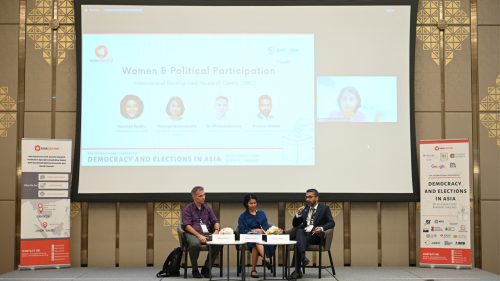
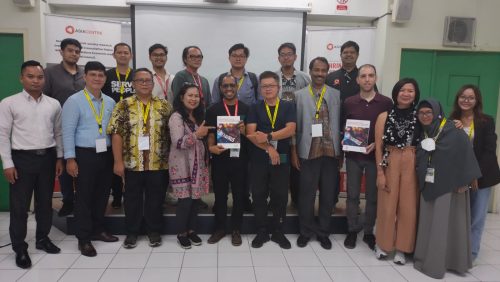
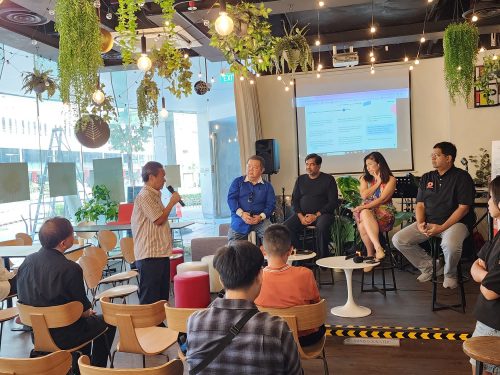
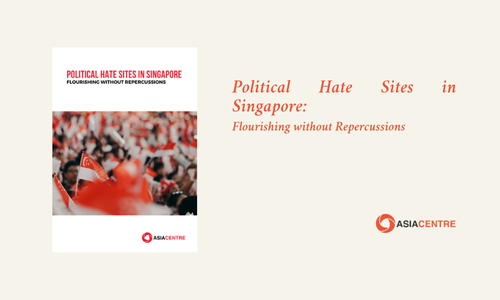
On 8 July 2023, Asia Centre held a discussion panel for the launch of its newest report, Political Hate Sites in Singapore: Flourishing without Repercussions. The event, jointly organised with two Singapore-based independent media platforms: The Independent Singapore and Wake Up Singapore, gained over 30 participants. To promote the launch event, Asia Centre released two promotional videos on its social media platforms introducing what are political hate sites in Singapore. Additionally,  The Independent Singapore, one of the organising partners, published a promotional pre-event article, and The Online Citizen, a regional news platform based in Taiwan, released an audio post of Dr James Gomez, Asia Centre’s regional director, providing a summarised definition of political hate sites. Shortly after its release on 8 July 2023, Agencia EFE, a Spanish international news agency, reported the findings of the report in its article “Aumentan los discursos de odio contra opositores y activistas en Singapur, según estudio” (Hate speech against opponents and activists on the rise in Singapore, study finds) with SWI swissinfo.ch – the Swiss news and information platform. This is followed by another article published by The Online Citizen, a regional news platform based in Taiwan on 9 July 2023, “Asia Centre report highlights the proliferation of unchecked hate sites in Singapore” to share its findings. Besides, the key research findings were also promoted via an online campaign with infographics and infographic video posted on Asia Centre’s social media platforms, Facebook, Linkedin, Instagram, Twitter and Tiktok. The event, held at Palms Bistro, Singapore, was attended by lay Singaporeans, members of the opposition political parties, media activists and journalists of independent media platforms. Dr James Gomez, Asia Centre’s regional director, delivered the presentation about the report’s findings and highlighted how many Singaporeans often overlook the existence of such political hate sites due to the normalisation of hate speech in political discourse and debate in Parliament and the mainstream media. Through the 3 phases of internet control and various laws and legislations, the state has controlled and regulated political discourse and participation of the opposition parties, media advocates, independent journalists and media platforms, thereby narrowing the space of critical political discourse both offline and online. The report has identified the proliferation of hate content and hate sites online as the fourth phase of internet control, whereby Dr James expounded on the traits, tactics and targets of political hate sites by presenting 4 case studies as identified by the report. Moderated by Craig Teo of Reverse Auction & Financial Services Consultant, the findings were further discussed by Wendy Low of Eldan Law LLP, Jeannette Chong-Aruldoss, a prominent lawyer with 30 years of experience and a former politician, and Kumaran Pillai of The independent Singapore. Wendy Low presented over a pre-recorded video the strategies that victims of online hate speech can utilise to seek legal justice against their perpetrators through four main strategies; identifying the hater before taking legal actions, building one’s narrative through independent news platforms to amplify one’s side of the story, remaining above board by exercising transparency in the investigation process and using existing laws on harassments (such as POHA) against the perpetrators of hate. Jeannette Chong Aruldoss pointed out that the public has generally accepted certain behaviours and speech which disable them from identifying the hate narratives contained within them. Hate speech is a dangerous, divisive tool to society and must be curbed not just by legislation but also by civic actions from the members of society. Bringing in the insider’s perspective as an independent media practitioner, Kumaran Pillai asserts that the incumbent political party has distorted the online landscape for political discourse and restricts the space for different political parties and the general public to contest for the best ideas through constructive debates on policies and to call for accountability of public officials. In the report, Asia Centre recommends the international community, UN bodies, Singapore parliament, political parties, tech companies, and civil society organisations to 1) monitor, document, and call out cases of online hate speech in Singapore; 2) use UN mechanisms to engage with the Singaporean government to address political hate speech and commit itself to international standards of freedom of expression; 3) advocate for the amendment of laws restricting freedom of expression; 4) develop new technology solutions to improve the detection of online hate speech; and 5) work cooperatively to consider everyone’s views in the development of new strategies to address online hate speech. This small cluster of critical voices is a manifestation of a larger, suppressed and silent resistance to the ruling regime in Singapore. Improved internet freedoms and safety to voice criticisms will provide the necessary valve to express democratic aspirations in Singapore without risking unnecessary and abrupt political upheavals. Read the full report here. You can also watch the TikTok video of the report launch event here, as well as the infographic video here. This report is Asia Centre’s first report on Singapore. The Centre has published four other reports on internet freedoms in Southeast Asia: Internet Freedoms in Malaysia: Regulating Online Discourse on Race, Religion, and Royalty (2023) Internet Freedoms in Cambodia: A Gateway to Control (2021) Timor-Leste: Internet Freedoms Under Threat (2021) Myanmar: Dismantling Dissent – Crackdowns on Internet Freedoms (2021) Asia Centre is a civil society research institute in Special Consultative Status with the United Nations Economic and Social Council. It serves as a knowledge partner and undertakes evidence-based research as well as provides capacity-building training for end beneficiaries. If you would like to collaborate with the Centre, please send an expression of interest to contact@asiacentre.org.

Team Malaysia Wins Hackathon on ASEAN-EU Relations: Will Travel  to Germany

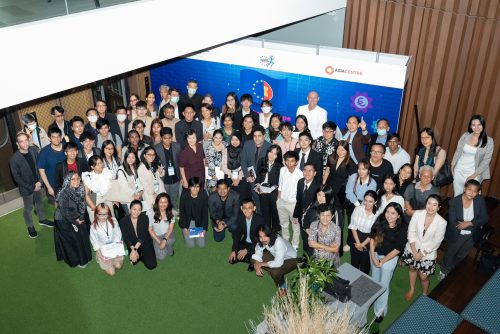
Between 21 and 23 July 2023, the Asia Centre and Friedrich Naumann Foundation for Freedom Southeast & East Asia jointly organised the #Reshaping Europe: Hackathon on the ASEAN-EU Relations. The primary objective of the Hackathon was to provide young leaders with an opportunity to propose initiatives aimed at enhancing the relationship between ASEAN and the EU. During the event, ten teams of two participants each from Southeast and East Asia worked on developing and presenting their project ideas to a wider audience. Participants were required to align the goals of their initiatives with trade and economic cooperation between ASEAN and EU or the promotion of human rights and democracy.  The ten teams were selected from a pool of 175 applications originating from various East and Southeast Asian countries. After several rounds of evaluations conducted by the Asia Centre, FNF Regional Office, and FNF Country Offices, these were the ten participating teams in the Hackathon: Indonesia A: Muhammad Ridho Izzulhaq and Aryo Bagas Indonesia B: Muhammad Ananda Maulana and Chendy Pusputa Malaysia: Nurilly Rania Jusly and Dean Delaina Denis Ejoh Myanmar: Myat Thu and Eaindray Myint Mo Philippines: Prince Ernest Eugene Ronson D. Sabado and Crizelle Quiniquini Joya South Korea: Ha Neul Kim and Truston Yu Taiwan: Hui En Chang and Ting Yu Sun Thailand A: Pakornwit Wiangsripanawan and Apisara Haingsa Thailand B: Narisara Charoensap and Kamonchai Chalee Vietnam: Nhi Dung Hoang and Trang Minh Nguyen The Hackathon activities spanned three days and included an introduction, keynote speeches, hacking sessions and project presentations. On the first day, the Hackathon kicked off with opening remarks by Dr James Gomez, Regional Director of Asia Centre, and Mr Moritz Kleine-Brockhoff, Head of the Regional Office of Southeast and East Asia of Friedrich Naumann Foundation. Following the opening remarks, Dr Marc Pinol Rovira, Research Manager of Asia Centre, introduced the policy report “EU-ASEAN Relations in Light of the War in Ukraine”, highlighting the potential benefits and challenges of deeper integration between the two blocs. The keynote speeches were delivered by Dr Vachararutai Boontinand from Mahidol University and Dr Suwannarat Meesomboonpoonsuk from Thammasat University. Dr Boontinand’s speech focused on human rights and democracy in the ASEAN-EU integration, while Dr Meesomboonpoonsuk discussed existing economic cooperation between ASEAN and EU and provided examples of economic and institutional limitations faced by both blocs. On the second day, teams were assigned to one of the four mentors: Associate Professor Surachanee Sriyai and Associate Professor Dr Narut Charoensri from Chiang Mai University and Dr Marc Piñol Rovira and Lina Sakina Salim from the Asia Centre. Each team thereafter had several hacking sessions to develop their projects and separately consulted with their assigned mentors to identify potential challenges and come up with solutions. In the afternoon of the third day, the teams showcased their projects to over 40 members of the public. The judging panel consisted of Dr James Gomez from Asia Centre, Asst. Prof. Dr Natthanan Kunnamas from Chulalongkorn University, and Ed Legaspi, former Executive Director of SEAPA (Southeast Asian Press Alliance). These were the presentations by the ten teams: Indonesia A: DemocraSEA Indonesia B: ASEAN-EU Strategic Partnership on Critical Raw Materials Malaysia: Connecting Futures: ASEAN-EU Changemaker Ambassador Myanmar: Garmify Philippines:  Bridging the Gap of Educational Inequalities South Korea: Programme on EU-ASEAN Connectivity Taiwan: Med It Together Thailand A: Foodscape Thailand B: Identity Diversity Vietnam: EduStation After each presentation, the three judges had the opportunity to ask questions to all presenters, allowing the teams to elaborate further on their projects.  The combined scores of the three judges resulted in Team Malaysia being declared the winner of the regional hackathon. As a result, Team Malaysia will present its project at the upcoming FNF Annual Conference in Berlin, Germany, in October 2023. Watch the highlights of the Hackathon

Oxfam Young Leaders Fellowship Programme 2023 Kicks Off

A total of seven speakers, one facilitator, three project coaches, and two field visits made up the programme activity for Induction Meeting for eight Oxfam Fellows from 10 to 14 July 2023 in Bangkok, co-convened by Asia Centre and Oxfam.  The Induction Meeting was part of the Oxfam Young Leaders Fellowship Programme 2023, which aims to provide tools to empower young people with hands-on training and close mentorship to strengthen their capacity to make social change happen. The eight fellows, constituting the inaugural cohort of the fellowship programme, who participated in the event are Lamia Mohsin from Bangladesh, Sanjana Chettri and Soumya Mishra from India, Chikita Edrini Marpaung from Indonesia, Wajid Zahid from Pakistan, Ellenor Bartolome and Gerald John C. Guillermo from the Philippines, and Ricardo Valente Araujo from Timor-Leste. Fellows were selected from a diverse pool of over 400 candidates from Asia by the judginging panel consisting of Oxfam, Asia Centre, and external judges. Together, they represent a group of individuals with a strong determination to bring about positive change within their respective societies. They have devised innovative ideas aimed at improving their communities and have taken steps towards implementing them. Their projects are focused on addressing pressing global issues, such as climate justice, women’s rights, and the preservation of civic space.  The induction meeting consisted of five leadership modules: “Development Challenges of Our Era,” “The Role of CSOs,” “Global Development Actors and their Legitimacy,” “Gender Justice in Today’s World,” and “Youth Leadership and Advocacy and Campaigning Tools.” These modules were specifically designed to equip the fellows with the essential skills required for their project implementation. Both the Asia Centre and Oxfam had their staff participate as lecturers for these modules. Representing the Asia Centre were Dr James Gomez, the Regional Director, and Dr Marc Pinol Rovira, the Centre’s Research Manager. Joining them from Oxfam in Asia were John Samuel, Regional Director, and Mustafa Talpur, Head of Advocacy and Campaigns. Eight speakers who work on a wide range of global issues were invited to share their knowledge and experiences with the fellows:  Minh Tran, from Stockholm Environment Institute. Wilfried Herrmann, from Human Development Forum Foundation Hnin Wut Yee, form Corporate Accountability Myanmar Poramet Tangsathaporn, from Bangkok Post Wipaphan Wongsawang, from Thaiconsent Kewalin Sa-ngapet, from Friedrich Naumann Foundation for Freedom Saijai Liangpunsakul, from Myanmar Witness And Matt Yutthaworakool, from ASEAN Youth Advisory Group. The Fellows made two site visits, one to the Foreign Correspondents’ Club of Thailand (FCCT) and another to Google Thailand. At FCCT, they interacted with renowned journalists such as Fransesca Regalado, Bangkok correspondent of Nikkei Asia, Rebecca Ratcliffe, Southeast Asia correspondent of Guardian News and Media, and Jonathan Head, Southeast Asia correspondent of BBC News. This encounter shed light on how media can play a crucial role in implementing the fellows’ projects under the fellowship programme. At Google Thailand, the Fellows participated in a workshop on Digital Verification, learning about information disorders and tools to verify online information. Throughout the sessions that were organised during the induction meeting, the fellows had the opportunity to present their project to other fellows as well as to Asia Centre and Oxfam. Chettri’s initiative is to build political consciousness among first-generation learners in India’s northeast region. Zahid’s project aims to train journalists and online content creators on fair and inclusive representation of marginalised groups. Mishra’s podcast will chronicle the stories of queer-disabled individuals in India. Mohsin’s presentation focused on training young people living in disaster-prone areas of Bangladesh. Valente Araujo proposed a virtual community platform for Gen Z to express their views on social issues. Marpaung planned to provide legal education to young people about their fundamental human rights. Guillermo aimed at creating opportunities for Filipino youth to participate in formal political and governance processes. Bartolome’s presentation was on training aspiring young public servants and youth leaders through five different modules.  The presentations were followed by constructive Q&A sessions involving the fellows and members of Asia Centre and Oxfam. The fellows also received valuable feedback from Asia Centre and Oxfam to enhance their project planning.  Towards the end of the meeting, the fellows shared their impressions and reflections. 67 percent of the fellows think the meeting has significantly increased their knowledge on the implementation of their project, according to the survey. One fellow noted that “the feedback received from coaches, particularly regarding innovation and social entrepreneurship models for sustainability, will undoubtedly assist me in making my initiatives more effective and sustainable”. One conclusion shared by the fellows is that the fellowship programme has not only  taught them how to become leaders but will also inspire others to become leaders and make social changes. Over the course of the next nine months, under the guidance and mentorship of Asia Centre and Oxfam, these fellows will carry out their transformative initiatives in their home countries. Get to know the eight fellows and their projects Watch the highlights of the induction meeting

Political Hate Sites in Singapore: Flourishing without Repercussions

Download Full Report Political Hate Sites in Singapore: Flourishing without Repercussions explains how hate sites and internet brigades seek to maliciously negate the criticism of public officials and policy in Singapore. Targets of hate sites include activists, bloggers, civil society organisations, independent media outlets and journalists, human rights lawyers, and opposition political parties and politicians. Singapore, a one-party dominated state, has regularly updated and passed new legislation that criminalises criticism of its public officials and policies, leaving only a narrow margin for expressing dissenting views within the established legal boundaries. As a result, the government can repress opposition voices through the tight policing of political expression both offline and online. This includes blocking, removing, and delegitimising critical online content, as well as prosecuting content creators and distributors. This leads to the manipulation of the public narrative and fosters widespread self-censorship. Despite these measures, there is an underbelly of critical voices that continue to occupy the extremely limited space allowed by the law. In the last few years, these voices have experienced an increase in targeted attacks and hate speech by pro-government hate sites and internet brigades. Yet, public officials and technology companies remain silent about these hate sites and the coordinated inauthentic behaviour of internet brigades. Meanwhile, current laws and content moderation policies to protect them remain inadequate and insufficient. Hence, this report recommends the international community, UN bodies, Singapore parliament, political parties, tech companies, and civil society organisations to 1) monitor, document, and call out cases of online hate speech in Singapore; 2) use UN mechanisms to engage with the Singaporean government to address political hate speech and commit itself to international standards of freedom of expression; 3) advocate for the amendment of laws restricting freedom of expression; 4) develop new technology solutions to improve the detection of online hate speech; and 5) work cooperatively to consider everyone’s views in the development of new strategies to address online hate speech. This small cluster of critical voices is a manifestation of a larger, suppressed and silent resistance to the ruling regime in Singapore. Improved internet freedoms and safety to voice criticisms will provide the necessary valve to express democratic aspirations within Singapore society without risking any unnecessary and abrupt political upheavals.

Asia Centre Launches Report on Burmanisation and Buddhisation

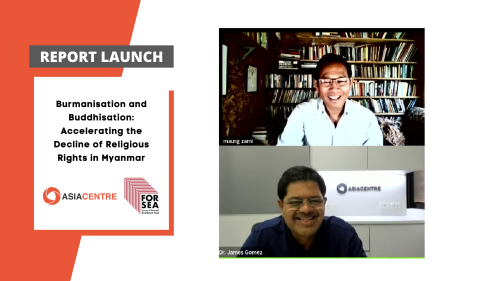
On 13 June 2023, Asia Centre and FORSEA held a virtual launch and discussion of Asia Centre’s latest report Burmanisation and Buddhisation: The Coup’s Impact on Religious Minorities. The event, which was hosted on FORSEA’s Youtube channel, received over 60 views within the first night. The report was first released online to the public and the media on 8 June 2023. The next day, The Online Citizen published an article, “Asia Centre highlights Myanmar’s alarming erosion of religious rights in new report.”  Asia Centre was also invited to present the report at a closed-door meeting with representatives of INGOs and local partners interested in the state of FoRB in Myanmar. This meeting not only discussed the impacts of the 2021 coup on the state of Freedom of Religion or Belief (FoRB) in Myanmar and the ideologies of Burmanisation and Buddhisation, but also included a discussion about the impact of FoRB violations on indigenous peoples and their commitment to environmental protection. The key research findings were additionally promoted via an online campaign with infographics posted on Asia Centre’s social media platforms, Facebook, Linkedin, and Instagram. In less than a week of releasing the report online, there have already been over 1,500 downloads. In the report launch event, Dr. Gomez elaborated on the definitions of “Burmanisation and Buddhisation”, framing these two concepts as political ideologies of the Military in its pursuit of combatting terrorism and national security threats posed by the diverse ethno-religious communities of the nation. The discussion also brought comparisons between the situation in Myanmar with neighbouring countries such as Sri Lanka and Malaysia on the politicisation of national and religious identities to serve the aims of the ruling governments.  The report launch also highlighted the recommendations that can be adopted by the international community, INGOs, and CSOs to reduce the impact of the coup on Religious Freedoms in Myanmar. While the government is strongly urged to review, repeal and amend laws that are discriminatory, NGOs and CSOs have an active role to monitor and report the infringement of rights by the state. The report aims to provide a baseline study on the state of freedom of religion or belief, and how developments related to the 2021 coup have impacted the rights of ethno-religious minorities. The policy report is part of Asia Centre’s FoRB Knowledge Hub efforts to publish evidence-based research and increase advocacy for the religious rights of people in Southeast Asia.    Read the full report here. Watch the YouTube livestream recording here. Asia Centre is a civil society research institute in Special Consultative Status with the United Nations Economic and Social Council. It serves as a knowledge partner and undertakes evidence-based research as well as provides capacity-building training for end beneficiaries. If you would like to collaborate with the Centre, please send an expression of interest to contact@asiacentre.org.

Asia Centre and Oxfam Announce Fellows for the Oxfam Young Leaders Fellowship Programme 2023

Asia Centre and Oxfam in Asia are pleased to announce the fellows for the Oxfam Young Leaders Fellowship Programme 2023! The fellowship will provide tools to empower young people with hands-on training and close mentorship to strengthen their capacity to make social change happen. These individuals have been carefully chosen from a diverse pool of over 400 candidates hailing from Asia. These eight fellows represent a group of remarkable individuals who possess the vision and determination to bring about positive change within their respective societies. They have devised innovative ideas aimed at improving their communities and have taken steps towards implementing them. Their projects are focused on addressing pressing global issues, such as climate justice, women’s rights, and the preservation of civic space. Over the course of the next nine months, under the guidance and mentorship of Asia Centre and Oxfam, these fellows will carry out their transformative initiatives in their home countries. Dr James Gomez  Regional Director, Asia Centre Congratulations to all the talented young people who have been selected for the Oxfam Young Leaders Fellowship Programme 2023! Your passion, innovative ideas, and commitment to social justice are commendable. This fellowship is a remarkable opportunity to make a real impact in addressing pressing issues such as inequality, climate change, and gender justice. Through mentorship, training, and international exposure, you will gain invaluable skills and connections to bring about positive change. Asia Centre eagerly looks forward to witnessing the incredible contributions you will make. Best of luck on this exciting journey! To know more about the fellows, download and read the Oxfam Fellowship – Meet The Fellows Booklet here.

The Threat of State-sponsored Disinformation to the Integrity of Election in Thailand

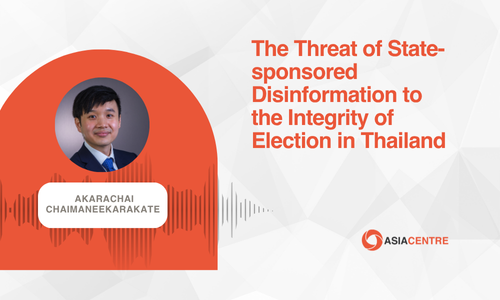
This podcast episode is part of the report “State-Sponsored Online Disinformation in Thailand: Impact on Electoral Integrity in Thailand”. The report examines government-backed disinformation campaigns, known as information operations, and assesses their impact on the integrity of elections. The report identifies key actions domestic and international state actors contribute to false information campaigns. Based on the evidence of information operations in Thailand and the absence of effective legal and non-legal measures to address them, the 2023 Thai General Election is expected to experience its share of state-sponsored disinformation over social media platforms. So what happened? This episode examines these issues. Our discussant for this episode is Akarachai Chaimaneekarakate, a Harvard Law School graduate. Akarachai is a Legal Fellow at Thai Lawyers for Human Rights (TLHR). The main focus of his work is to explore ways in which international human rights law can be used to promote and advance the protection of human rights in Thailand. Before TLHR, Akarachai worked as a legal advocate for refugees in Bangkok. He also worked with the Office of the Co-Prosecutors at the Extraordinary Chambers in the Courts of Cambodia, focusing on prosecuting senior military officers in Cambodia accused of crimes against humanity, war crimes, and genocide.

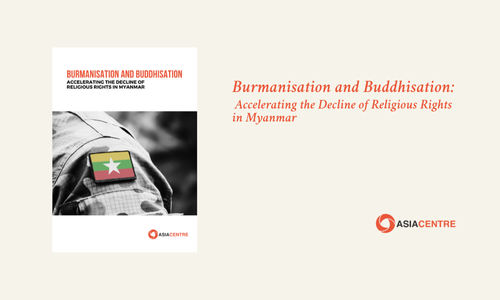
Burmanisation and Buddhisation: Accelerating the Decline of Religious Rights in Myanmar

Download Full Report Burmanisation and Buddhisation: Accelerating the Decline of Religious Rights in Myanmar exposes the rapid decline of religious rights among minority communities following the 2021 military coup. Burmanisation and Buddhisation, two policies that have shaped Myanmar’s identity landscape since the colonial era, are now justified as a response to ensure national security and address the threat of terrorism. Under this response, minority ethno-religious communities are being targeted as subversive forces to be dealt with. This results in four key impacts. One, ethno-religious communities are targeted with violence and military attacks to silence their calls for autonomy. Two, religious sites predominantly belonging to minority religions and communities are subject to damage, destruction, and occupation by the military and pro-military groups. Three, members of minority groups are arbitrarily detained based on religious affiliation, often subjected to practices that contravene their religious beliefs. Four, the report exposes the persecution of the Muslim Rohingya, who face ethnic cleansing, detention camp internment, and forced displacement. The report concludes with a set of recommendations to the international community, international non-governmental organisations and civil society organisations urging them to monitor, record, and report on religious-based rights violations while also exploring diplomatic channels to halt all forms of violence. 

ข้อมูลบิดเบือนออนไลน์โดยรัฐ: ผลกระทบต่อความสุจริตและสมบูรณ์ของการเลือกตั้งในประเทศไทย

ข้อมูลบิดเบือนออนไลน์โดยรัฐ: ผลกระทบต่อความสุจริตและสมบูรณ์ของการเลือกตั้งในประเทศไทย     เมื่อวันที่ 28 เมษายน 2563 สองอาทิตย์ก่อนหน้าการเลือกตั้งทั่วไป สถาบันวิจัยเอเชีย เซ็นเตอร์ ได้เปิดตัวรายงานเรื่อง “ข้อมูลบิดเบือนออนไลน์โดยรัฐ: ผลกระทบต่อความสุจริตและสมบูรณ์ของการเลือกตั้งในประเทศไทย” ที่ศึกษาการเผยแพร่ข้อมูลบิดเบือนออนไลน์โดยรัฐและประเมินผลกระทบต่อความสุจริตและเที่ยงธรรมของการเลือกตั้ง ในพอดแคสตอนนี้ เอเชีย เซ็นเตอร์ได้รับเกียตริจากคุณพรเพ็ญ คงขจรเกียรติ ที่จะมาพูดคุยในประเด็นข้อมูลบิดเบือนออนไลน์โดยรัฐและผลกระทบต่อการเลือกตั้งในไทยที่พึ่งผ่านพ้นไป คุณพรเพ็ญ คงขจรเกียรติ เป็นผู้อำนวยการมูลนิธิผสานวัฒนธรรม ซึ่งเป็นองค์กรที่ทำหน้าที่เฝ้าระวังและบันทึกเรื่องราวกรณีการทรมานและการปฏิบัติอันโหดร้ายในประเทศไทย คุณพรเพ็ญเป็นหนึ่งในแนวหน้าของผู้ที่ต่อสู้ด้านสิทธิมนุษยชนในประเทศไทย นอกจากนั้นแล้วคุณพรเพ็ญยังทำหน้าที่เป็นทนายความฝ่ายโจทก์ร่วมในคดีการหายตัวไปของ บิลลี่ พอละจี รักจงเจริญ นักปกป้องสิทธิมนุษยชนชาวกะเหรี่ยงบ้านโป่งลึก-บางกลอย On 28 April 2023, about 2 weeks before the Thai general elections, Asia Centre launched its report on Thailand. “State-Sponsored Online Disinformation: Impact on Election Integrity in Thailand” which examines four types of government-backed disinformation campaigns and assesses their impact on the integrity of elections.   Pornpen is the Executive Director of CrossCultural Foundation, an NGO that monitors and documents torture and inhumane treatments by the state in Thailand. She frontlines in fighting for human rights in the country and is currently the joint plaintiff’s attorney for the case of the disappearance of Billy Polaji, a Karen human rights defender from Ban Pong Luk-Bang Kroy.

Coalitions, both regional and national, needed to promote and improve internet freedoms in Southeast Asia through legislative reform and media literacy training.

Advocacy for reforming key restrictive legislations and capacity-building, especially on media literacy, and the formation of regional and national coalitions are the top strategy choices to improve internet freedoms in Southeast Asia. These were the practical approaches identified by over 30 parliamentarians, UN agencies, representatives from CSOs and media associations across Southeast Asia who attended the “IFSEA (Internet Freedom in Southeast Asia) Regional Conference” co-convened by Asia Centre and the International Center for Not-for-Profit Law (ICNL) between 9–10 May 2023, in Bangkok, Thailand.  The regional conference is a part of the wider IFSEA project undertaken by Asia Centre with the support of ICNL to assess the situation of internet freedoms in the region and improve digital rights through advocacy work, public engagement, UN human rights mechanism engagement and network-building. The Regional Conference was organised for the following purposes: to assess the situation of internet freedoms in the region; identify key trends; and find new solutions to improve freedoms of people in accessing and using the internet.  To frame the conference and identify key trends of internet freedoms in the region, Asia Centre set the scene by outlining the overarching themes across its four reports on internet freedoms in Myanmar, Timor-Leste, Cambodia and Malaysia published between 2021-2023. Common themes across the reports were: the inclusion of “internet” as a human right; compliance with international standards of internet freedoms; measures taken by state authorities that violate and restrict internet freedoms; and the joint role of parliamentarians and CSOs in drafting rights-based legislation and establishing oversight mechanisms.   The two-day conference included four panel discussions. The first panel “Internet as a Human Rights in Southeast Asia” assessed the necessary conditions for the use of the internet including infrastructure, fair access and affordability. In the second panel “International Standards of Internet Freedoms”, panellists and participants identified the gaps between international and national legislations in Southeast Asia. In the third panel – “Impacts of Internet Freedoms in Southeast Asia – speakers from CSOs pointed out that individuals, as well as organisations in Southeast Asia, are subjected to prosecution, censorship, and online harassment.  In the last and fourth panel, parliamentarians and CSOs jointly spoke to the challenges facing their partnership and outlined how they can work better together. Following the panel discussions, the conference moved to group discussions to identify and prioritise strategies to ensure internet freedoms in Southeast Asia both at the regional and national levels. Guided by these discussions, a roadmap was plotted. At the regional level, the possibilities to undertake four main actions were established.  First, CSOs shall form national and regional coalitions to arrive at a common understanding of access to the internet being a human right, to mutually learn from each other, and to  mobilise stakeholders for policy intervention.  Second, as individual organisations or as national and/or regional coalitions, CSOs should advocate and encourage governments to: (1) enhance monitoring mechanisms, (2) build human capacity to raise digital literacy, (3) invest in physical infrastructure expansion and lower prices, (4) localise community guidelines reflect positive cultural norms and (5) encourage context-specific and participatory content moderation practices by social media platforms, while acknowledging local languages and contexts. Additionally, when engaging MPs with these topics, CSOs should draft bills which can be presented to parliamentarians in order to increase the likelihood of parliamentarians taking them up for the necessary action.  Third, discussants also noted the lack of political will to promote internet freedoms across the region. Thus, government representatives and MPs were urged to agree on access to the internet as a human right. Furthermore, parliamentarians were cajoled to openly collaborate with CSOs in the course of drafting relevant laws. In doing so, it was noted that it might be beneficial to foster cross-ministerial initiatives to design the laws in a holistic manner. In this way, the drafting process contributes to a sound legal system that improves internet freedoms.  Fourth and finally, the participants agreed to national multi-stakeholder committees, situated outside the government, which include lawyers, journalists, CSOs and HRDs. Their task would be to exercise oversight over governmental actions and to raise awareness on internet freedoms.  The regional conference brought the three-year IFSEA project nearer to its close. In the next 6 months, before the project officially ends, the Asia Centre IFSEA country project partners (CamboJA and Kyrss Network) will make UPR submissions and meet one last time to brainstorm possible future alliterations of the project. To find out more about the event and see more pictures, please see event pictures here and a TikTok Video. Asia Centre is a civil society research institute in Special Consultative Status with the United Nations Economic and Social Council. It serves as a knowledge partner and undertakes evidence-based research as well as provides capacity-building training for end beneficiaries. If you would like to collaborate with the Centre, please send an expression of interest to contact@asiacentre.org. 

© 2015 ASIACENTRE, BANGKOK, THAILAND. – INFO@ASIACENTRE.ORG