Working with People-Centred Processes: Art, Education & Cross-Sector Collaboration

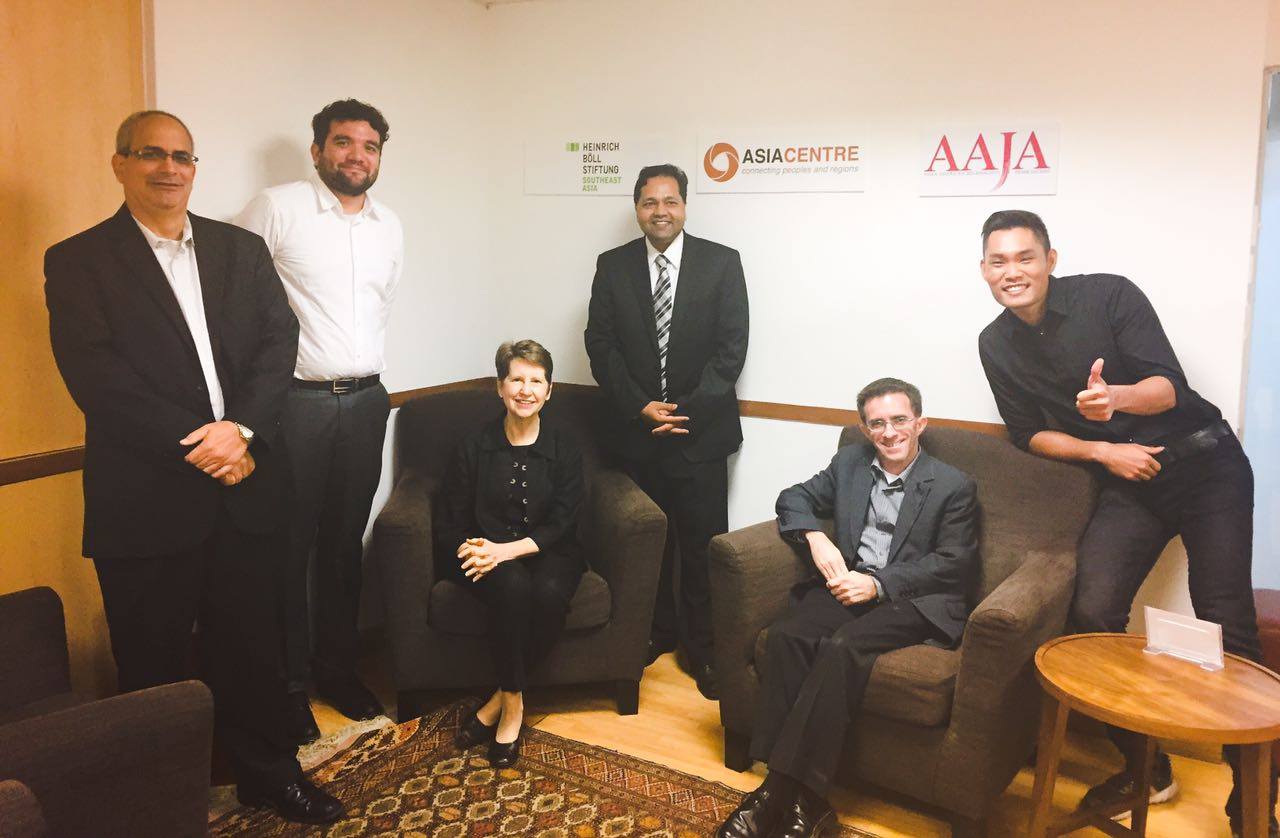
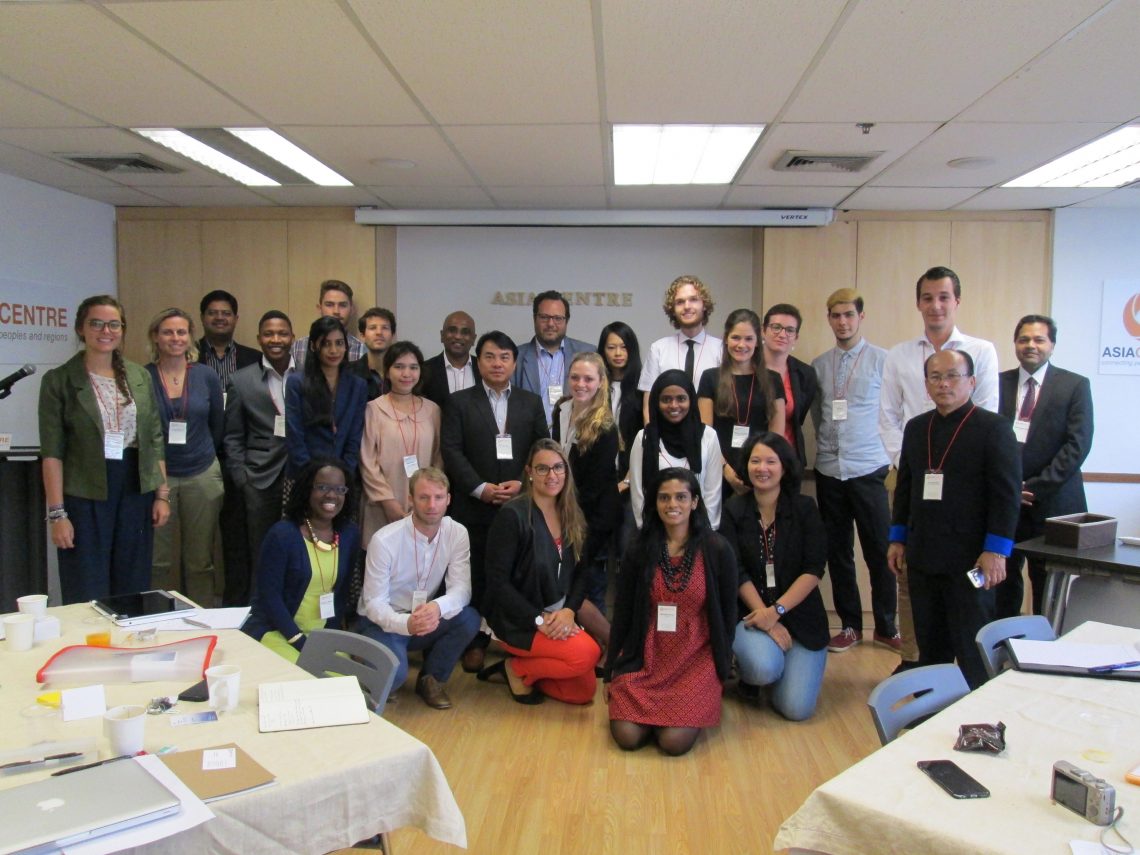
From October 14 to 17 2016, Asia Centre in partnership with International Forum for Inter-Media Art and Brack organised a cross-sector collaboration workshop. Conceptualised by Asia Centre Associate and iFima founder Dr Jay Koh, the 4 day conference cum workshop; explored how to stir civic consciousness and foster open social structures through public participation and engagement. The opening session on the 14th of October featured a discussion on Engaged Listening Across Fields of Practice with Dr Patama Satawedin (Som), Director of the Master of Communication Arts Programme at Bangkok University and Dr Jeremiah F. Morris, lecturer in Media and Communications at Mahidol University International College. Participants were very much engaged in the discussions which continued on at the welcome dinner later that evening. The following two days of the conference proper featured panel discussions designed to facilitate critical engagement. Presenters gave short presentations on their research and projects, this was followed by feedback and input from respondents before the discussion was open to the floor for further input. Each panel explored a different aspect of artistic engagement, praxis and research, covering the following areas: Art Praxis in Public: Engaging “Others” Contemporising Art History with Current Practices Innovation, Education & Sustainability: Citizen Science, Arts Management and Social Entrepreneurship Art Praxis in Public: Participation & Collaboration Artistic Research: To Ground a Constructive & Progressive Praxis Arts & Health: Clients, Victims & Participants The final day featured a participant-led workshop using Open Space and World Cafe methods of participative and consultative processes. Participants then explored two case studies of collaborative projects, the first being the Bangkok based 3C – Canal, Cycling, Community project designed to engage the community living by the canal through art and cycling. The second case study considered was a research project on Art in Action, focused on using art strategies to initiate, support and engage social transformations. This gathering of artists, educators and practitioners from countries in the Asia Pacific region and beyond provided a space for diverse and different perspectives.
Asia Centre Facilitates Focus On Life Discussion

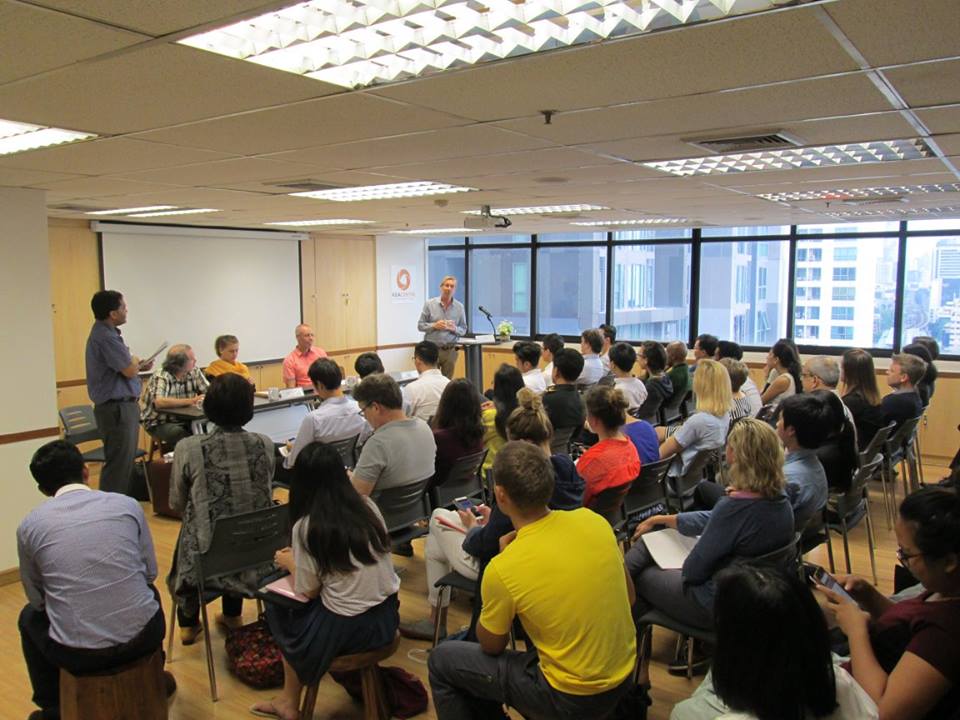
New York-based Japanese photographer and anti-death penalty activist Toshi Kazama held a photo exhibition and discussion of his work on 11 October 2016 at The Sukosol Hotel. Asia Centre facilitated the discussion and networking session following Mr Kazama’s presentation which focused on how he uses photography as a tool to express his point of view on human rights and specifically on the death penalty. A diverse crowd of about 35 people came together to listen to Mr Kazama narrate the stories behind each picture exhibited; those of people on death row and the execution methods in various countries. Asia Centre’s Dr. Robin Ramcharan managed the audience’’s queries on Mr. Kazama’s perspective on the use of the death penalty in the ASEAN region. Key questions from the audience centred around events in the Philippines and Indonesia that have reignited the debate on the the use of the death penalty to tackle crime. Other issues raised by the audience touched on the morality of the death penalty and the role of the media. This audience discussion was followed by a networking session where participants could view the photo exhibition and further their conversations with Mr. Kazama. The Focus on Life discussion and photo exhibition was part of the End Crime Not Life regional campaign against the death penalty which will continue its tour through major cities in ASEAN. You can learn more about the campaign at the following link: http://www.endcrimenotlife.com/ The photo exhibition, discussion and networking was a parallel event to the SEAHRN 4th International Conference on Human Rights and Peace in Southeast Asia facilitated by Asia Centre.
Media & Communications Workshop 2016

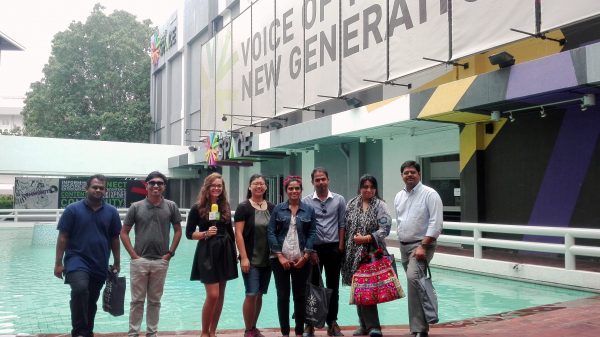
From 19 to 30 September 2016, Asia Centre held a Media & Communications Workshop for students from the University of Liberal Arts Bangladesh. The two week experiential learning programme was designed to give students an introduction to the Asian media landscape, hone their practical skills and undertake a multimedia project of their own. The programme kicked off with an orientation to the course and brainstorming for their media project under the guidance of Asia Centre’s Dr. James Gomez and Dr Robin. Ramcharan. The group then participated in a team building scavenger hunt to help them work together and learn to navigate Bangkok. Classroom sessions during the first week were focused on understanding the marketing and communication strategies for businesses. Bamboo Labs, a social media and digital marketing start-up introduced students to their latest software designed to help people who are learning English. They introduced their product and discussed some of the challenges in getting it to the target markets. Students also participated in a session facilitated by Brice Degeyter from The Football Agency, a sports sponsorship and activation company using the platform of football to attract, connect and engage with the consumers in Asia. Beyond the classroom, students were able to network with journalists, political commentators and academics at the Foreign Correspondents Club of Thailand. The highlight of the event was a panel discussion on Religious Tolerance in Thailand featuring Mrs Angkhana Neelapaijit, a Commissioner from the National Human Rights Commission of Thailand. They also visited the ASEAN Cultural Centre which provided an excellent introduction to the diversity of the region and the historical linkages between Southeast Asian countries through trade as well as the spread of religion and colonisation. Beyond the fun of the interactive exhibitions on national costumes and glimpses into the food and flavours of Southeast Asia, the visit also provided critical information on the populations, politics and present day conditions in the region. Their introduction to the Thai media landscape came in the form of a visit to Voice TV, one of the country’s most popular news and variety channels. Students got the opportunity to tour the studios, witness a live broadcast and field their questions to Voice TV’s lead news anchor Teerat Ratanasevi. Week one of the workshop rounded off with students pitching their projects to their advisors who provided advice and critique on their objectives and strategies for carrying out their multimedia projects. In the second week of the workshop, a visit to the Thai Public Broadcasting Service allowed students to understand some of the challenges of producing critical content in the context of shrinking civil and political space for discourse. They also toured the studios and spoke with staff in the television and radio broadcasting departments. They were able to network with students and faculty at Stenden University, Thailand during a discussion on academic and industry collaboration. Students spent much of the week venturing out into the big city to conduct their interviews and take photos and videos for their final project. Navigating the bustling alleyways of Chinatown was an excellent opportunity to understand the dynamics of the different communities within Bangkok and to contemplate the impact of China on the region. They also toured areas relevant to their particular subject matter. At the end of the week the students presented their findings to a panel of experts including journalists, media and communications experts and lecturers. The topics covered in the multimedia projects displayed a diverse and nuanced appreciation of Bangkok, from its train system to the everyday experiences of Muslim minorities and the off the beaten track adventures of backpackers. Presented through storytelling, short videos and photo essays, the students also made efforts to uncover lessons that could apply to their own lives in Bangladesh, from developing Bangladesh as the next budget travel hotspot to inclusive urban planning strategies. The workshop was structured to include learning and practical components with in-class activities complemented by learning visits to media companies and opportunities to network and interact with industry professionals. At the end to two weeks the students displayed critical thinking, developed insight into the media landscape and understood the context surrounding each story. They also demonstrated their professional skills and competencies in interviewing, photography and video editing in the execution of their projects. Asia Centre will be running the Media & Communications Workshop on a regular basis, if you are interested in honing your professional skills as a budding journalist, building your network in media and communications and learning to think critically about issues facing the region, sign up for our next workshop from 9-20th January 2017.
1st International Conference (2016): Universal Periodic Review (UPR) in Southeast Asia, An Evidence-Based Regional Assessment

The UPR has been an effective mechanism for putting human rights issues on the agenda and engaging states in conversation about critical issues. However, systemic problems remain with regards to engagement with other stakeholders, the implementation of recommendations by governments, the efficacy of follow up processes and the UPR’s ability to address hard political issues. These were key takeaways from Asia Centre’s conference, Universal Periodic Review in Southeast Asia: An Evidence-Based Regional Assessment, held from 15 to 17 September 2016 at Asia Centre’s premises in Bangkok. Asia Centre’s first international conference on the Universal Periodic Review in Southeast Asia was held in partnership with Taiwan Foundation for Democracy, Heinrich Böll Stiftung Southeast Asia, and Stenden Thailand. Asia Centre Conferences: Designed For Discourse The conference hosted thirteen presenters and upwards of fifty participants whose discussions were structured around thematic clusters on stakeholder involvement, minority rights, civil and political freedoms and the death penalty. It included country specific discussions on Indonesia, Timor-Leste, Malaysia, Laos, Singapore, Myanmar, Brunei and Thailand. Researchers were provided slots to present their findings (See Conference Proceedings). The conference’s program can be found here. Watch the conference’s video here. Day One: The Conversation Is Key The first day of the conference saw over 30 participants from diverse backgrounds including members of civil society organisation, national human rights institutions, academia, the United Nations, as well as students. Some of the key discussion points to emerge from the first day of discourse, included the value of the UPR as a platform for dialogue, interaction with other UN and regional human rights mechanisms, patterns of enhanced CSO engagement with the process as well as the role that other stakeholders such national human rights institutions can play in monitoring the implementation of recommendations. There were also issue specific discussions on the role of the UPR in pushing for the abolition of the death penalty and the efficacy of the process in addressing past human rights abuses in Timor-Leste. Day Two: Emerging Patterns & Trends in Engagement The second day of the conference saw more in-depth discussion on how specific countries were engaging on contentious issues. This covered freedom of expression in Thailand, freedom of religion and belief in Indonesia and civil and political rights in Singapore. The discussion on how minority rights were raised under the UPR centred on the experiences of the Hmong community in Laos as well as a regional overview of the particular challenges faced by LGBTIQ human rights, defenders prepared by Destination Justice. One critical discussion point on day two was the approach to engagement, with the Lutheran World Federation backing making the most of the non-confrontational nature of the UPR dialogue to push for solutions rather than naming and shaming. The plenary session provided an overview of emerging patterns and trends in interaction with the UPR such as greater CSO participation and coalition building efforts.It also called into question the efficacy of mid-term reporting and follow up processes. Day Three: Southeast Asia & the UPR: All Talk & No Action? The final day of the conference was an open forum discussion titled Southeast Asia & the UPR: All Talk & No Action? This session was open to members of the public and it attracted an audience over 25 people. The panel featured Imesh Pokharel from Office of the High Commissioner of Human Rights(OHCHR) Regional Office Bangkok, Michael J V White from the New Zealand Human Rights Commission, Celine Martin from Destination Justice and Gymbay Moua from the World Congress of Hmong People. The panelists shared their first hand experiences of engaging with the UPR process, highlighting key challenges faced and offering input on some of the best practices from their respective organisations. It was a very interactive discussion, moderated by Asia Centre’s Robin Ramcharan and it provided a unique entry point into the UPR for members of the public who were interested in understanding the process. Overall Asia Centre’s inaugural conference was successful in creating a platform for participatory discourse among different stakeholders who are actively engaged in with the UPR. It provided all present the opportunity to identify trends and patterns of engagement with the UPR over the two cycles and provided critical analysis of the UPR’s achievement in Southeast Asia. There was also discussion of establishing an evidence-based UPR network with the conference participants forming a core The conference inspired Asia Centre’s publication: The Universal Periodic Review of Southeast Asia: Civil Society Perspectives. Published in 2018, it identifies the trends and patterns of engagement with the UPR over the two cycles, provides analyses of the UPR framework’s achievement specific to Southeast Asia, and forecasts the likely developments in the 3rd cycle.
Southeast Asian Studies Series – Call for Manuscripts
GerakBudaya and Asia Centre are pleased to announce the launch of a joint regional publications series which aims to focus upon the politics, history and culture of Southeast Asian societies. Together we are launching a publications series on issues that matter to the peoples of the region. The series will contribute to cross-disciplinary research and debate on the region and to highlighting new and innovative research on the region to a wider audience. Manuscripts are welcome from contributors who are critically examining contemporary issues and would like to reach a wider audience. The Series In launching a Southeast Asian publication series we wish to understand the region in its broadest sense, not as a rigidly defined region but as also including those countries such as India and China which have always been important to its history and will be integral to its future. We are therefore interested in intellectually sound manuscripts from across academic disciplines and from the policy sphere which speak to the wider region, which escape the confines of the nation-state and which highlight the transnational linkages and the historical ties which continue to structure present day Southeast Asia. As a guide, we welcome manuscripts in the following areas but we will happy to consider others: ASEAN and Regionalism Conflicts in the 21st Century Civil Society and Transnational Activism Democratization & Authoritarianism Ethnic Relations Gender Studies Humanitarianism Human Rights Migration New Media Regional Arts & Culture Sustainable Development We are also interested to publish manuscripts in the following formats: 1. Monographs We welcome a wide array of monographs. From academic research monographs to semi-academic and general non-fiction pieces by journalists and civil society activists. We are looking to publish pieces of original research which contribute something important to the scholarship on the region and which also talk to the work of civil society groups, NGOs and activists. We accept monographs of no longer than 40-100,000 words. 2. Edited Volumes We are interested to receive various proposals for edited volumes with a regional focus. In particular we are interested to publish edited volumes of no more than 12 chapters which bring together a diverse range of voices from around the region and neighbouring regions on topics of contemporary importance to Southeast Asia. We are happy to receive initial proposals for such volumes and work with editors in order to develop their proposal. 3. Conference Proceedings We are also interested to publish conference proceedings of important regional conferences which highlight cutting edge research and new and emerging perspectives on the region. 4. Self-Funded Publications Finally we are interested in hearing from any individuals or organisations who have research funding or other such funding to contribute towards the cost of publishing research monographs, edited volumes and conference proceedings in keeping with our series specifications. This can be organised either as a self-publishing service, where GerakBudaya and Asia Centre will provide editing, production and distribution services, or as a co-publishing initiative in which the book will be jointly published by both parties. Costs for book production can range from USD$ 1000–3500 depending on the length and nature of the manuscript and interested persons are encouraged to contact Series Editor James Gomez to find out more. Series Editor GerakBudaya and Asia Centre are proud to announce the appointment of Dr. James Gomez as the series editor of our Southeast Asian Studies series. Dr. James Gomez is an academic, author and editor with over 20 years of international experience at universities, think-tanks, inter-governmental agencies and non-governmental organisations. He has worked with numerous publishers and serves on international advisory boards, editorial committees and as external resource person to academic departments, schools, faculties and universities.He is presently Professor of Communications and Associate Dean (International Affairs), School of Communication Arts, Bangkok University, Thailand. He is also Executive-Director of Asia Centre. Submissions Procedure In order to consider your manuscript for publication we ask that you submit the following documents to us: 1-page summary of the manuscript that outlines the number of pages or words. Contents page Estimated length of manuscript (current). (Estimate based on MS Word, 12 point font, Times New Roman or similar, 1 1/2 space;A4 size paper;inclusive of notes and appendices.) A sample of 20 to 30 pages, or the introduction and one chapter. A short biography of the author. For edited volumes and conference proceedings we are happy to receive a provisional table of contents and a one page synopsis of the intended volume. Please forward all submissions with a short covering letter to series editor Dr. James Gomez (james@asiacentre.co.th). We aim to respond to your submission in 4-6 weeks. Our Services We will be able to provide full editorial, production and distribution services. We are able to provide professional editors who can assist in developmental editing, copy-editing and proofreading of your manuscript and we will then provide layout design, printing, marketing and distribution services. In addition we can also organise on your behalf co-publication initiatives with other international academic and non-academic presses and manage translation and territorial rights purchases to enable to your research to reach a wider audience. About Gerak Budaya GerakBudaya has long been established in Malaysia as a publisher and distributor of titles embodying social awareness, critical perspectives and the hidden histories of Malaysia and the wider region. Under their SIRD imprint, they have established a major non-university publishing house with titles covering a wide range of academic disciplines from history to political science, economics, cultural studies and sociology. To learn more about the Asia Centre – Gerak Budaya partnership, please click here.
Brexit: A Failure to Promote the European Union

UK voters were not properly informed by political leaders about the functions, institutions and powers of the EU, which has made a great contribution to the prosperity of the UK and peace in Europe. As a result, Britain’s referendum vote of 23 June 2016 ended up with a “leave the European Union (EU)” result – aka ‘Brexit’. This was the key conclusion from Asia Centre’s roundtable which attracted some 50 participants from academia, international organizations, the media, the NGO community, the public sector and the private sector. The panel (L-R) was moderated by Asia Centre’s Dr Robin Ramcharan and featured Alexandra Demetrianova, Thammasat University; Dr. David Moore, Portland State University;Dr. Kenneth Houston, Webster University and Dr.Peter Shearman, Chulalongkorn University. Among the other points made, the panellists noted that the Brexit vote was predictable and that it reflected voter dissatisfaction with political elites in Britain. However, the vote testifies to the enduring power of nationalism even as the world globalizes. Local identities still matter, as evidenced by demands for local autonomy in parts of the UK. But early indications are that the UK will not trigger its Article 50 notice to leave the EU until first quarter 2017 at the earliest. From that point, two years is allowed for the negotiation of post-Brexit trade, military, diplomatic, legal and social policy and legislation changes (amongst others) before the full exit happens. So – the earliest possible exit date is end of 2018. More likely, it will be later. Hence, the Brexit saga is expected to continue for some time. While the EU will endure, it will be weakened by Britain’s eventual exit. This makes the EU very vulnerable to forces of fragmentation moving forward. In order to stem such challenges, the EU needs to better sell itself across generations and across Europe.
Asia Centre to Focus on Human Rights Policy Analysis
Having established a presence and network in Bangkok in its first year, in its second year Asia Centre turns to its programmatic focus. This will centre on human rights policy analysis covering key regional and international institutions. These are the national human rights institutions, the ASEAN Intergovernmental Commission on Human Rights (AICHR) and the Universal Periodic Review (UPR) of the United Nations Human Rights Council. Asia Centre’s focus on human rights policy was highlighted during its one year anniversary commemorations with Bangkok based academics and civil society representatives. This provided an opportunity to catch up and thank all those associated with the Centre in the last one year. Established in July 2015, Asia Centre spent July 2015 – Dec 2015 setting up its office at Phayathai Plaza. During that period, the Centre focused on its legal and financial registration in Thailand as well as the renovation and setting up of its physical premises. Various individuals were also identified to serve on the Advisory Board, as Centre Associates and to make up the Management Team. In the next phase – January to June 2016 – the Centre promoted its presence in Bangkok through the Asia Centre Seminars that generated interest among academia, NGOs and students. During this period, the Centre also set up meetings and explored opportunities for collaboration with numerous NGOs, social enterprises, businesses as well as university departments and faculties. These partnerships are currently helping to promote Asia Centre beyond its Bangkok base. As the candle was blown out marking Asia Centre’s first year in operation, the Centre is grateful for the support received thus far. It has been a strong start. We look forward with confidence to our second year.
Impunity waters down accountability in Southeast Asia
The provision of impunity to human rights violators is the biggest challenge for ensuring accountability. This was the general conclusion of the panelists at the event Confronting Elusiveness: Demanding Accountability in Southeast Asia. The speakers from Indonesia, Philippines and Myanmar highlighted how in each of their respective countries human rights violators went on to occupy positions in different human rights mechanisms which watered the whole idea of holding such violators accountable. Speakers featured at the event included, Galuh Wandita, Co-founder and Director at Asia Justice and Rights (AJAR), Aung Khaing Min, Advocacy and Research Officer Burma Partnership and Edgardo Legaspi, Executive Director, Southeast Asian Press Alliance. Some 30 people attended the activity which was held as an inaugural panel of SEA Junction hosted by Asia Centre. Its founding executive-director Rosalia Sciortino, moderated the panel discussion. The event also featured the presentation of the book “Enduring Impunity” a compilation of stories of women survivors in Indonesia, Timor Leste and Myanmar. SEA Junction was launched later in the day at the Bangkok Art and Cultural Center. Asia Centre wishes them success.
Asia Centre: Regional Representative for Malaysian Publisher Gerakbudaya
Asia Centre has signed a partnership with Malaysian Publisher Gerakbudaya to be its regional representative in Thailand. Moving forward, Asia Centre will commission, edit, launch a publication series, distribute and sell books on Southeast Asian studies. The publication series will explore critical issues impacting Southeast Asia as well as the region’s linkages to the rest of the world. The aim is to contribute to research and discussions on regional matters which are alternative and can highlight new and important issues to a wider audience. The Centre will also act as a bookshop and has started featuring a selection of Gerakbudaya books. These will be on sale during office hours at the Centre’s premises and during its activities. There are also plans to develop a web portal for e-books. Gerakbudaya publishers and distributes books that spark social awareness and critical discourse on Southeast Asia. Its very name Gerakbudaya represents the movement (gerak) of culture and ideas (budaya) through books. It is Gerakbudaya’s first foray outside of Malaysia. The man behind Gerakbudaya, Mr. Chong Ton Sin or “Pak Chong” as he is more commonly known, has been in the business for over 20 years with over 300 publications under his belt. You can read more about Gerakbudaya Enterprises at our Partners page.
Cause Lawyering: Advocating For Justice

Cause lawyers set themselves apart in their profession by using the law as tool for social justice. They protect the rights of marginalised communities and bridge the gap between law as it is written in the books and the law as it is lived and experienced. This was how our panelists described the linchpin role that cause lawyers play in advocating for justice. Cause Lawyering: In Conversation With Regional Advocates was held on 14 May 2016 and attracted about 20 participants. Mr. Henning Glaser, Director of the German-Southeast Asia Centre of Excellence for Public Policy and Good Governance at Thammasat University provided an overview of how lawyers work to achieve justice for marginalised communities. The panel also explored on the role that lawyers and advocates play on the issue of the death penalty, with human rights lawyer and anti-death penalty advocate M.Ravi sharing his personal experiences fighting against Singapore’s draconian death penalty laws. Akanit Horatanakun from Amnesty International Thailand providing an update on the use of the death penalty in Thailand. The event also saw the Bangkok launch of M Ravi’s critically acclaimed autobiography Kampong Boy. His book, Kampong Boy,was shortlisted for the 2014 Singapore Literature Prize. It is on sale at Asia Centre.