Over the past decade, from 2016 to 2025, Asia Centre’s annual conferences have evolved from a modest gathering of researchers and civil society actors into one of the region’s regular convening platforms on democracy and human rights.
Having completed 10 impactful years of conference convening, the Asia Centre annual conference now enters a new chapter. Beginning with its 11th edition, the annual Conference will be rebranded as the Asia Centre Summit – marking a significant step forward in institutionalising the annual Conference as a leading regional forum for dialogue and collaboration.
Needless to say, the Summit will remain guided by a consistent objective: to provide a credible forum to discuss Asia’s complex and intersecting challenges, while facilitating meaningful engagement among international non-governmental organisations (INGOs), civil society organisations (CSOs), the diplomatic community, parliamentarians and other key stakeholders.
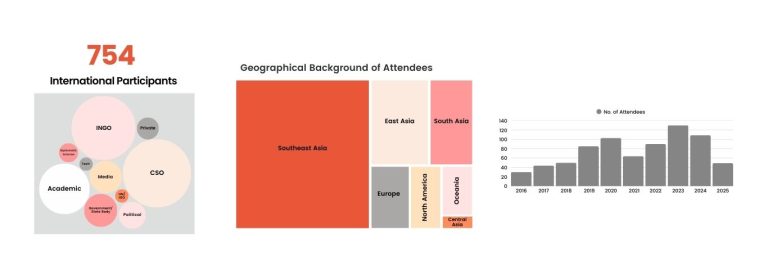
In ten years, the Asia Centre has convened 754 participants and speakers from INGOs, civil society organisations, political parties and parliaments, media and technology companies and other entities across its annual Conferences. They achieved close to gender parity with a nearly equal gender ratio of speakers, reflecting a strong commitment to gender inclusivity. Geographically, participants represented over 40 countries and regions worldwide.
Today, as Asia Centre navigates an across-the-board reduction in development aid funding, it’s now a good opportunity to reflect and rethink the modalities of the annual Conference beyond its 10th year.
To start off … How did we get here?
Asia Centre’s annual Conferences can be traced across four distinct evolutionary phases, each reflecting shifts in scale, partnership models and focus.
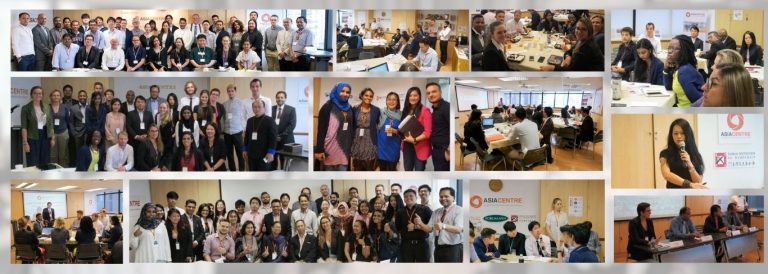
In the first phase, between 2016 and 2018, Asia Centre’s 1st (Universal Periodic Review in Southeast Asia: An Evidence-Based Regional Assessment), 2nd (National Human Rights Institutions in Southeast Asia: Challenges of Protection) and 3rd (Business and Human Rights: Holding Governments Accountable in Asia) annual Conferences were positioned as research-oriented convenings, bringing together scholars and civil society practitioners to strengthen analytical depth on democracy and human rights in the region. Conferences were designed to bridge evidence-based inquiry with policy-relevant dialogue.
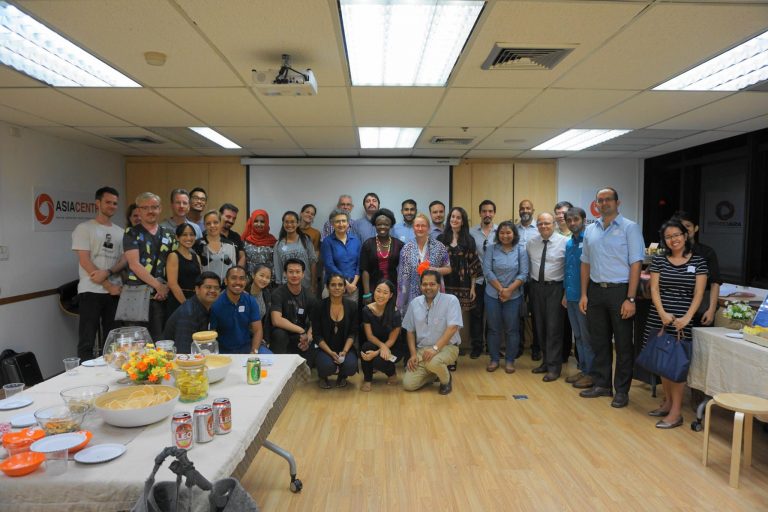
Given their modest scale, they were held entirely at Asia Centre’s Phayathai Building premises in Bangkok, Thailand. These early convenings gradually strengthened the Centre’s visibility and credibility within civil society, INGOs, diplomatic and donor communities.
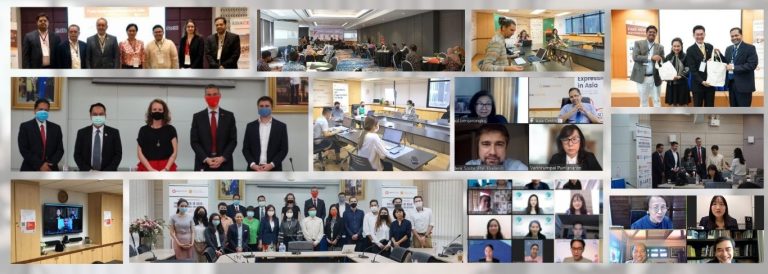
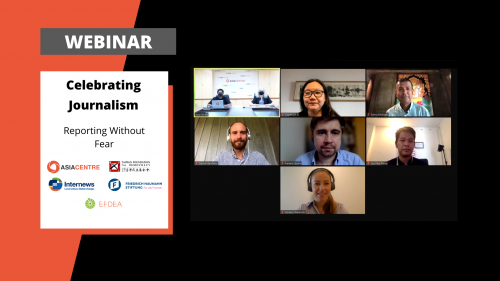
As Asia Centre’s regional profile expanded, the Conference entered a second phase, between 2019 and 2021, with the 4th (Fake News and Elections in Asia), 5th (Hate Speech in Asia: Challenges and Solutions) and 6th (COVID-19 in Asia: Communication, Nationalism and Technology) annual conferences – notable for their growth in size, diversity and partnership arrangements. The 5th and 6th conferences were held in a hybrid format as a result of the pandemic. Civil society-led panels gradually became a focus and a defining feature, enabling INGOs to support their CSO partners to curate discussions aligned with respective conference themes. Participation at the Conferences broadened to include representatives from the media, technology companies, national human rights institutions and parliaments.
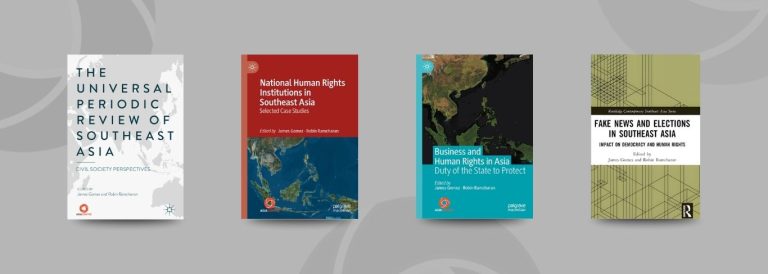
Across the first two phases, a major output was the publication of conference proceedings, which consolidated panel papers and articles. These publications remain among Asia Centre’s most accessed knowledge products, forming a lasting repository of regional analysis. The conference proceedings can be accessed here.
Due to strong interest, selected contributions were further consolidated into standalone edited volumes and formally published. These include: The Universal Periodic Review of Southeast Asia: Civil Society Perspectives (2018), National Human Rights Institutions in Southeast Asia: Selected Case Studies (2020), Business and Human Rights in Asia: The Duty of the State to Protect (2021) and Fake News and Elections in Southeast Asia: Impact on Democracy and Human Rights (2023).
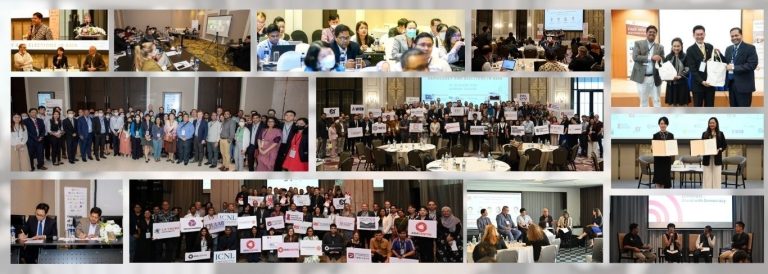
From 2022 to 2024, the Conference entered a third phase of consolidation, moving into a policy and practice trajectory, with a strategic emphasis on networking and a more structured partnership scheme. This phase encompassed the 7th (Freedom of Expression in Asia), 8th (Democracy and Elections in Asia), and 9th (Shrinking Civic Space in Asia: Stories of Resistance and Pushback) annual Conferences. During this period, Asia Centre introduced a title partner model, under which INGOs and development partners could support between one and three panels, in addition to other partners who convened their respective panels. This approach enabled deeper collaboration, clearer partner visibility and the production of dedicated partner write-ups capturing key discussions and outcomes. Following the pandemic, the Conferences also returned to in-person formats, reinforcing networking, coalition-building and cross-sector exchange.
This period represented the high point in terms of scale, international reach, partnership density and the signing of several MoUs. It also included a growing number of side events, with partners convening their own meetings on the day before or immediately following a Conference, leveraging the concentration of regional and international participants already gathered in Bangkok. In this way, the Conferences evolved into both a platform for dialogue and a mechanism for INGOs to build activities and meetings around.
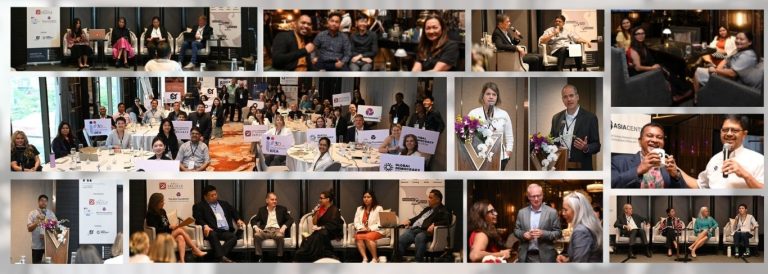
In 2025, the Asia Centre’s annual conferences entered the fourth and current phase, marked by a sharp reduction in global funding for civil society and a hard technology shift. The 10th International Conference “AI and Governance in Asia: Civil Society, Democracy and Media”, held 22-23 August 2025, felt the brunt of the funding cuts with a drop in the number of title partners and participants. Although interest in the conference and topic remained strong, the financial limitations kept the number of title partners and participants small.
Moving forward, the learnings suggest a need to adopt a more condensed and regionally grounded model, sourcing newer partners and in-kind support, and with a stronger emphasis on participant-driven dialogue and regional expertise.Taking into account the changing landscape, Asia Centre, as it convenes its 11th Asia Centre Summit “Religious Freedom in Asia: Representation, Restrictions, Rights” on 20-21 August 2026, will be mindful of the new environment as it engages with prospective partners.
In ten years, the Asia Centre annual Conference has become a regional convening platform that brings together civil society, policymakers, diplomats, researchers and international partners to address democracy, human rights and governance challenges in Asia. It has helped reinforce Asia Centre’s role as a trusted regional convenor seeking to continue a sustainable and inclusive space for stakeholders to connect, build partnerships and contribute to regional civil society dialogue and advocacy.
As Asia Centre marks a decade of impactful convenings, we are proud to announce that the Asia Centre annual Conference will be rebranded and institutionalised as the Asia Centre Summit.
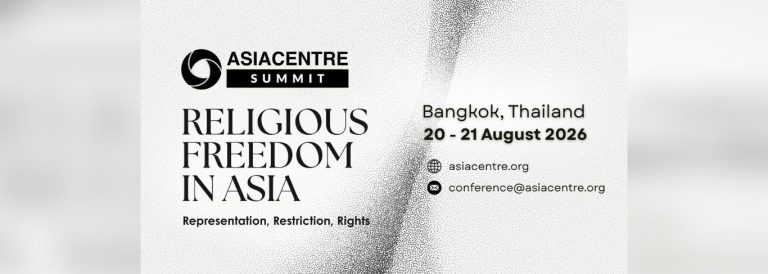
The registration of the 1st Asia Centre Summit is open to participants from national, regional, and global organisations, including civil society organisations, faith-based NGOs, human rights organisations, media and journalism associations, legal and policy institutions, parliaments and political parties, technology firms, government agencies, and intergovernmental organisations.
For inquiries, please contact conference@asiacentre.org
The full concept note is available here. Interested participants are invited to register through the link here.
We look forward to more years of advancing dialogue, strengthening partnerships, and shaping meaningful conversations on democracy and human rights in Asia.