Artificial intelligence (AI)’s growing role in shaping elections, governance and civic participation presents both opportunities for democratic transparency, but at the same time, challenges of authoritarian misuse.
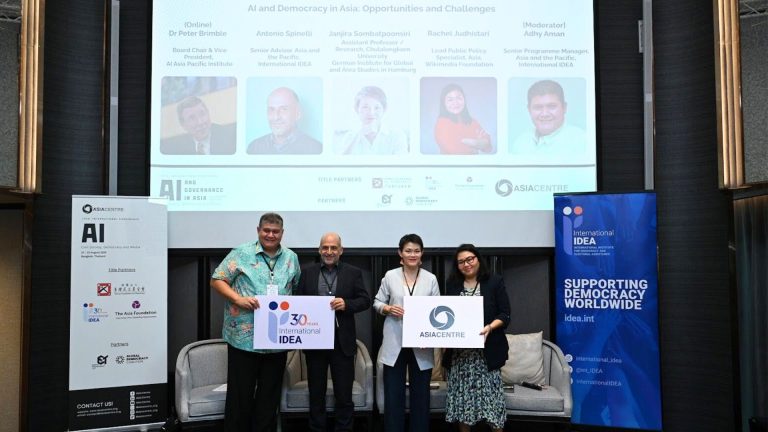
To safeguard democratic resilience in Asia, governments, media and civil society groups must work together to ensure ethical frameworks and inclusive innovation that proves AI strengthens democracy rather than undermining it. This was the main message from a panel discussion hosted by International IDEA during Asia Centre’s 10th Annual International Conference, held in Bangkok from 21 to 22 August 2025 under the theme “AI and Governance in Asia: Civil Society, Democracy and Media”.
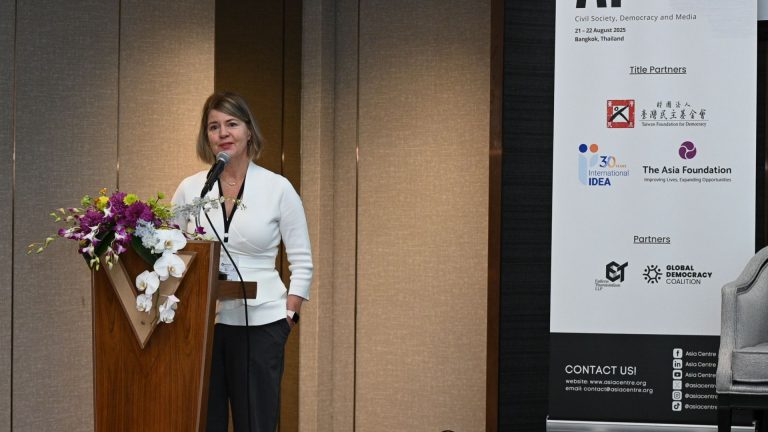
In her opening remarks on 21 August 2025, Leena Rikkilä Tamang, Regional Director for Asia and the Pacific at the International IDEA, emphasised the urgent need for greater awareness, stronger regulation, and robust AI safeguards to address challenges such as bias, data misuse and security risks. However, she underlined, while AI poses serious threats to democracy, it also offers potential benefits – for example, improving campaign logistics and strengthening monitoring of campaign finance – if guided by ethical frameworks and human oversight.
Following her remarks, International IDEA convened a plenary session titled “AI and Democracy in Asia: Opportunities and Challenges”. Moderated by Adhy Aman, Senior Programme Manager for Asia and the Pacific at International IDEA, the session explored AI’s role in elections, legislative work and governance. The panel featured four speakers:
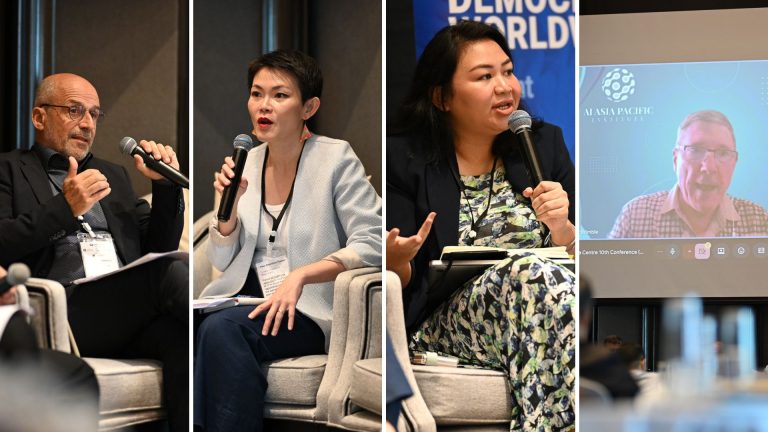
Antonio Spinelli, Senior Advisor on Electoral Processes, International IDEA, examined the growing influence of AI in elections. While acknowledging its value in campaigning, he warned that AI can also undermine trust, spread disinformation, intimidate opponents and harm democratic institutions. He recommended independent oversight of AI use in campaigns, investment in detection and verification tools and leveraging democratic innovation to enhance election preparedness.
Dr. Janjira Sombatpoonsiri, Research Fellow at the German Institute for Global and Area Studies in Hamburg and an assistant professor at Institute of Asian Studies, Chulalongkorn University, Thailand, discussed the suppression of civil society and political opposition in Bangladesh as a case example of how AI and social media tools can both aid democratisation and exacerbate inequality. She noted that AI’s power and resource demands may disadvantage civil society, given their financial vulnerabilities, budget cuts and limited resources – underscoring the urgent need for stronger institutional guardrails.
Rachel Judhistari, Lead Public Policy Specialist, Asia, Wikimedia Foundation, stressed that online knowledge production is deeply tied to power, bias and the ongoing struggle for digital rights and freedoms. She highlighted Wikimedia’s critical role in AI development due to its extensive, regularly updated knowledge base. However, she noted that Wikimedia and its contributors face challenges such as state control, surveillance and harassment, which create significant psychological and political pressures.
Peter Brimble, the Vice President of the AI Asia Pacific Institute, addressed AI’s potential to strengthen democratic institutions, improve citizen participation and measure public sentiment. At the same time, he cautioned that misinformation, manipulation and digital inequality threaten democracy and risk excluding marginalised communities. He called for regional cooperation to advance AI literacy, safeguard digital rights and develop governance models that balance innovation with accountability.
During the Q&A session, participants raised questions about AI’s role in governance, civil society and democratic processes. Panellists emphasised that while AI can enhance capacity – for instance, by improving financial literacy – it can also reduce critical thinking if over-relied upon. They stressed the need for governance, regulation and safeguards to prevent misuse, and called for environmental impacts to be included in AI policy discussions.
Asia Centre’s International Conference is its flagship annual gathering, designed to bring partners together to present outcomes, share expertise, and develop future collaborations. Over the years, it has become a trusted space for open dialogue on democracy and human rights in Asia.
Asia Centre is a civil society research institute in Special Consultative Status with the United Nations Economic and Social Council. It serves as a knowledge partner and undertakes evidence-based research as well as provides capacity-building training for end beneficiaries. If you would like to collaborate with the Centre, please send an expression of interest to contact@asiacentre.org. Follow Asia Centre’s social media channels for updates.