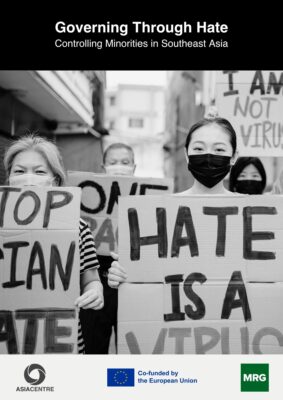
Governing Through Hate: Controlling Minorities in Southeast Asia examines how political and influential actors use ethno-religious hate speech as a tool of governance to define national and religious belonging, reinforce dominant identities and control communities perceived as falling outside majoritarian norms. Drawing on a year-long monitoring process tracking hate speech trends in Cambodia, Indonesia, Malaysia, Myanmar and Thailand in 2025, the report makes three principal contributions. First, it examines how international, constitutional, legal and administrative frameworks ostensibly designed to protect religious and minority rights, religious harmony, public order and national security instead institutionalise dominant ethno-religious hierarchies and constrain minorities. Second, it identifies four interrelated ways in which hate speech is used to control minority communities beyond the expression of prejudice: reinforcing structural inequalities; legitimising restrictions on religious freedom; creating conditions conducive to physical violence; and fostering fear that drives self-censorship and withdrawal from public participation. Third, it provides targeted recommendations for international human rights mechanisms, national governments, international non-governmental organisations and donors, civil society organisations, media organisations and technology companies. These recommendations call for legal and administrative reform, impartial protection against discrimination and rights-based approaches to countering hate speech. The report concludes that addressing hate speech requires more than countering discriminatory language: it requires challenging the political and institutional practices through which hostility is used to define belonging, legitimise exclusion and maintain unequal power relations. Efforts to promote social harmony must therefore safeguard the rights and inclusion of all communities, irrespective of religion or belief, rather than preserve the dominance of any particular group.