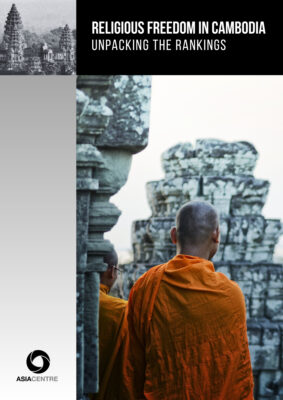
Religious Freedom in Cambodia: Unpacking the Rankings examines the state of freedom of religion or belief (FoRB) in the Kingdom, interrogating the anomaly between its positive global rankings on religious freedom and its poor standing in broader human rights and democracy indices. Drawing on policy analysis and stakeholder insights, the report reveals that positive rankings obscure longstanding structural challenges, including state oversight and political co-optation of Buddhism, systemic discrimination experienced by Muslim and Christian minority communities and the destruction of Indigenous Peoples’ ancestral lands and sacred sites for development. These challenges are compounded by a bureaucratic administration that enforces inequitable school curricula, inconsistent permit procedures for places of worship, and restrictions on public proselytisation. While the Cambodian Constitution formally guarantees religious freedom, these protections are weakened by provisions that privilege Buddhism as the state religion, alongside vague legal terms that expose FoRB advocates to risk. Ultimately, the report calls on the United Nations, government agencies, civil society, and faith-based organisations to address these structural inequalities and advance evidence-based policies that protect religious freedom for all. This report is part of Asia Centre’s Asia FoRB Policy Initiative.