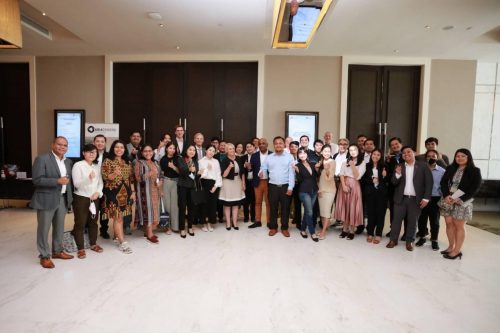
From 9 to 12 November 2026, Asia Centre’s delegation comprising its Regional Director, Dr. James Gomez and Programme Manager Sanjay Gathia, visited the Siem Reap region, Banteay Meanchey province and the adjoining border region in Cambodia.
On 11 November, the delegation visited Rong Cham Villages (also known as “Waiting Villages”), located in Sla Kram commune, Svay Chek district, Banteay Meanchey province – a government resettlement site for people displaced by the border tensions with Thailand, featuring more than 3,000 housing units (Reuters, 2026). During the site visit, the Asia Centre delegation was accompanied by Leang Delux, Co-Founder of Thmey Thmey Digital Media, and Ky Chamna, reporter and translator at Cambodianess.
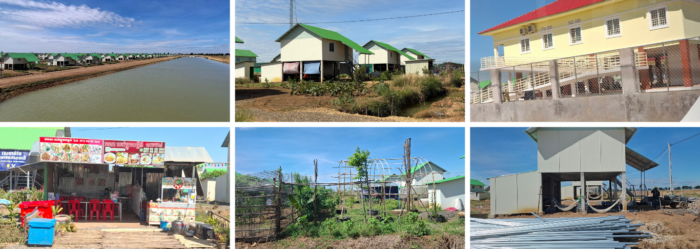
The Centre’s overall assessment is that those staying in the village are settling in for a default long-term, quasi-permanent stay. Observations confirmed residents are regularising their routines, daily living and commerce, indirectly pointing towards the absence of immediate solutions for the border tensions and disputed areas, as evidenced by the construction of semi-permanent and concrete building structures.
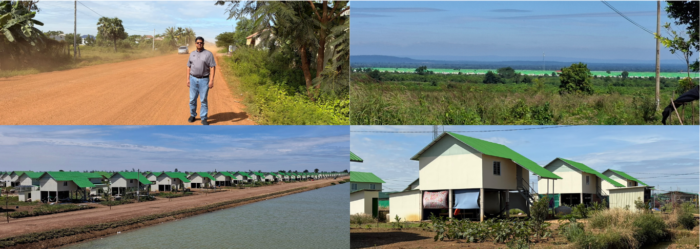
Top Left: Road Leading Up to the Village, Top Right: Village Complex at a Distance, Bottom Left: Village Complex, Bottom Right: Houses
The border conflict between Cambodia and Thailand caused a mass displacement of communities living by the border, with 644,589 Cambodian people displaced in December 2025 (UNDP Cambodia, 2026). 11 months after the ceasefire agreement in December 2025, more than 20,000 individuals still remain displaced from their homes, facing prolonged uncertainty (Reuters, 2026).
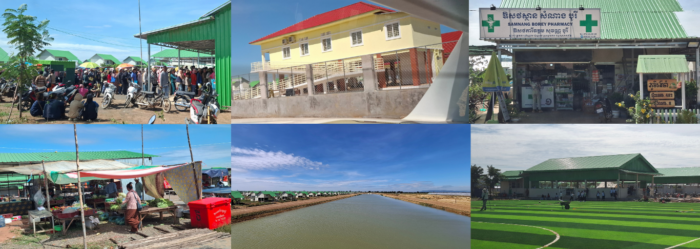
Top Left: Community Hall, Centre Top: Hospital, Top Right: Pharmacy, Bottom Left: Vegetable Market Stall, Centre Bottom: Water Reservoir, Bottom Right: School and Football Field
In the Rong Cham village, there were several features observed by the delegation that pointed to a long-term stay.
First, essential public facilities and services, including electricity, water supply, internet access, and a small water reservoir have been established. Amenities such as a marketplace, school facilities, healthcare infrastructure and agricultural facilities, including greenhouses, are under active development.
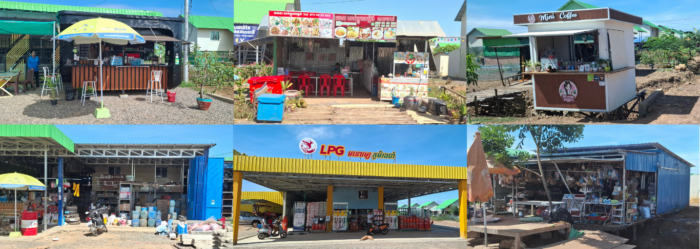
Top Left: Cafe, Centre Top: Restaurant, Top Right: Coffee Shop, Bottom Left: Mechanics, Centre Bottom: Petrol Station, Bottom Right: Gorocher
Second, many residents have begun engaging in commerce activities through self-built shops, selling groceries, operating cafes and food stalls, petrol stations, as well as offering services such as hair and nail saloons. There was even a guest house. The delegation talked to residents, with one telling them about a car wash service they operated within their small house-complex.
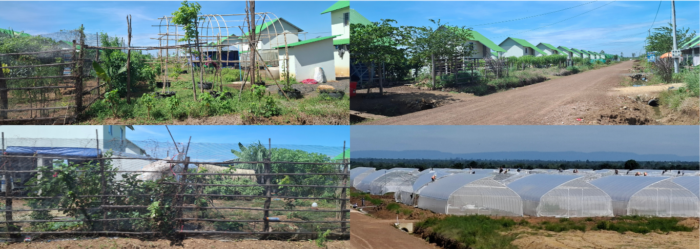
Top Left, Right & Bottom Left: Private gardening structures by residents, Bottom Right: Greenhouses.
Third, there is a move to ensure food security via vegetable gardens to support livelihoods and supplement food sources while reducing household expenses – an initiative encouraged by the Ministry of Agriculture of Cambodia. The Ministry also recently distributed 3,000 mixed-species saplings in Banteay Meanchey province to foster greener communities and promote local development, specifically around Rong Cham village (The Phnom Penh Post, 2026), promoting sustainable long-term community usage and benefits to be self-reliant.
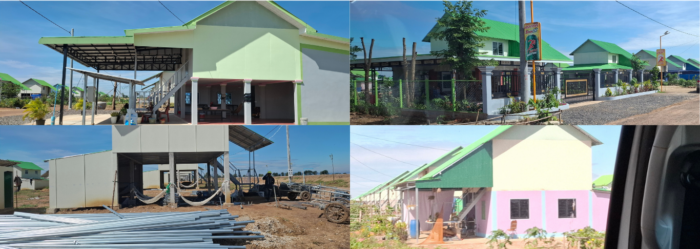
Top Left: Additional Porch Roof, Top Right: Fencing, Bottom Left: Construction Materials, Bottom Right: Painted Facade.
Fourth, some residents have also begun to modify and expand their allocated housing units by adding fencing or small additional structures. These additions were both functional and ornate. People spoke about the yet to be confirmed government pledge to formally award the ownership of the land plots allocated to the affected households in the village (The Star, 2026).
These observations during the field visit highlighted how the resettlement site has gradually evolved into a more semi-permanent and possibly long-term residential community. This evolution suggests that the border uncertainties are likely to remain for sometime.
The Asia Centre delegation’s overall impression upon visiting the settlement was that it is very well-organised and maintained. As families rebuild their lives and forge strong community ties within the expanding site. The visit underscored the evolving situation as well as the long-term uncertainty along the Cambodia-Thailand border.