
Views Navigation

Event Views Navigation

Today

Latest Past Events

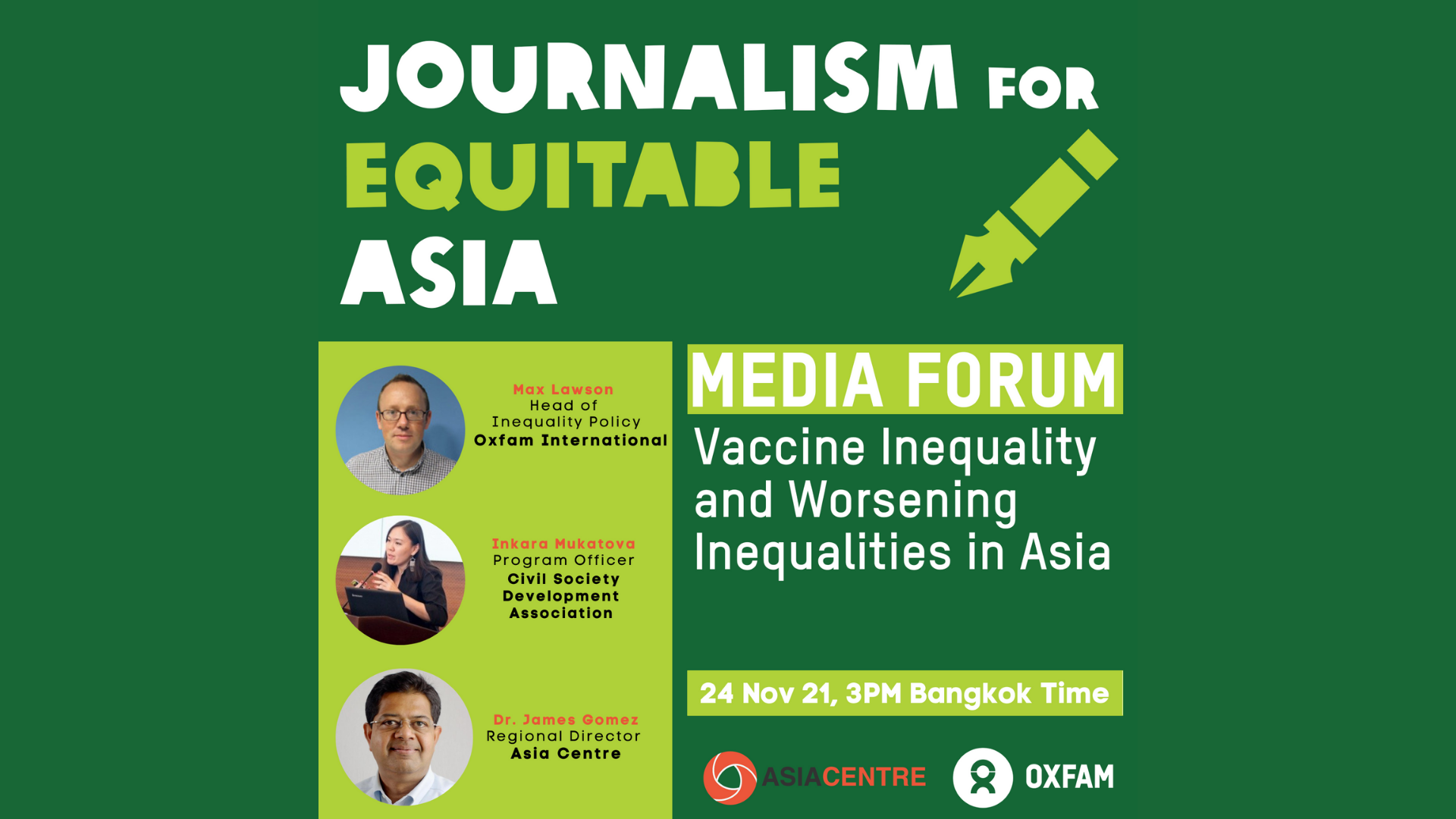
Vaccine Inequality and Worsening Inequalities in Asia

About the Event: Oxfam International and Asia Centre are bringing together experts from Asia and elsewhere to explore how vaccine inequality is worsening and fuelling other forms of inequality in Asia. The webinar is part of Oxfam International and Asia Centre’s Journalism for an Equitable Asia project, which aims to increase public awareness and support and encourage reporting on inequality in Asia. Register Fill in the Google Form Background: As millions of doses of the COVID-19 vaccine are administered each day, nearly half of the world’s population has received at least one shot of the vaccine. However, most of those who are fully vaccinated against the Coronavirus live in rich, developed countries and our world continues to be marred by staggering vaccine inequality. While some countries have vaccinated nearly half of all adults, in low income countries, less than 3 percent of the population has received a dose. In places grappling with conflict, such as Afghanistan, less than a million people have received a single dose of the vaccine. Moreover, vaccine inequality does not just exist between countries but also within countries, with certain regions and groups faring worse than others. Vulnerable and disadvantaged groups such as rural communities, indigenous groups, migrants, refugees and LGBTQI individuals are far less likely to have access to the vaccine. In Asia, the massive impact of vaccine inequality has been visible in an increasing number of cases and resulting lockdowns and restrictions. For poor Asians, 1.2 billion of whom were already struggling in or on the brink of poverty before the pandemic hit, the resulting economic fallout is nothing short of a death-sentence. COVID-19 has widened the cracks in this unequal system, fuelling a pernicious cycle of poverty and economic inequality. While wealthy elites have been able to protect their health and wealth, the poorest people and minorities have faced a greater risk of illness, death, and economic destitution. In 2020, lockdowns and economic stagnation destroyed the livelihoods of many poor and ‘just managing’ families, while the wealthiest recovered and even increased their fortunes. Poor people, among them a large number of women and migrants, predominate in low-paid informal work. In the first month of the pandemic, the income of informal workers in Asia Pacific fell by an estimated 21.6 percent, and these people are more likely to have suffered long-term job losses and reduced incomes. At the same time, coronavirus has increased the amount of unpaid care work, especially for women and girls. While developed nations are beginning to see their economies bounce back, Asian countries will once again fail to achieve targeted growth, with their poorest bearing the brunt in the form of reduced social spending and job cuts. In November 2020, the World Bank estimated that a combination of coronavirus and increased economic inequality, pushed between 107 and 114 million more people into extreme poverty ($1.90) in Asia. Wealthy nations are quickly moving towards the target of complete vaccination of all adults against the coronavirus, while preventing most people in developing and low-income countries from vaccinating their citizens. In this way, vaccine inequality is exacerbating and fuelling other forms of inequalities already persistent across Asia. Speakers:  Max Lawson, Head of Inequality Policy, Oxfam International Inkara Mukatova, Program officer, Civil Society Development Association Dr.James Gomez, Regional Director, Asia Centre Moderator: Shiza Malik, Regional Communications and Media Leads - Asia, Oxfam International
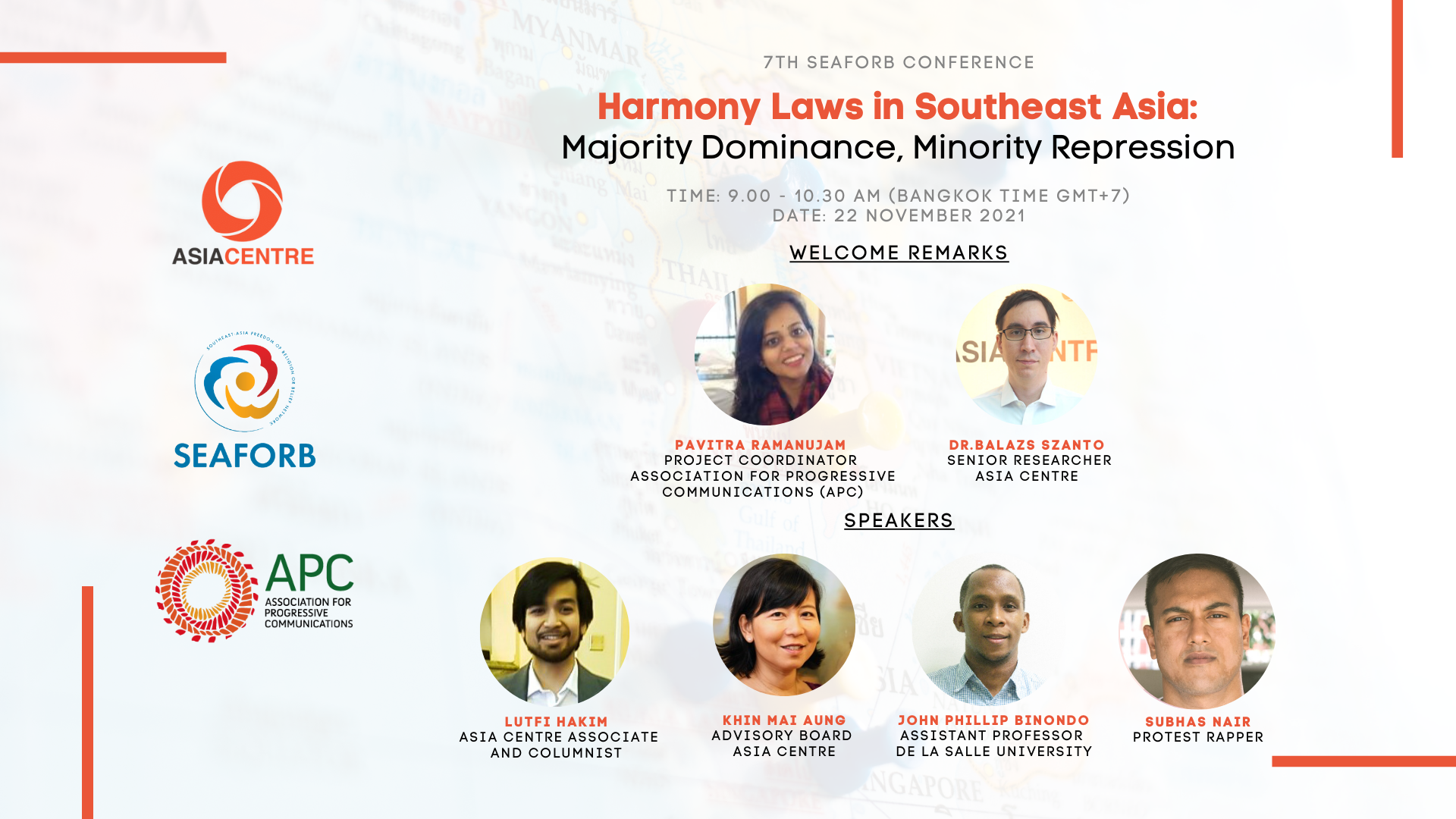
Report Launch – Harmony Laws in Southeast Asia: Majority Dominance, Minority Repression

Abstract: Governments in Southeast Asia often proclaim that they promote and protect racial and religious harmony through their domestic laws. On occasions they even insist that these laws are aligned with international standards. However, in reality, evidence from the Universal Periodic Review (UPR) and Committee on Racial Discrimination (CERD) suggests otherwise. When challenged, government representatives will claim that international human rights mechanisms or other states do not understand their countries’ exceptional circumstances and hence could not appreciate their progress thus far. However, these legal measures often police the freedom of religious and racial expression and discriminate against minorities. Asia Centre’s new baseline study Harmony Laws in Southeast Asia: Majority Dominance, Minority Repression examines the situation in Malaysia, Myanmar, the Philippines and Singapore. All four countries are ethnically and religiously diverse nations with divisive, painful colonial legacies and have long grappled with ethnic and religious tensions accentuated by contemporary migration. The launch of Asia Centre’s new report and panel discussion is part of the 7th SEAFoRB International Conference. Register Fill in the Google Form Welcome Remarks Pavitra Ramanujam, Project coordinator, Association for Progressive Communications (APC) Dr. Balazs Szanto, Senior Researcher, Asia Centre Presenter Dr. James Gomez, Regional Director, Asia Centre Speakers Lutfi Hakim, Asia Centre Associate and Columnist (Malaysia) Khin Mai Aung, Advisory Board, Asia Centre (Myanmar) Asst. Prof. John Phillip Binondo, Lecturer, De La Salle University Manila (Philippines) Subhas Nair, Protest Rapper (Singapore) Closing Remarks Dr. Robin Ramcharan, Executive Director, Asia Centre Contact Details Address: 128/183, Phayathai Plaza Building, Fl. 17, Phayathai Road, Ratchathewi, Bangkok 10400, Thailand. Tel: +66 2 129 3773 Email: contact@asiacentre.org Website: https://asiacentre.org/ Facebook: https://www.facebook.com/asiacentre.org/ LinkedIn: https://www.linkedin.com/company/asiacentre

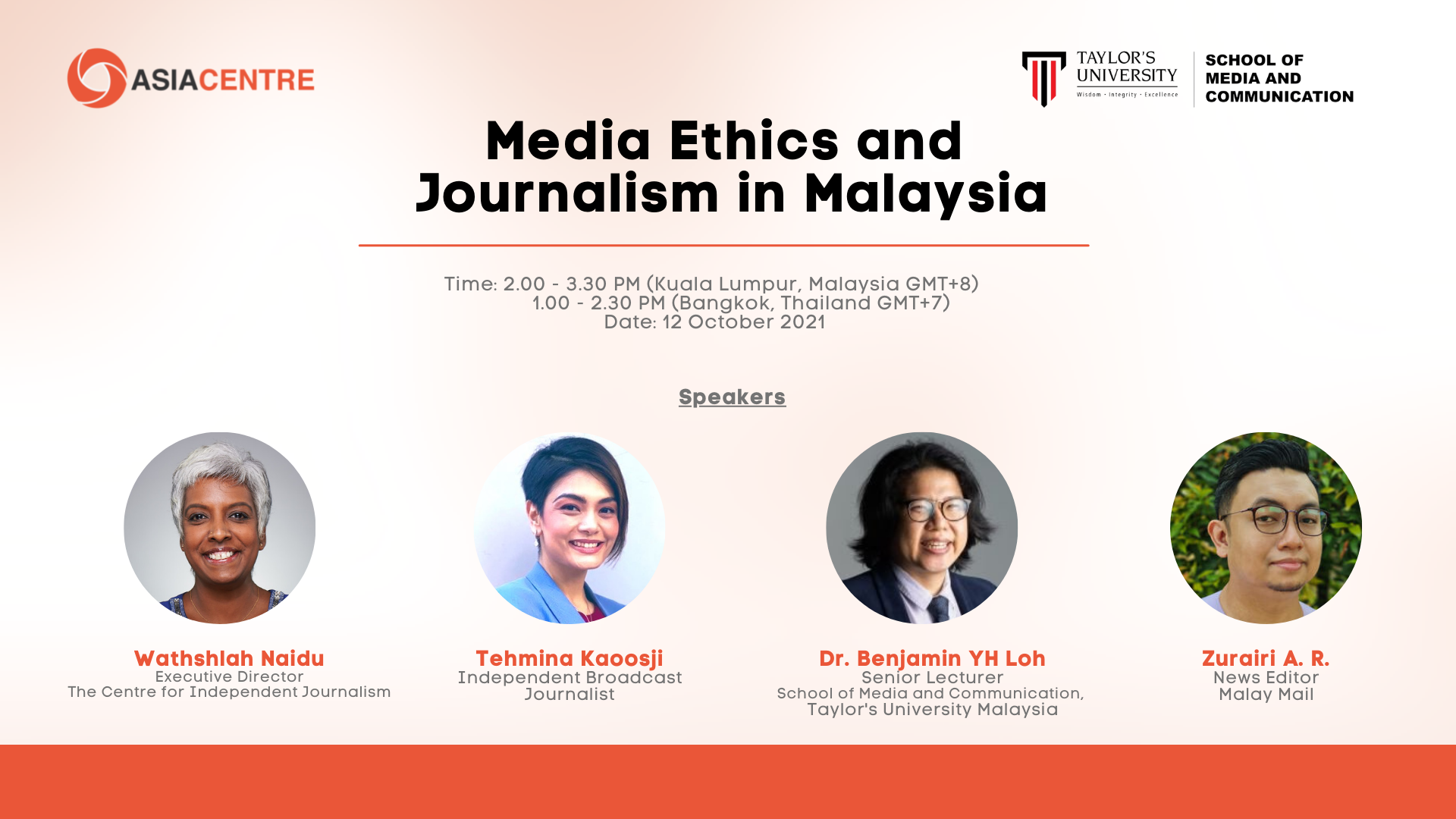
Media Ethics and Journalism in Malaysia

Online

Abstract On 31st of July, following the LAWAN demonstration held in Kuala Lumpur, Malaysia, the police released a series of photos asking the public to share any information they had on these individuals in the pictures. One veteran journalist who worked the crime desk of a prominent local daily participated in sharing that information. The journalist was heavily criticized for what amounted to putting peaceful demonstrators in harm’s way and cited his lack of ethics in being a journalist. This is not the first time a journalist or a media outlet has engaged in unethical behaviour. There have been numerous other infractions such as the unfiltered sharing of private information of victims of crimes, callous headlines that reinforce stereotypes (racial and gender-based) and reports that lack rigour and basic fact checking. The term “journalism ethics” is very vague in Malaysia as the journalism industry, while long established, has always been forced to operate under oppressive regulations where there is overt political interference, through ownership and influence, in media operations. Since the 14th General Election in 2018 and the political change thereafter, there has been a corresponding change in media regulations that still is in flux. A key gap that remains is the huge void in media oversight in Malaysia. Lacking a standardized set of ethics in the country, different media outlets adopt different practices and in general have caused an erosion in trust and public faith in journalism. Without a state governing body or media council to self-regulate the media, it befalls upon developing a strong core set of ethics that ensure that journalists are aware of what are the best practices to engage in journalism and what are their roles and responsibilities to the general public vis-a-vis political actors. This seminar will convene key voices from the country's media landscape to discuss how to empower Malaysian journalism to improve its quality and return public confidence to this battered field. Welcome remarksDr. Charmnan Ngammaneeudom, Advisor, Thai Media Fund Philip Gan Chee Keat, Programme Director, School of Media & Communication, Taylor University, Malaysia. Speakers Dr. Benjamin YH Loh, Senior Lecturer, the School of Media and Communication, Taylor’s University Malaysia Wathshlah Naidu, Executive Director, Centre for Independent Journalism (CIJ) Tehmina Kaoosji, Independent Broadcast Journalist Zurairi A. R., Journalist and Editor, Malay Mail Convener Asia Centre is a not-for-profit social enterprise that seeks to create human rights impact in Southeast Asia. The Centre achieves this by undertaking evidence-based research on critical human rights challenges and develops knowledge toolkits, such as books, reports, baseline studies, policy briefs, commentaries which are used for advocacy purposes to promote and protect democracy and human rights. Date : 12 October 2021 Time : 2.00 - 3.30 PM (Kuala Lumpur, Malaysia GMT+8) 1.00 - 2.30 PM (Bangkok, Thailand GMT+7) Registration from 1.45 PM (Kuala Lumpur, Malaysia GMT+8) 12.45 PM (Bangkok, Thailand GMT+7) SIGN UP HERE