
Views Navigation

Event Views Navigation

Today

Latest Past Events

11th International Conference – Religious Freedom in Asia: Representation, Restriction, Rights

Asia Centre 128/183, Phayathai Plaza Building, 17th Floor, Phayathai Road, Thung-Phayathai, Rachatewi, 10400, Bangkok

1. Overview Asia Centre’s 11th Annual International Conference will examine the current state and future trajectory of religious freedom in Asia, focusing on representation, restrictions and rights. The right to freedom of religion or belief (FoRB) is fundamental to human dignity. Article 18 of the Universal Declaration of Human Rights (UDHR) (1948) enshrines the inalienable right to adopt, change, or renounce a religion without coercion or discrimination – a principle further reinforced by the International Covenant on Civil and Political Rights (1966). In this context, the conference will examine religious freedom in Asia as a human rights issue, based on legal standards, state responsibility, and institutional accountability. By convening stakeholders from a range of organisations, the event seeks to identify threats to religious freedom, foster dialogue and develop actionable frameworks. This is to ensure that religious freedom is a justiciable right that states are obligated to protect and individuals are empowered to claim. It is hoped that insights gained from the conference will inform effective practices and support policy development that recognises religious freedom as integral to broader democratic and human rights commitments, while fostering a community of practice. Conference Themes  The conference will examine the following sub-themes: FoRB as a Human Right: International Norms and Domestic Obligations Legal and Structural Restrictions on Religious Freedom Division Between Secular and Religious Courts The Bureaucratic Control of Religion Religious Freedom in Conflict Zones and Authoritarian Regimes Transnational Repression of Religious Activists and Asylum-Seekers Religious Fundamentalism, State-Sanctioned Religion and the Erosion of Pluralism Uncivil Society and Social Hostilities against FoRB Representation and Marginalisation of Ethno-Religious Minorities Online Harassment and Surveillance of Religious Communities Gender, Religion, and Intersectional Discrimination Indigenous People, Atheists, and Non-Believers From Tolerance to Accountability: Responses from Civil Society and Media Note: The above sub-themes are a preliminary guide. Flexibility is encouraged, and partners may propose additional topics aligned with their expertise under the overarching theme of Religious Freedom in Asia to ensure contextual relevance and innovation.  3. Objectives  The conference aims to achieve the following objectives: Examine the state of religious freedom in Asia. Identify threats to religious freedom and current responses. Build strategies and actions for advancing religious freedom in the region. 4. Conference Structure  The conference will consist of short opening remarks, keynote speeches, plenary sessions, and breakout sessions arranged according to themes and/or region and country-specific discussions. 5. Conference Participants  Registration is open to participants from national, regional, and global organisations, including civil society organisations, faith-based NGOs, human rights organisations, media and journalism associations, legal and policy entities, parliaments and political parties, technology firms, government agencies, and intergovernmental organisations. 6. Programme Outline Day 1, Thursday, 20 August 2026 9:00 - 17:00     Morning & Afternoon Panels Day 2, Friday, 21 August 2026 9:00 - 17:00     Morning & Afternoon Panels 17:00 - 20:00     Networking Hour 7. Inquiries Please contact us at conference@asiacentre.org For the full concept note, please click here. 8. Registration We invite all participants to register through this Google Form.

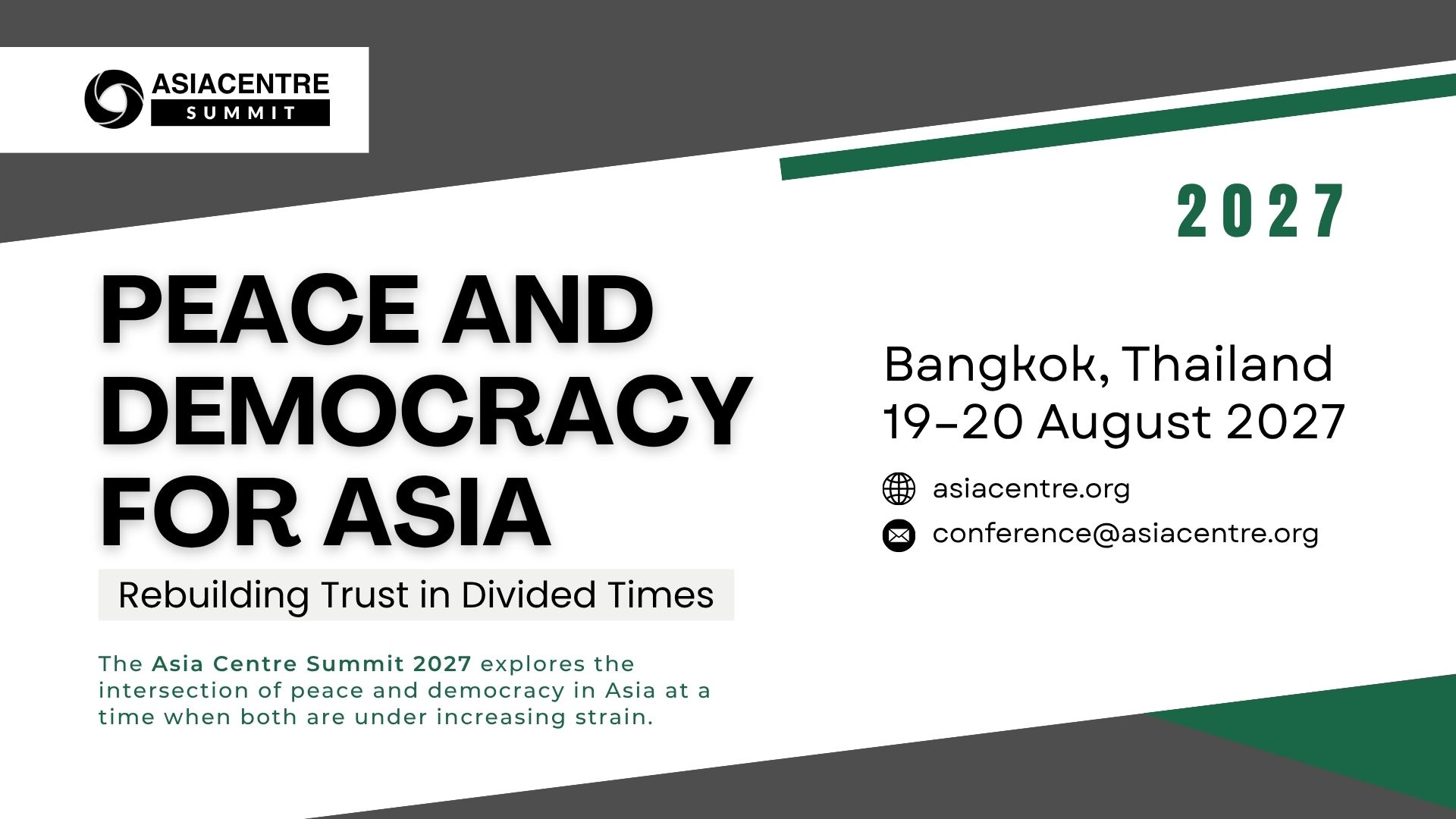
Asia Centre Summit 2027 – Peace and Democracy for Asia: Rebuilding Trust in Divided Times

1. OverviewThe Asia Centre Summit 2027 examines the intersection of peace and democracy in Asia at a time when both are under increasing strain. While many of the region’s challenges are not new and are widely recognised, the central task lies in identifying democratic pathways to foster dialogue, strengthen cooperation and rebuild trust across divided societies. Building peace in Asia requires a firm commitment to democratic principles to ensure lasting and effective outcomes. Several examples from across Asia illustrate how these principles have already translated into more inclusive and constructive approaches to addressing division. Civil society organisations, women groups, youth movements, journalists associations, faith-based organisations and local communities continue to develop innovative approaches to dialogue, conflict prevention and democratic participation. 2. Conference Themes The conference will examine the following themes:Democratic Resilience Amidst ConflictDemocratic Approaches to Peace-BuildingSelf-Determination, Autonomy and PeaceRise of Nationalism and Identity PoliticsWomen, Gender and Inclusive Peace ProcessesYouth Participation, Peace Activism and Civic SpaceReligious Freedom, Minority Rights, and Social CohesionHate Speech and Social PolarisationPeace Journalism, Media Ethics and Information IntegrityTransnational Repression and the Safety of DissidentsDigital Democracy and SurveillanceTechnology, AI and Peace-BuildingNote: The above sub-themes are a preliminary guide. Flexibility is encouraged, and partners may propose additional topics aligned with their expertise under the overarching theme of Peace and Democracy in Asia to ensure contextual relevance and innovation.. 3. Objectives The Conference aims to achieve the following objectives: Identify the key drivers of ongoing conflicts, social fragmentation and emerging flashpoints across the Asian region.Highlight current peacebuilding initiatives, including their strengths, limitations and potential pathways for strengthening trust and cooperation in divided societies. Discuss how inclusive, participatory and accountable democratic frameworks can support sustained dialogue, conflict management and the long-term maintenance of peace and social cohesion.4. Conference Structure The Asia Centre Summit 2027 features opening remarks, keynote speeches, plenary discussions, and thematic breakout sessions, and other formats bringing together diverse perspectives from across the globe to exchange ideas, address regional challenges, and explore practical solutions for peace and democracy in Asia.5. Conference Participants Open to participants from civil society groups, international NGOs, faith-based organisations, media outlets, journalists’ associations, private sector companies, political parties, parliaments, technology firms, intergovernmental organisations, academic institutions, and individuals promoting peace and democracy.6. Programme OutlineDay 1, Thursday 19 August 20279:00 – 17:00     Morning & Afternoon PanelsDay 2, Friday 20 August 20279:00 – 17:00     Morning & Afternoon Panels17:00 – 20:00     Networking Session7. InquiriesPlease contact us at conference@asiacentre.org For the full concept note please click here.8. RegistrationWe invite all participants to register through this Google Form.

10th International Conference – AI and Governance in Asia: Civil Society, Democracy, and Media

OverviewAsia Centre’s 10th Annual International Conference will explore the impact of artificial intelligence (AI) on governance, in particular its impact on civil society, democracy and media in Asia. Artificial Intelligence (AI) is poised to become the next transformative technology, with significant implications for governance across the region. Various stakeholders in the region have adopted AI strategies to maximise its opportunities. However, there are significant disparities in AI adoption across countries, as reflected in the Government AI Readiness Index (2023). This index, which measures readiness on a scale from 0 to 100, where 100 indicates the highest level of preparedness, shows that Singapore leads with a score of 82, followed by South Korea at 76 and Japan at 75. In contrast, several countries are lagging far behind, with Cambodia scoring 32, Myanmar and Nepal both at 31 and Timor-Leste at 30. These disparities underscore the uneven pace of AI integration in governance and highlight the challenges faced by lower-scoring nations in harnessing AI's potential.While the Government AI Readiness Index shows governmental preparedness for AI, it is essential to assess AI's impact on civil society, democracy, and media. Since indices for these areas are still developing, a qualitative assessment is needed initially before creating a comprehensive AI and Democracy Index. This will help ensure AI integration supports democratic processes, civil society, and media freedom in Asia.In this context, the conference will explore both the challenges and opportunities presented by AI in the effort to strengthen civil society, democracy and the media in Asia. By fostering dialogue and collaboration among a range of stakeholders, the conference aims to develop actionable insights and solutions for advancing the responsible and equitable use of AI. This is particularly important given the current contraction of democratic spaces and the increasing restrictions on freedoms in the region. The goal is to address these issues and promote AI’s role in supporting and enhancing good governance. It is hoped that following the conference, the analysis can also move AI and Democracy from a qualitative to a quantitative assessment.For more information, please click here.ThemesThe conference will examine the following sub-themes:AI and Democracy in Asia: Opportunities and ChallengesAI and Electoral IntegrityAI and ParliamentsAI-Driven Election CampaignsThe Role of AI in Strengthening Civil SocietyAI and Human RightsAI, Gender and InclusionAI and its Impact on Civic SpacesBuilding Public Trust in AI-generated MediaAI's Role in Shaping Public OpinionAI and Media SustainabilityAI and DisinformationAI Regulatory FrameworksData Privacy and Security in AI-Enhanced GovernanceEthical Implications of AI in PoliticsObjectivesThe conference aims to achieve the following objectives:Convene stakeholders interested in how AI intersects with democracy in AsiaExamine the impact of AI on democracy, civil society, and media in AsiaEvaluate the challenges and opportunities to harness AI for democracy in AsiaConference StructureThe conference will consist of short opening remarks, keynote speeches, plenary sessions, and breakout sessions arranged according to themes and/or region and country-specific discussions.Conference ParticipantsRegistration is open to participants from academic institutions, media outlets, journalist associations, businesses, national and regional civil society organisations, international NGOs, political parties, parliaments, technology companies, government agencies, and intergovernmental organisations. This inclusive approach aims to facilitate knowledge sharing and networking among diverse stakeholders.Programme OutlineDay 1, Thursday, 21 August 20259:00 - 17:00     Morning & Afternoon PanelsDay 2, Friday, 22 August 20259:00 - 17:00     Morning & Afternoon Panels17:00 - 20:00     Networking Hour Conference FeeThis is a self-funded conference, hence a flat, base fee of USD 350 will be charged to all presenters, participants and drop-in visitors. This will go towards covering the cost of the venue, equipment and logistics, coffee breaks on all days, certificates for participants, conference communications and staff. Conference fee (USD 350) does NOT cover a flight ticket, accommodation, and any other expenses related to travel advisory.Conference PartnershipsThis conference is currently open for title partnerships at Tier 1 and Tier 2 to lead the shaping of the conference programme. Fees from the title partnerships will be utilised to cover the expenses associated with the venue, equipment and logistics, coffee breaks and meals throughout the event, certificates for participants, conference communications, and staff. Once the key title partnership lineups are confirmed, the conference will be open to participants.Partnership Packages BenefitsPresentation of welcome remarks or keynote address at the conferenceClosed-door Meetings with partners and donorsNetworking Welcome DinnerTable-top space to display and distribute promotional materials during the conferenceInclusion in Asia Centre website reporting on the conferenceLogo on conference online and offline publicity materialsSocial media promotion of the panel(s) through Asia Centre’s networksMOU signing and partnership opportunities for 2025Additional OptionsSponsor participants by buying conference tickets.Sponsor a keynote speaker by providing a financial grant to the conference.Provide corporate sponsorship (in-kind and/or financial grants) and be featured on promotional materials.Inquiries and RegistrationPlease contact us at contact@asiacentre.orgPlease register here to indicate your interest in self-participation