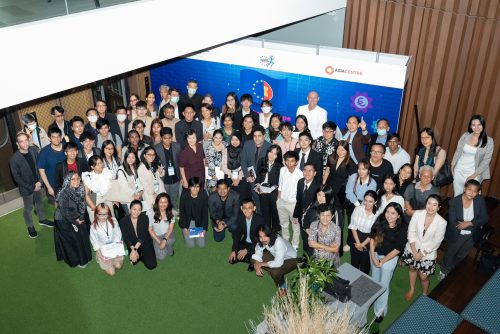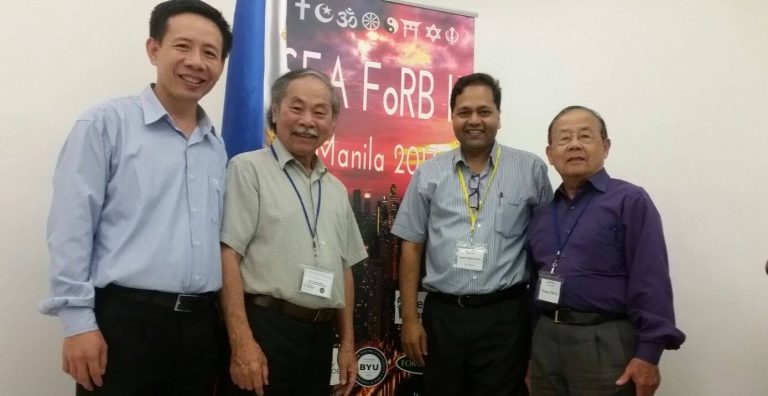
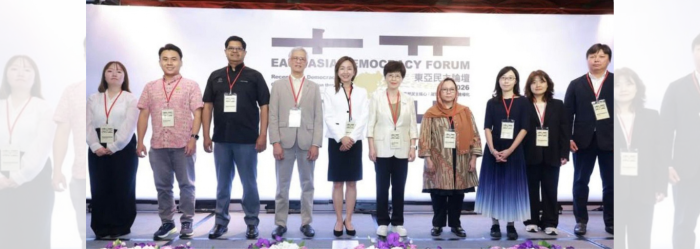
Countering polarisation in Asia requires a firm commitment to democratic principles – pluralism, accountability and non-violent political engagement – to ensure lasting and effective outcomes. In contrast, authoritarian notions of “peace” and “harmony” often suppress dissent, forcibly shut down genuine concerns and deepen divisions – undermining the conditions necessary for genuine social resilience.
This was the key message presented by Dr James Gomez, Regional Director, Asia Centre, during the 2026 East Asia Democracy Forum (EADF) on 1 June 2026, as a speaker in the first session “Polarisation and Its Regional Fallout”.
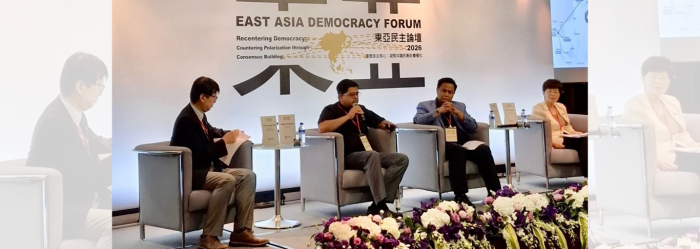
During the presentation, Dr Gomez elaborated on this message by pointing to the increasing regional polarisation trends in Asia. He identified five key drivers currently accelerating polarisation in the region: ethnicity and religion, gender, refugee and migration, economic inequality and political ideologies. In addition, rapid digitisation and Artificial Intelligence have made regional polarisation more severe than ever.
Speakers joining Dr Gomez at the panel highlighted specific national and geopolitical polarisation battlegrounds where democratic frameworks are being tested. In Taiwan, for instance, public opinion data reveals a strong polarisation between those wanting to increase the national defence budget and others who want to maintain the status quo. Panellists also noted that safeguarding such resilience remains an uphill battle. Even among civil society organisations, polarisation is occurring, and this would weaken the sector’s cohesion and resilience.
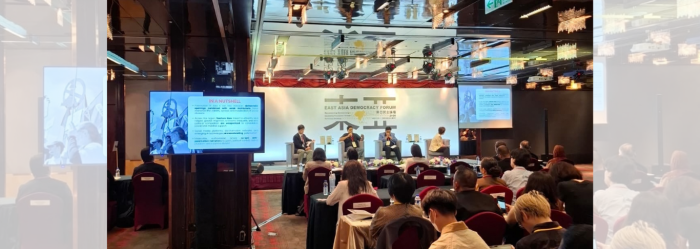
The second session, “Authoritarian Influence and Affective Polarisation”, analysed how regimes like China actively confuse public narratives to systematically erode trust in democratic systems. One example brought up was China’s United Front Work Department, which has infiltrated religious organisations in Taiwan and uses such organisations to promote pro-CCP narratives of cross-strait harmony. The discussion underscored that while democratic societies inherently require a healthy level of alternative viewpoints, authoritarian actors exploit these open debates to stifle true pluralism and drive deep societal division. The panellists agreed with Dr Gomez’s earlier warnings that authoritarians weaponise polarisation to frame pluralism as a weakness rather than a strength.
The final session, “Depolarisation in Practice”, highlighted actionable regional frameworks to counter division through building national community networks to train citizens, conduct youth-led dialogues and establish independent fact-checking efforts to neutralise pro-authoritarian disinformation campaigns that seek to polarise societies. For example, the May 18 democratic uprising in South Korea is quickly becoming a partisan flashpoint where pro-authoritarian narratives seek to diminish the uprising. Proactive public awareness is needed to counter narratives designed to destabilise social cohesion.
Engagements like the EADF reinforce Asia Centre’s commitment to fostering regional dialogue and building partnerships that contribute to peace. Asia Centre’s approach is a more inclusive, resilient and democratic way to rebuild trust in divided societies across Asia.
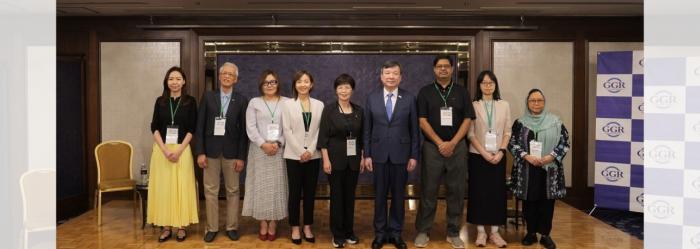
Asia Centre’s involvement in EADF builds upon its active role within the network. As a member of the Steering Committee since October 2024, the Centre has contributed to EADF discussions in both 2024 and 2025, including sessions examining authoritarian strategies undermining democracy in Asia and the significance of foreign aid in strengthening democratic movements and civil society organisations across the region.
It also builds upon its long-standing engagement with the Taiwan Foundation for Democracy, EADF’s Secretariat.
The partnership dates back to 2019, when TFD served as a partner for Asia Centre’s 4th International Conference, Fake News and Elections in Asia, and supported the Centre’s Nite for Rights event on disinformation and human rights abuses. In the same year, Dr James Gomez participated in the Taiwan-based workshop Defending Democracy Through Media Literacy II, organised by TFD and international partners. Collaboration continued through Asia Centre’s 5th International Conference, Hate Speech in Asia (2020), joint initiatives on academic freedom, media freedom, and information integrity in 2021, and discussions on journalist safety through the panel STOP: Crimes Against Female Journalists and the 7th International Conference, Freedom of Expression in Asia, in 2022. These engagements helped establish a sustained platform for regional dialogue on democratic governance and human rights challenges.
The relationship further deepened from 2023 onwards, when TFD became a Title Partner of Asia Centre’s flagship International Conferences. This included the 8th International Conference on Democracy and Elections in Asia (2023), the 9th International Conference on Shrinking Civic Space in Asia: Stories of Resistance and Pushback (2024), and the 10th International Conference on AI and Governance in Asia (2025).
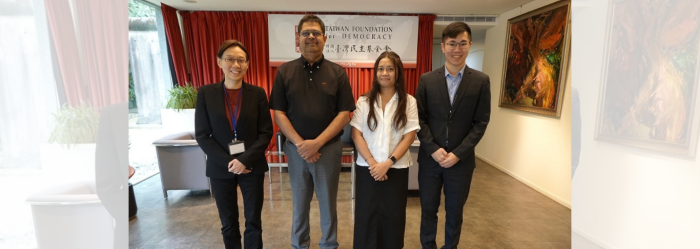
Earlier in 2026, TFD also hosted an Asia Centre delegation in Taipei to further strengthen institutional ties and explore future areas of cooperation. Through these continued engagements, Asia Centre and TFD have reinforced a shared commitment to advancing democratic resilience, regional cooperation, and civic participation throughout Asia.
Building on this momentum, Asia Centre is pleased to announce its upcoming project, “Bridge-builders: Cambodian-Thai Civil Society Cooperation to Counter Polarisation”, supported by TFD. This initiative is designed to foster strategic dialogue and cooperation between civil society stakeholders in Cambodia and Thailand, empowering civil society organisations in both countries to play an essential role in mitigating societal polarisation and paving the way forward for long-term reconciliation.