Restrictions on Internet Freedoms: Recommendations for Thai Policy-makers and Civil Society

Download Restrictions on Internet Freedoms: Recommendations for Thai Policy-makers and Civil Society assesses both legal and non-legal measures that adversely affect online internet usage in Thailand. These measures encompass the Country’s Penal Code, Computer Crime Act, Internal Security Act, information operations, and targeted online surveillance. The presence of vaguely-worded laws has facilitated the direct persecution of internet and social media users based on their content and exercise of freedom of expression. Moreover, these laws provide a legal basis for online surveillance and state-sponsored disinformation campaigns against critics. This report analyses the resulting impacts of such measures and offers key recommendations to ameliorate the situation and provides a set of recommendations for the government to improve internet freedoms in the country.

Digital Security and Human Rights Defenders in the Asia-Pacific

Download Full Report Digital Security and Human Rights Defenders in the Asia-Pacific assesses the adoption of digital security tools and measures by changemakers in the region to address online threats that they currently face amid increasing state surveillance. The report highlights the various ways in which changemakers in the region have adopted to the threats: they are evaluating the security of their online infrastructure, increasing ownership of these infrastructures, and adopting secure software and work flows. Nonetheless, changemakers face varying obstacles in adopting online security measures, including complexity of the tools, limited adoption of these measures in the wider sector, cultural/language barriers and technical, financial and human resource constraints. The report concludes with a set of recommendations for changemakers, INGOs, donors, and technology companies to address key challenges that limit the effective implementation of digital security tools and protocols. It points to the need of a multi-stakeholder approach to address digital threats faced by changemakers.  

The Bureaucratisation of Religion in Southeast Asia

Download Full Report The Bureaucratisation of Religion in Southeast Asia assess the role of regulatory and administrative framework related to religious manifestation in Southeast Asian countries to evaluate the impact they have on Freedom of Religion or Belief in the region. This report highlights five major features of bureaucratisation of religion in Southeast Asia, using the case examples of Indonesia, Malaysia, Singapore and Thailand: 1) the creation of national religious frameworks and administrative structures to oversee religious affairs; 2) existence of quasi-governmental religious organisations to conduct religious outreach; 3) administrative frameworks for religious practices in order to shape the manifestation of religious beliefs; 4) the establish of moral policing institutions and bodies of religious legal rulings; and 5) a system of dual legal jurisdiction to project the influence of the state to the judiciary. Together, these systems have impacted FoRB by creating restrictions on houses of worship and barriers to conversion and proselytisation. Bureaucratisation of religion also served to suppress expression and criticism, discriminate against gender and sexual minorities; and facilitate ethno-religious dominance.

Strategic Development for SEAFORB Network: Needs Assessment Report

Download Full Report Strategic Development for SEAFORB Network: Needs Assessment Report analyses the environment of Freedom of Religion or Belief (FoRB) advocacy in Southeast Asia to outline the concerns and needs of FoRB advocates in the region. The report underscores the importance of a consolidated network at the regional level to coordinate strategies for addressing FoRB violations in Southeast Asia. It emphasises three core principles for strengthening the SEAFORB Network: 1) to serve as a FoRB-focused platform integrating human rights, 2) to be civil society-led and regionally aligned, and 3) to engage diverse stakeholders. The findings from the report informs the drafting of a strategic plan for the SEAFORB Network for the years 2024-2026..  

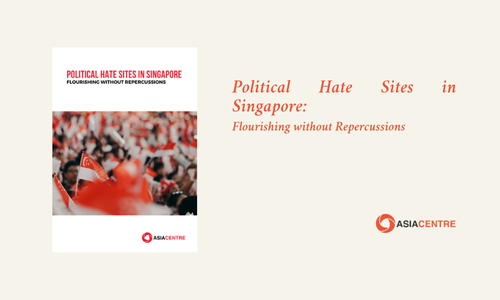
Political Hate Sites in Singapore: Flourishing without Repercussions

Download Full Report Political Hate Sites in Singapore: Flourishing without Repercussions explains how hate sites and internet brigades seek to maliciously negate the criticism of public officials and policy in Singapore. Targets of hate sites include activists, bloggers, civil society organisations, independent media outlets and journalists, human rights lawyers, and opposition political parties and politicians. Singapore, a one-party dominated state, has regularly updated and passed new legislation that criminalises criticism of its public officials and policies, leaving only a narrow margin for expressing dissenting views within the established legal boundaries. As a result, the government can repress opposition voices through the tight policing of political expression both offline and online. This includes blocking, removing, and delegitimising critical online content, as well as prosecuting content creators and distributors. This leads to the manipulation of the public narrative and fosters widespread self-censorship. Despite these measures, there is an underbelly of critical voices that continue to occupy the extremely limited space allowed by the law. In the last few years, these voices have experienced an increase in targeted attacks and hate speech by pro-government hate sites and internet brigades. Yet, public officials and technology companies remain silent about these hate sites and the coordinated inauthentic behaviour of internet brigades. Meanwhile, current laws and content moderation policies to protect them remain inadequate and insufficient. Hence, this report recommends the international community, UN bodies, Singapore parliament, political parties, tech companies, and civil society organisations to 1) monitor, document, and call out cases of online hate speech in Singapore; 2) use UN mechanisms to engage with the Singaporean government to address political hate speech and commit itself to international standards of freedom of expression; 3) advocate for the amendment of laws restricting freedom of expression; 4) develop new technology solutions to improve the detection of online hate speech; and 5) work cooperatively to consider everyone’s views in the development of new strategies to address online hate speech. This small cluster of critical voices is a manifestation of a larger, suppressed and silent resistance to the ruling regime in Singapore. Improved internet freedoms and safety to voice criticisms will provide the necessary valve to express democratic aspirations within Singapore society without risking any unnecessary and abrupt political upheavals.

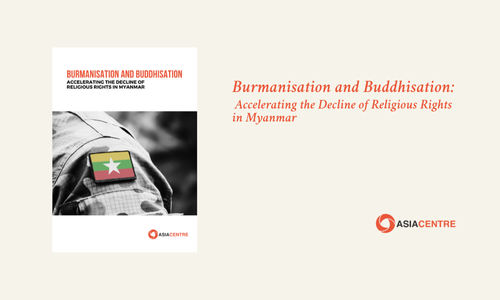
Burmanisation and Buddhisation: Accelerating the Decline of Religious Rights in Myanmar

Download Full Report Burmanisation and Buddhisation: Accelerating the Decline of Religious Rights in Myanmar exposes the rapid decline of religious rights among minority communities following the 2021 military coup. Burmanisation and Buddhisation, two policies that have shaped Myanmar’s identity landscape since the colonial era, are now justified as a response to ensure national security and address the threat of terrorism. Under this response, minority ethno-religious communities are being targeted as subversive forces to be dealt with. This results in four key impacts. One, ethno-religious communities are targeted with violence and military attacks to silence their calls for autonomy. Two, religious sites predominantly belonging to minority religions and communities are subject to damage, destruction, and occupation by the military and pro-military groups. Three, members of minority groups are arbitrarily detained based on religious affiliation, often subjected to practices that contravene their religious beliefs. Four, the report exposes the persecution of the Muslim Rohingya, who face ethnic cleansing, detention camp internment, and forced displacement. The report concludes with a set of recommendations to the international community, international non-governmental organisations and civil society organisations urging them to monitor, record, and report on religious-based rights violations while also exploring diplomatic channels to halt all forms of violence. 

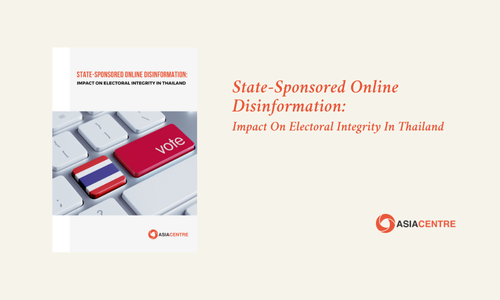
State-Sponsored Online Disinformation: Impact On Electoral Integrity In Thailand

Download Full Report State-Sponsored Online Disinformation: Impact On Electoral Integrity In Thailand examines government-backed disinformation campaigns, known as information operations, and assesses their impact on the integrity of elections. The report identifies the actions of key domestic and international state actors that contribute to the false information campaigns. Based on the evidence of the existence of information operations in Thailand and the absence of effective legal and non-legal measures to address them, the 2023 Thai General Election is expected to experience its share of state-sponsored disinformation over social media platforms. The report identifies four types of information operations in Thailand that stand to impact electoral integrity: 1) using of state resources to create and disseminate pro-establishment content which promotes a positive image of the government, army and monarchy; 2) weaponising disinformation to harass politicians and activists from marginalised groups such as women, LGBT+ and ethno-religious minorities which obstructs their meaningful electoral participation; 3) distorting information related to the electoral process and discrediting selected political parties and their policies thereby depriving voters of alternative information for their decision-making; and 4) stirring hatred and exacerbate existing ideological divisions within society leading to extreme political polarisation. Given these issues, Asia Centre recommends relevant stakeholders take the following key actions: restrain from undertaking information operations, identify state agencies and report the type and targets of information operations, focus on providing voters with reliable and verified electoral information, and take measures to ensure electoral integrity through free and fair elections. These and other measures will help cast a light on state-sanctioned information operations with a view to addressing their impact on election integrity and political participation.  

Moving Beyond COVID-19 Restrictions in South Asia: Pushing Back Against Authoritarian Pandemic Governance

Download In South Asia, governments tended to adopt two approaches to contain the spread of the pandemic. The Maldives and Sri Lanka declared state of emergencies, while Bangladesh, India and Nepal relied on temporary health emergency laws. Regardless of the differences between these two approaches, all these measures restricted people’s civic freedoms, thus curbing democracy in the region. The policy brief “Moving Beyond COVID-19 Restrictions in South Asia: Pushing Back Against Authoritarian Pandemic Governance” makes an assessment of the impact of anti-COVID-19 legal measures on people’s fundamental rights in South Asia.  

Moving Beyond COVID-19 Restrictions in East Asia: Pushing Back Against Authoritarian Pandemic Governance

Download In East Asia, regional countries have sought two main approaches to managing COVID-19. On the one hand, Japan, South Korea and Taiwan adopted anti-COVID-19 measures that aligned with international human rights standards. On the other hand, China, North Korea, Hong Kong’s “Zero-COVID” mechanisms to contain the pandemic were more restrictive, threatening people’s fundamental rights. The policy brief “Moving Beyond COVID-19 Restrictions in East Asia: Pushing Back Against Authoritarian Pandemic Governance” provides an overview of these two approaches and the impact on human rights in East Asia.  

Internet Freedoms in Malaysia: Regulating Online Discourse on Race, Religion, and Royalty

Download Internet Freedoms in Malaysia: Regulating Online Discourse on Race, Religion, and Royalty analyses how Malaysia’s legal provisions impact online discussions of the 3Rs (race, religion and royalty) that question the special position of the Malays, Islam and the Monarchy. The report explains that Malaysia’s restrictive legal provisions inherited from the colonial era and expanded during the six decades of successive UMNO-led BN governments are used to regulate the online discourse of the 3Rs. Following the 2022 general election, Malaysia finds itself at a political crossroads where three different narratives on the 3Rs that this report labels as traditional, progressive, and right-wing are being used by political parties and coalitions to appeal to the Malay-Muslim community for political legitimacy. As it was before the 2022 general election, the report argues that websites will continue to be blocked, online content removed, and individuals and organisations connected to the production and dissemination of content that questions the special position of the Malays, Islam and the Monarchy investigated and prosecuted. Meanwhile, online harassment and hate content will continue to be weaponised by ultranationalist groups against those who hold different views in relation to the 3Rs and are allowed to do so without legal consequences. To improve internet freedoms in the country, this report makes several key recommendations directed at the government, the national human rights institution, parliamentarians, civil society, and technology companies. The implementation of recommendations can help ensure that the 3Rs can be discussed safely without unwarranted censorship and self-censorship in Malaysia.  

© 2015 ASIACENTRE, BANGKOK, THAILAND. – INFO@ASIACENTRE.ORG