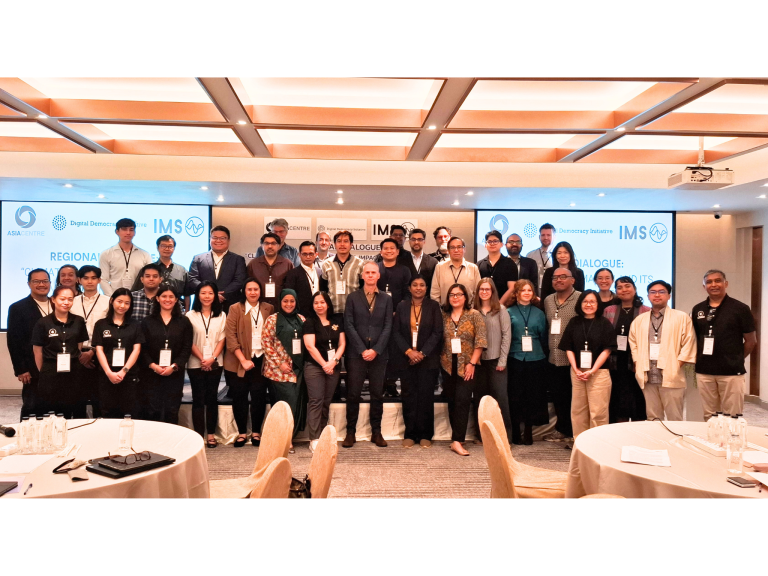
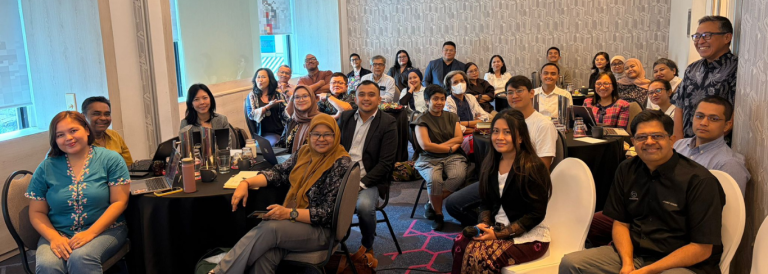
Indigenous Peoples’ (IPs) vulnerabilities in Indonesia are being exacerbated by climate disinformation that prioritises national development narratives over Indigenous rights and knowledge systems. This was the central finding presented at a national convening reviewing the preliminary outcomes of Asia Centre’s forthcoming report, “Climate Disinformation in Indonesia: Prioritising Development Over Indigenous Peoples’ Vulnerability”. Attended by nearly 40 people, the event took place on 21 January 2026 at Aloft Jakarta Wahid Hasyim Hotel, Jakarta.
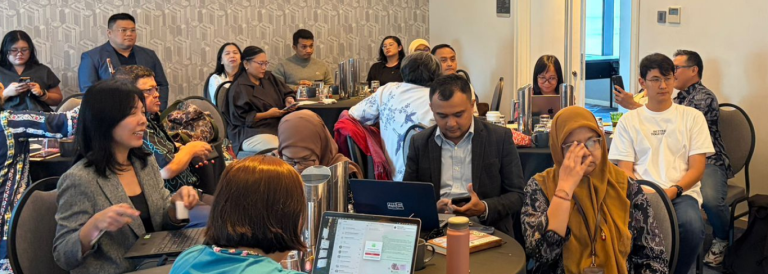
The convening was organised by Asia Centre in partnership with International Media Support (IMS) and brought together journalists, civil society actors, Indigenous rights advocates, and policy experts. The event examined how climate disinformation operates in Indonesia, assessed its impact on Indigenous communities, and gathered expert feedback to strengthen the report prior to its finalisation and publication.
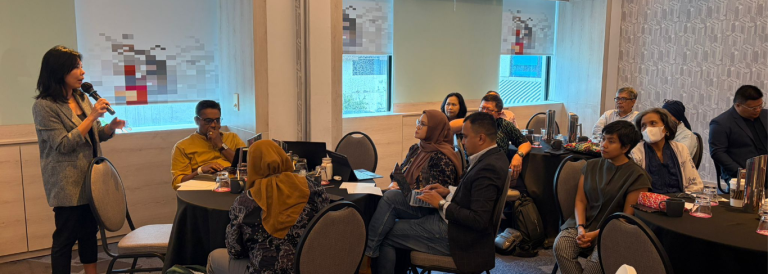
The session opened with welcoming remarks by Dr James Gomez, Regional Director of Asia Centre, who said the Indonesia report is the 5th in a series of 6 country and 1 regional report led by Asia Centre with the support of IMS. Vanessa Chong, Programme Manager from International Media Support went next and expressed thanks to everyone and introduced the work of IMS in the region.
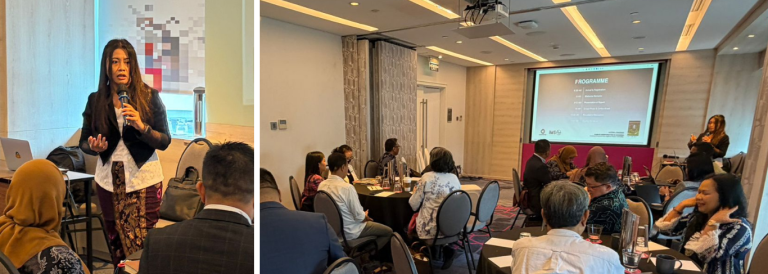
The session then moved on with Kartini Sunityo, Partnership Manager at Asia Centre, who presented the key findings from the draft Indonesia report. Her presentation highlighted three interlinked issues in Indonesia. First, the state’s official stance which does not recognise Indigenous Peoples as distinct rights holders, departing from the UN framework by treating all citizens as the same. Second, national development plans prioritise economic growth while overlooking the social, environmental, and rights-based costs to Indigenous communities. Crucially, these dynamics are amplified by climate disinformation, which frames development as inherently beneficial and casts Indigenous claims as obstacles.
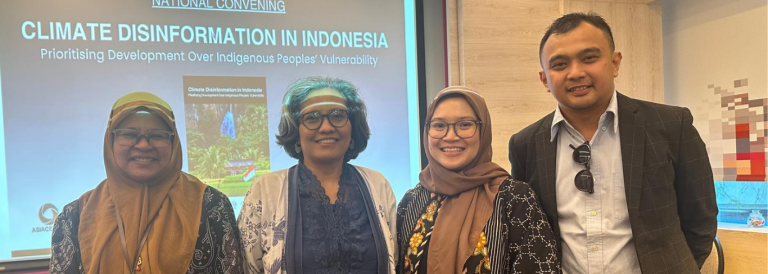
The discussion featured contributions from Nany Afrida, President of Aliansi Jurnalis Independen (AJI), who highlighted that Indigenous Peoples are often portrayed by journalists as victims, obstacles to development, or through cultural exoticism, and framings shaped by heavy reliance on official sources and limited understanding of Indigenous rights and laws. She pointed to structural challenges such as restricted access to Indigenous communities, language barriers, fear linked to criminalisation and past violence, shrinking newsroom resources, and declining public trust in the media.
Sandra Winarsa, Climate and Energy Advisor at the Humanis Foundation, argued climate disinformation in Indonesia is deliberate, political, and structural, rather than accidental. She said, often developmental projects are “being presented as caring” while masking social and environmental harms. Sandra went on to emphasise that many so-called “green” projects, such as geothermal and renewable energy initiatives, are top-down, gender-blind, and rushed, resulting in misplaced blame on communities for project failures.
Following that, Haeril Halim, Media Manager at Amnesty International Indonesia, shed light on the criminalization of Indigenous Peoples (IPs) and the role of disinformation in Indonesia. He noted that the report is timely amid deadly floods, rising attacks on human rights defenders, and growing threats to IPs. Haeril highlighted how government-led disinformation often labels NGOs and activists as foreign agents or anti-development, undermining human rights campaigns. He continued that media coverage is frequently one-sided, reporting arrests without civil society perspectives, which can mislead the public into seeing environmental defense as criminal activity.
Finally, Devi Anggraini, President of PEREMPUAN AMAN (Association of Indigenous Women of The Archipelago) in Indonesia, said that the government recognition of Indigenous rights remains fragmented across ministries. She pointed out key legislation, including the Indigenous Peoples’ Rights Bill, are yet to be fully implemented. She also highlighted challenges posed by climate disinformation, green energy projects, and language barriers, which often prevent Indigenous women from understanding or participating in decisions affecting their land.
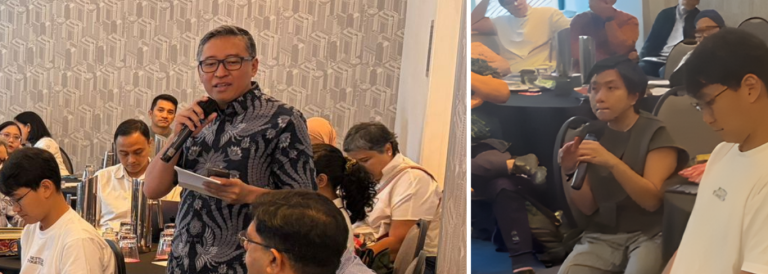
An open discussion with participants followed, during which questions were raised about the research methodology, media responsibility, platform governance, and the need for stronger collaboration between Indigenous communities, journalists, and policy actors.
Among the questions, Intan Febriani, Director International Education and Outreach Pulitzer Center, raised a query about examples of effective collaborations between Indigenous communities and journalists, seeking insight into what an ideal partnership looks like. The question was answered by Devi, who said that the collaboration between Indigenous Peoples and journalists has been ongoing since the beginning when the PEREMPUAN AMAN was set up. By way of example, she shared that PEREMPUAN AMAN has worked with media platforms such as Tempo, Kompas, and Antara to train Indigenous youth, particularly women, to act as credible sources and report directly from their communities. As part of this initiative, mainstream journalists have also been invited to visit Indigenous communities, conduct interviews, and produce feature stories, thereby ensuring that Indigenous voices are represented accurately in the news.
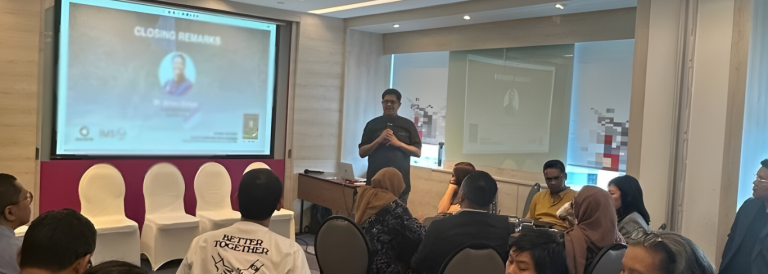
The convening concluded with closing remarks by Dr James Gomez, who expressed his gratitude to the panellists and participants for their valuable insights and contributions. He added that the feedback collected during the convening would help strengthen the upcoming report and foster ongoing collaboration among research institutions, civil society, and media actors both in Indonesia and in the region. He invited the participants to review the reports published thus far in the series.
For highlights of the National Convening on Climate Disinformation in Indonesia: Prioritising Development Over Indigenous Peoples’ Vulnerability, visit Asia Centre’s TikTok channel.
The published reports on this series thus far includes:
- Climate Disinformation in Cambodia: Undermining Indigenous Peoples’ Agency
- “Climate Disinformation in Thailand: Negating Indigenous Peoples’ Identity”
- “Climate Disinformation in India: Subverting Indigenous Peoples’ Rights”
- “Climate Disinformation in Malaysia: Appropriating Indigenous Peoples’ Entitlements”
Collectively, these reports examine how misleading narratives distort public understanding of climate issues, undermine Indigenous rights, and shape policy debates, highlighting the regional and cross-cutting nature of climate disinformation.
Upcoming reports include:
- “Climate Disinformation in the Philippines: Legitimising Attacks on Indigenous Peoples”
- “Climate Disinformation in Asia: Trends and Challenges”
These reports will continue this focus, highlighting the challenges faced by Indigenous communities and further shedding light on the dynamics of climate disinformation.