Nite for Rights: A Human Rights Open Mic Platform
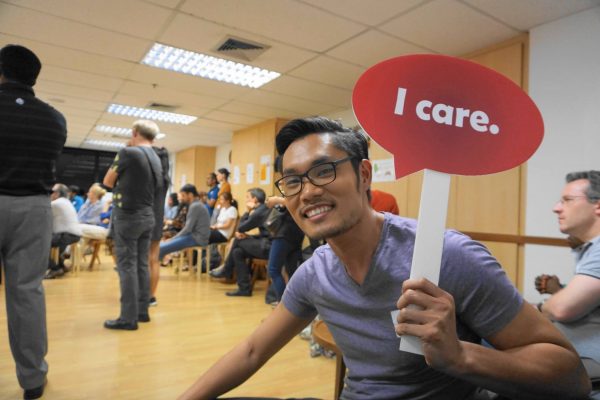
Asia Centre’s first human rights open mic night was held on the 30 June 2017 with an audience of about 35 from various backgrounds including academics, students, civil society representatives and media representatives. Nite for Rights was a celebration of human rights advocacy and activism in the region, with Asia Centre providing a platform for sharing and discussion into the critical human rights issues impacting the region as well as strategies for effective engagement. The event was opened with an overview of Asia Centre’s Human Rights Programme and sharing of key findings of our research into the Universal Periodic Review. This was followed by presentations from NGOs and individual presenters on topics ranging from the personal experiences of refugees in Thailand, accountability for human rights violations committed in Papua, the state of freedom of the press in 2017 and an overview of conflict and non-violent strategies for activism. Representatives from BPSOS and Asylum Access highlighted their work and some of their upcoming projects as well as key achievements in the year so far. Veerawit Tianchainan, founder of the Thai Committee for Refugees Foundation (TCR) shared his path to setting up TCR and its impact on changing mentalities. Sujit Peris, Head of Global Trusts and Foundations for Amnesty International (AI), shared insights from his years of expertise in fundraising and organisational development, while AI’s Regional Director for Southeast Asia and the Pacific, James Gomez, briefly outlined the focus of the newly set up AI regional office. The open mic was followed by networking and break out, informal discussions in which participants exchanged views on rights issues across the region. The event was held with the support of the Taiwanese Foundation for Democracy.
Asia Centre’s Second Anniversary

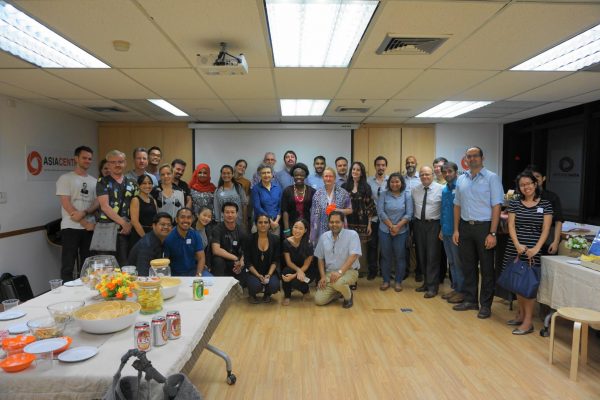
After two years of operations, Asia Centre cast a confident gaze at its steady growth, program development, outreach and presence in Bangkok. As a testament to the Centre’s community-building prowess the celebrations featured friends and associates from academia, local and international civil society organizations, international institutions, embassies, students and the media. Asia Centre provided a platform for sharing in the form of an open mic night dedicated to human rights in the region. Over the past year, the Centre focused on developing its role as a think tank and on its flagship Human Rights Programme, which carries out evidence-based research, policy oriented briefs and capacity building on key regional human rights mechanisms and issues. The Centre’s first book, title, (Gerak Budaya and Palgrave Macmillan) will be published later this year. Continuing with its examination of regional human rights mechanisms, the Centre’s second international human rights conference on national human rights institutions is set for July 13 to 14, 2017. The Centre has managed to attract new talent, adding to our Advisory Board and Centre Associates. It continues to attract a steady stream of interns. In 2017 we partnered with Forum Asia and hosted a public lecture by the UN Special Rapporteur on Human Rights Defenders, Mr. Michel Forst on the challenges faced by defenders in the region and beyond We also explored regional geopolitical issues, notably the implications of the US 2016 elections for America in Asia-Pacific and Russia’s engagement with the region. His Excellency, Mr Kirill Barsky, Ambassador of Russia to the Royal Kingdom of Thailand, made a keynote address at a Centre roundtable on Russia’s grand strategy in the Asia-Pacific. Later this year we will tackle Japan-ASEAN relations and it trajectory for the future. In this second year, Asia Centre also launched its Intellectual Exchange Programme which serves as a focal point for interdisciplinary exchange and discourse. The inaugural International Faculty Club (IFC) Night was also convened under the auspices of the new programme and it sparked great interest among Bangkok based academics, researchers and graduate students, who came to showcase their projects and research interests in a convivial and informal setting. The second IFC will take place on September 1, 2017. The anniversary celebrations saw a coming together of the community that the Centre has built and nurtured in its two years of operations from Bangkok. The Centre looks forward to continued community-building across the region and for 2017 to 2018 looks to explore projects and partnerships in Malaysia.
2nd Benedict Anderson Memorial Roundtable: Nationalism, Citizenship and Statelessness

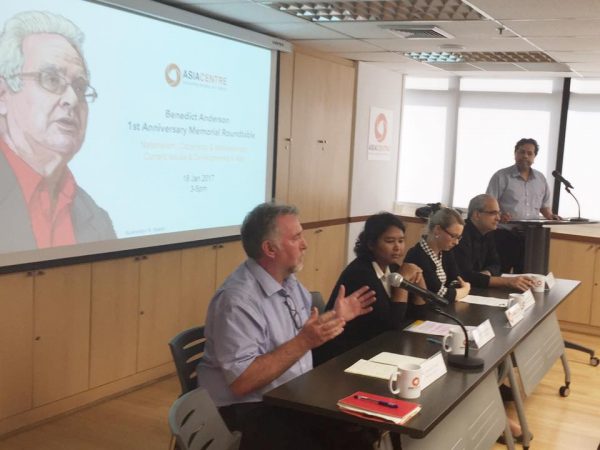
The Benedict Anderson 1st Anniversary Memorial Roundtable was a tribute to the life and legacy of the late professor. Centring on the topic Nationalism, Citizenship and Statelessness: Current Issues and Developments in Asia, the discussion attracted an audience of some 65 people, and featured a panel of diverse expertise. This event follows our inaugural memorial Debating Imagined Communities: A Tribute to Benedict Anderson held on 30 January 2016, and will be an annual feature in the Asia Centre calendar. Professor Kenneth Christie of Royal Roads University in British Columbia, Canada, and an expert on peace, development and security, provided an overview of Anderson’s concept of “imagined communities”. The point was made that the nation-state and nationalism are modern constructions. Citizenship entailed a sense of shared community among diverse peoples with common values and rights. The construction of shared communities was a global phenomenon as Anderson sought to show in his comparisons of nationalist experiments around the world. Ms Chontida Auikool, a lecturer from Thammasat University’s ASEAN-China programme provided insight into the Indonesian Chinese community’s struggle for inclusion and integration, and how anti-Chinese sentiment plays out in contemporary developments. Maritime nomadic communities in the region who face inter-generational statelessness are often rendered invisible according to Asia Pacific Refugee Rights Network (APRRN) Senior Programme Officer Ms. Helen Brunt. Using a case study of the communities in the Sulu Zone, she argued that migration flows in the region predate the development of nation states, a legacy that contributes to statelessness. Their lack of documentation and being labelled ‘illegal migrants’ condemns them to continued discrimination. Dr. Kevin Downey, a lecturer at Thammasat University and expert on political development, identity, civil society, and democratization in South and Southeast Asia discussed the lack of causal explanations for negative views on immigrants, ‘the other side of statelessness’. He went on to offer a hypothesis premised on the notion of insecurity and precarity in the era of globalisation, which features many dislocations and rising economic inequality. In the question and answer period moderated by Asia Centre’s Dr. Robin Ramcharan, potential flashpoints were mentioned. The two that were highlighted are: Rakhine State in Myanmar and the rise of intolerance in Indonesia. These are areas to monitor going forward, despite progress in democratizing both countries. A Life Beyond Boundaries The event also saw the Bangkok launch of Anderson’s memoir A Life Beyond Boundaries. Anderson defied his contemporaries by “globalizing” the study of nationalism and engaging in comparisons of seemingly disparate nation-states. In this work he also critically assesses the nation-state as a unit of analysis, noting that people globally formed communities around a great variety of interests that transcended boundaries and nations. A limited number of copies is available at Asia Centre for 450 Baht, if you are interested in getting a copy you can drop us an email at info@asiacentre.co.th. You can view images from the event here.