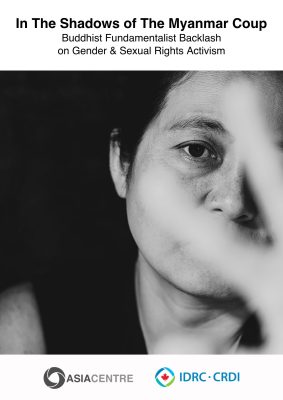
In Myanmar, the 2021 coup d’état led to the collapse of civic space and a rise in authoritarian control. At the same time – and less discussed – the authoritarian environment that followed has seen the re-emergence of Buddhist fundamentalism, which uses state violence and a centralised Buddhist-Bamar national identity to suppress dissent. A key target of Buddhist fundamentalist groups has been defenders of women, gender and sexual minority (WGSM) rights, whose advocacy is framed as a threat to “traditional” morality. In the Shadows of the Myanmar Coup: Buddhist Fundamentalist Backlash on Gender & Sexual Rights Activism shows the coordinated nature of the repression – including legal restrictions, physical violence and online harassment. It also traces how WGSM rights organisations have adopted fragmented survival strategies, including security measures, support networks and international aid, coordination with the National Unity Government (NUG) and long-term advocacy. However, to date, these efforts have been fragmented, reactive, scarce, unevenly accessible and insufficient compared with the scale and severity of the Buddhist fundamentalist backlash. The report recommends that the United Nations, the NUG, international aid organisations, international non-governmental organisations and WGSM rights organisations confront the ideological roots of repression. They must adopt an intersectional approach while addressing the structural links between religious fundamentalism, gender hierarchies and authoritarian repression to counteract these threats.